No. PEUR2026-001
La Paloma cave Magdalenian bramadera
Spain · Asturias · Soto de Las Regueras; Middle Magdalenian · Europe · Iberia
Function not recorded
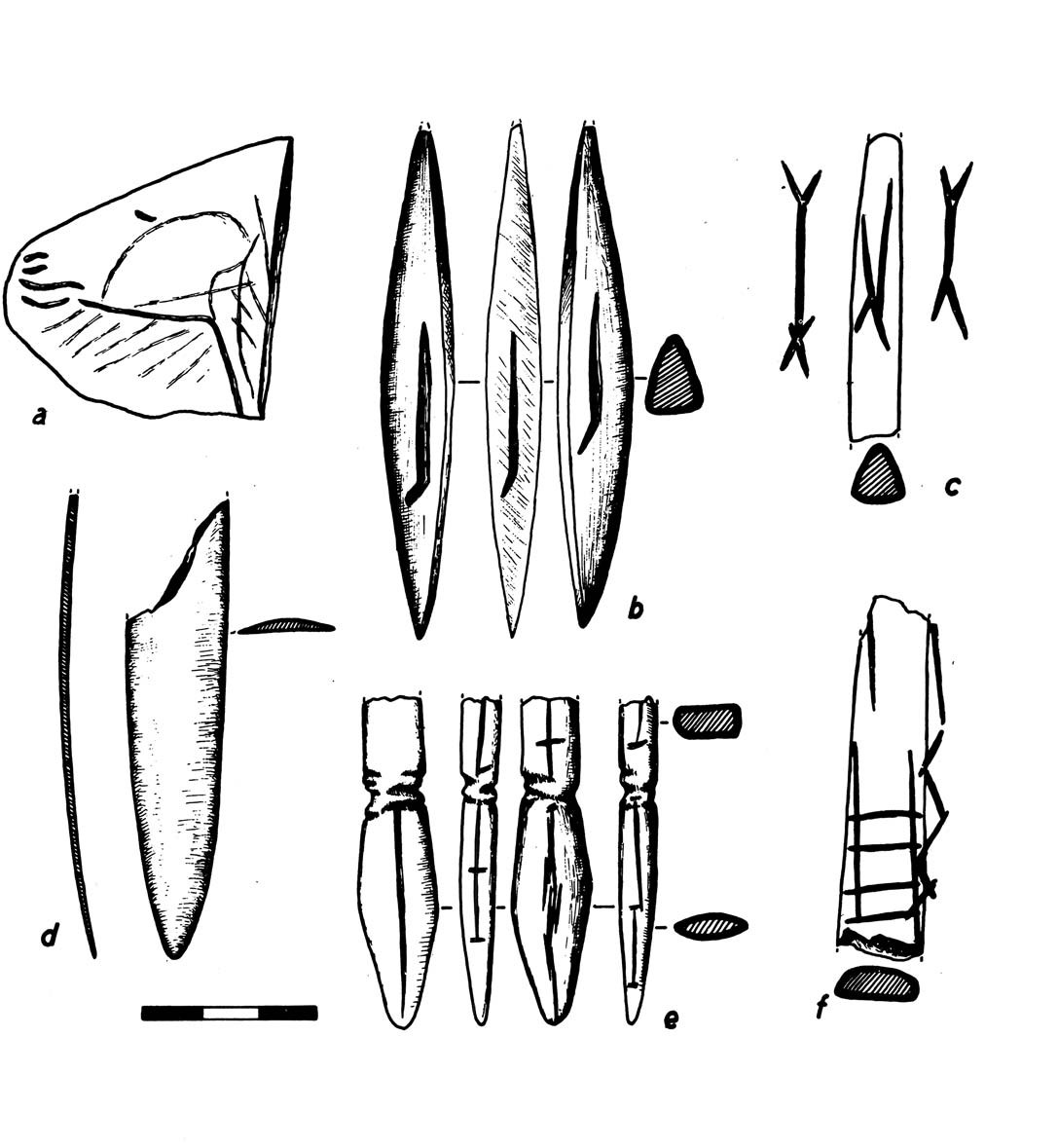
bramadera
bramadera (Spanish): the standard term for the bullroarer or whirled aerophone; here applied by Barandiarán to perforated Magdalenian bone laths.
Etymology. Spanish bramadera, "the roarer," is built on the verb bramar, to roar or bellow. It names a children's whirling toy that, the Real Academia says, makes a noise like the roar of the wind; Barandiarán applies it to the perforated bone laths.
Among roughly thirty perforated bone objects scattered across Magdalenian sites in northern Spain and southwestern France, one is a plain, fragmentary blade from the cave of La Paloma at Soto de las Regueras in Asturias. Ignacio Barandiarán Maestu lists it among the Iberian bramaderas: a slim, lenticular lath, usually cut from the rib bone of a medium-to-large grazing animal, pierced at one end for a cord. Tied to a long string and whirled rapidly, such an object hums and roars — the function archaeologists infer from its shape and from later ethnographic parallels, the Australian churinga among them. The La Paloma piece is undecorated and survives only as a fragment, recovered from a level Barandiarán assigns to the Middle Magdalenian; unlike the engraved specimens — the reindeer-bearing rombo from El Pendo, the abstractly incised holotype from Lalinde — it carries no ornament at all. Peyrony's old suspicion was that the ordinary versions were made of wood and have simply rotted away, leaving only the rare bone ones behind.
En la franja septentrional de la Península hay: una fragmentaria (no decorada) de La Paloma (Asturias) hallada en un nivel del Magdaleniense medio
In the northern strip of the Peninsula there is: a fragmentary (undecorated) one from La Paloma (Asturias), found in a Middle Magdalenian level
Barandiarán Maestu 2015, La bramadera de hueso, Kobie BAI 6:152
Particulars
- Object
- A fragmentary, undecorated bone blade, from a Middle Magdalenian level.
- Function
- Whirled-cord aerophone; site-level member of the Southwestern European Paleolithic bramadera corpus.
Source
Ignacio Barandiarán Maestu 2015, 'La bramadera de hueso', Kobie BAI 6:149-158, at p. 152