No. DIET2016-008
Abri de Laugerie Basse Magdalenian bullroarer
Dordogne · Les Eyzies · Europe · Southwest France
Function not recorded
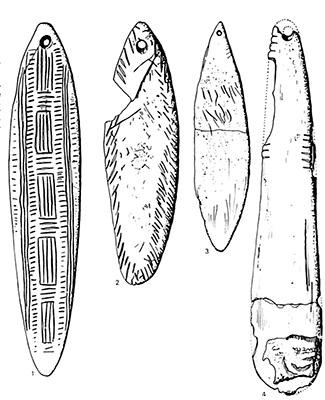
Source term: decorated Paleolithic bullroarer
From the Magdalenian rock shelter of Laugerie-Basse, in the Vezere valley at Les Eyzies-de-Tayac, comes a slender perforated piece about 107 millimetres long that ranks among a handful of French Palaeolithic objects read as bullroarers. Michel Dauvois illustrated it in his 1989 survey of Palaeolithic sound as one of seven likely Solutrean and Magdalenian specimens, and Iain Morley, reviewing that work, judged that for these pierced and engraved pieces interpretation as bullroarers "remains by far the most likely attribution of their purpose." The same shelter gave prehistory its first Ice Age woman: in 1863 the marquis Paul de Vibraye took from Laugerie-Basse a slim figure of mammoth ivory, the first human image ever found in France, and called her impudique, the immodest one, for her frankly carved sex.
any surviving bone examples are likely to represent only the tip of the iceberg ... as all could be (more) easily made from wood ... which would not survive to the present day.
Morley 2003, The Evolutionary Origins and Archaeology of Music (DCRR-002), p. 37
Particulars
- Object
- Leaf-shaped blade, 107 mm long, pierced near one end.
- Function
- Not recorded.
Source
Iain Morley, The Evolutionary Origins and Archaeology of Music (Darwin College Research Report DCRR-002, Cambridge, 2003), pp. 34-37, fig. 3.2 no. 2; M. Dauvois, 'Son et musique paléolithiques,' Les Dossiers d'Archéologie 142 (1989): 2-11, at p. 10