No. DIET2016-005
Çatalhöyük Building 52 antler bullroarer
Turkey · Konya Plain · Central Anatolia · Near East
Function not recorded
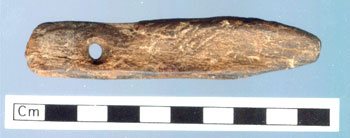
Source term: antler bullroarer
Among the worked-bone finds at Neolithic Çatalhöyük, in central Anatolia, the excavators identified a single antler bullroarer, recovered from a storage bin inside one of the houses, Building 52. It carries heavy polish and wear inside its perforation, on the edges beside the hole, and along one face, which led the analyst to suggest it had been worn on a cord when not being swung. The same bin held burned rib burnishers, unmodified metapodials, and antler points that may have served as pressure flakers. Nerissa Russell, who has worked the site's bone assemblage for years, observed that several of the roughly rectangular, crudely finished antler objects often catalogued as pendants look oddly unfinished compared with ordinary pendants, and that their wear shows they hung from a hole — weights, she suggested, or bullroarers “swung around on strings to make a loud noise.” Across the mound in Building 3, another of those plain antler plaques lay among the cattle scapulae set down when the house was abandoned; Russell called it a bullroarer pendant.
The bullroarer shows significant polish and wear inside the perforation, on the edges near the perforation, and on one side, indicating that it might have been worn when not in use as a bullroarer.
Daly, Worked Bone, Çatalhöyük 2005 Archive Report
Particulars
- Object
- Elongated antler blade with a single perforation near one end.
- Function
- Not recorded.
Source
Rebecca Daly, 'Worked Bone,' Çatalhöyük 2005 Archive Report, item 11910.X1, fig. 71; Nerissa Russell, 'Worked Bone from the BACH Area,' in Ruth Tringham and Mirjana Stevanović (eds.), Last House on the Hill: BACH Area Reports from Çatalhöyük, Turkey (Cotsen Institute of Archaeology Press, 2012), pp. 353 and 358