No. DAUVOIS2018-001
Pavlovian rhombe horizon
Czech Republic · Moravia; Pavlovian (eastern Gravettian) · Central Europe
Function not recorded Candidate only
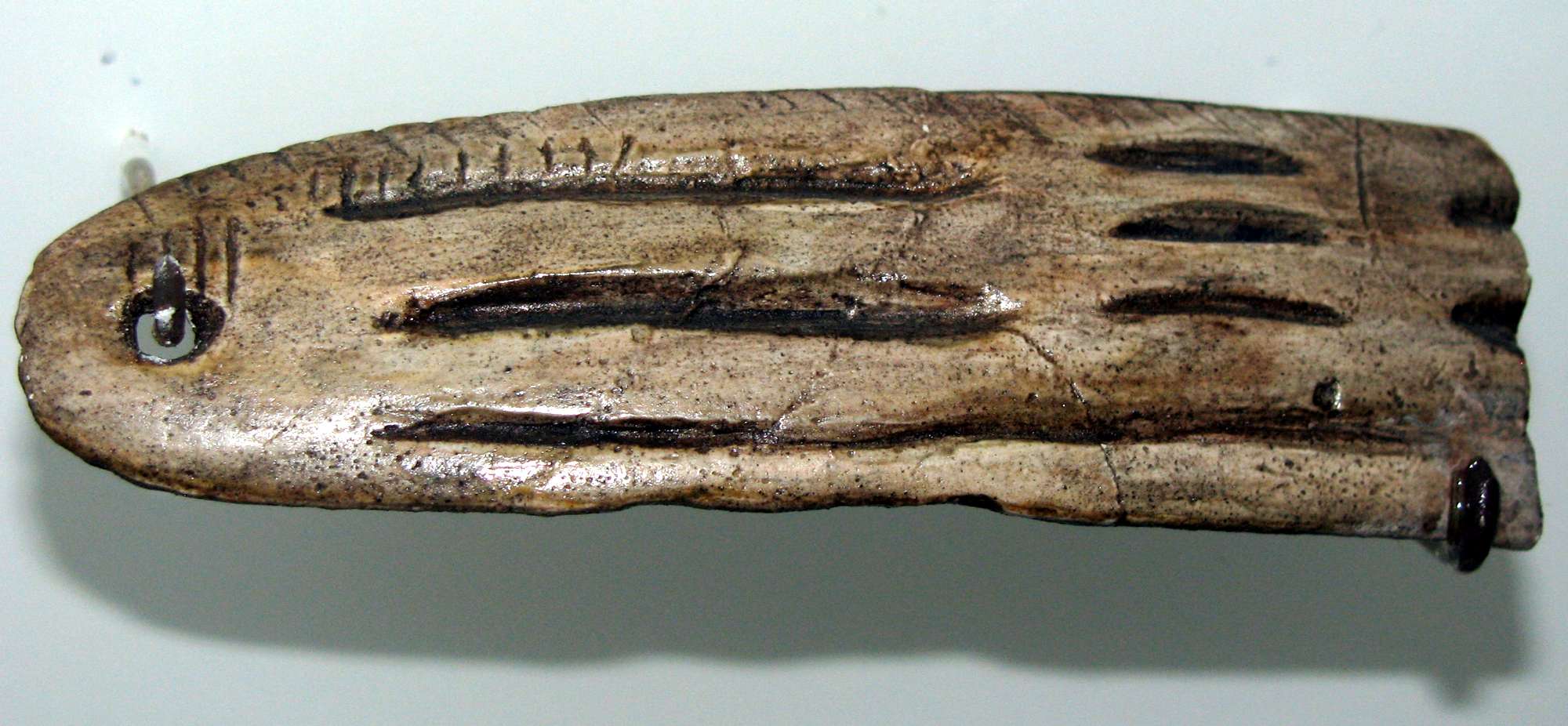

Source term: rhombe / bullroarer
rhombe (French): bullroarer — a thin, bevel-edged blade whirled on a cord to produce a roaring hum.
Michel Dauvois, the French specialist who catalogued the Ice Age bullroarers and set their replicas roaring, wrote that the instrument is older in Central Europe than in the West: at home in the Pavlovian of Moravia about 24,000 years ago, some five thousand years before the Solutrean examples of western Europe. The Pavlovians were the mammoth hunters of the Pavlov Hills who fired the world's first ceramic figures, the Venus of Dolní Věstonice among them, and carved women, animals and ornaments in ivory. The oldest bullroarers, then, belong to the same Central European world as its most famous Venuses.
En Europe occidentale, ils ne semblent pas de beaucoup antérieurs au Solutréen (environ -19 000) alors qu'ils sont plus anciens en Europe Centrale, au Pavlovien (environ -24 000).
In western Europe [bullroarers] seem not much older than the Solutrean (about 19,000 years ago), whereas they are older in Central Europe, in the Pavlovian (about 24,000 years ago).
Michel Dauvois, 'Néandertal et Cro-Magnon, le renne et le son,' Revue de Paléobiologie 37(2), 2018, section 7 'Rhombes'
Particulars
- Object
- No object identified: a culture-wide statement that bullroarers (rhombes) occur in the Pavlovian of Central Europe, about 24,000 years ago. Dauvois names no site, piece or figure.
- Function
- Not recorded.
Source
Michel Dauvois, 'Néandertal et Cro-Magnon, le renne et le son,' Revue de Paléobiologie 37(2) (2018): 457-468, section 7 'Rhombes'; Tinaig Clodoré-Tissot & Patrick Kersalé, Instruments et 'musiques' de la préhistoire (Lugdivine)