Forest voices, iron divinities and the obligations of a town
Across West Africa, the roarer gives a hidden being an audible office: it clears a path, summons a society, announces the dead or makes a divinity speak. Forest schools, ancestral graves and sacred forges hold related arrangements of voice and custody, renewed in distinct local institutions.
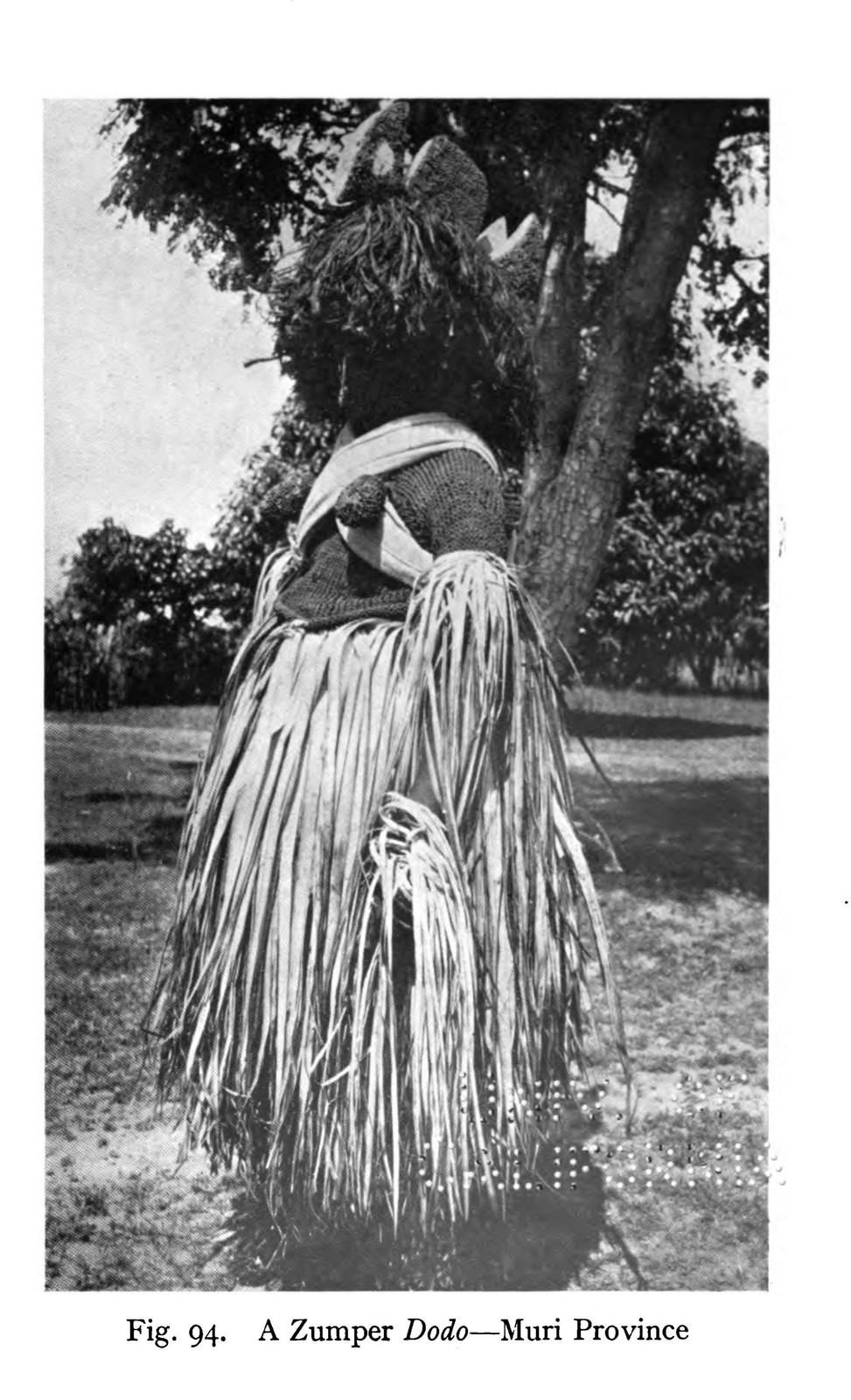
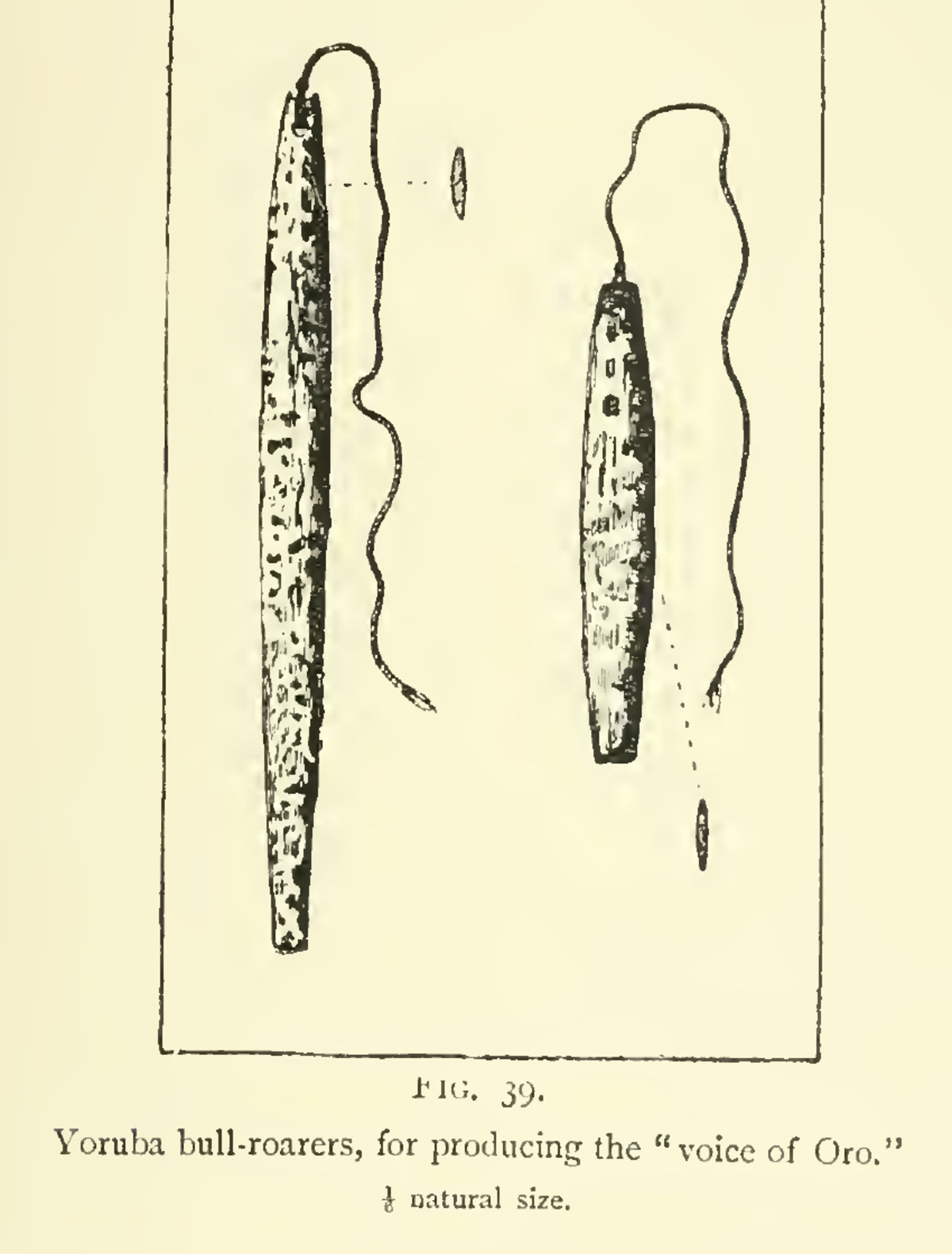
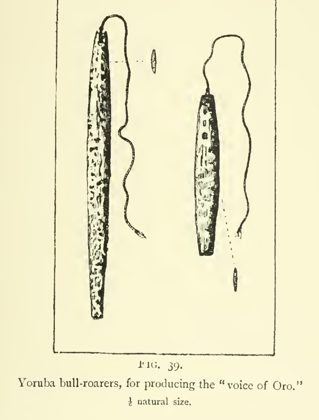
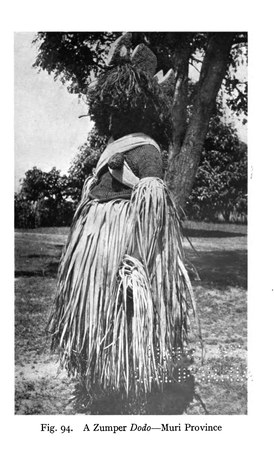
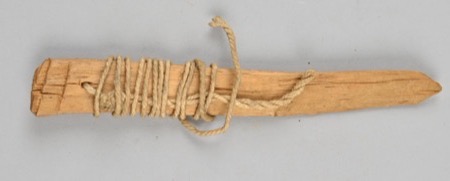
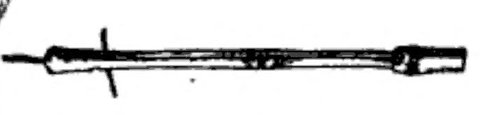
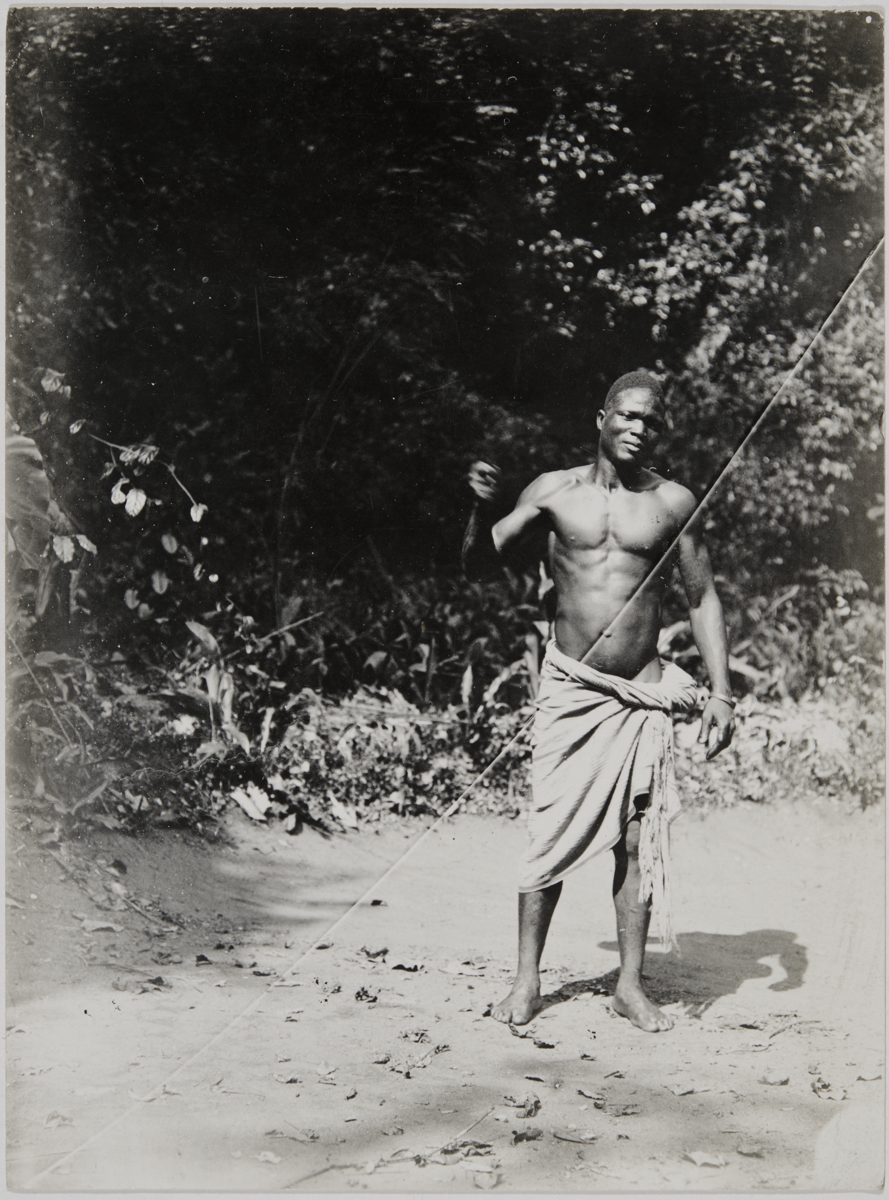
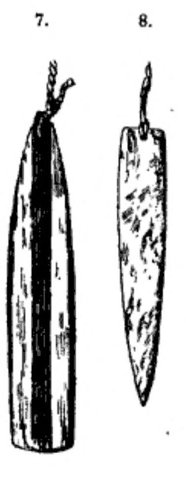
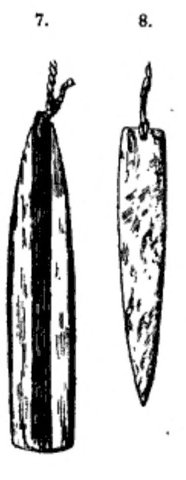
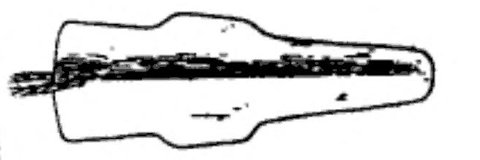
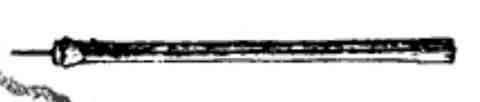
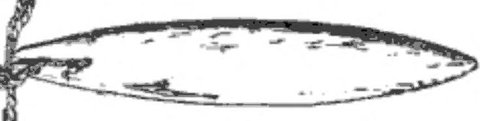
Gwana Jukun and neighboring Dodo-cult communitiesA Zumper Dodo masker photographed from behind in Muri Province.C. K. Meek, The Northern Tribes of Nigeria (1925), vol. II, fig. 94 · Public domainDogon / Awa societyA Dogon imina na from Ireli, Sanga, on the Bandiagara escarpment.Horniman Museum and Gardens, London (2000.46)Yoruba countryYoruba Oro bullroarers figured by Haddon in 1898.A. C. Haddon, "The bull-roarer" / The Study of Man (1898), pl. · Public domain
At Sanga a man steps to the village edge on the night another man dies, winds the cord around his hand and sets the mother of the mask crying. In a Gouin initiation the novices lie face down while iron passes roaring above them: the face of God, which they must not see. In a Ge forest school, vu ni clears the pupils’ road with a voice they have not yet been allowed to see. Across West Africa, a sound can carry the authority of the dead, a divinity or an initiation society into the space where people live. 3, 6, 1
The grove is more than a place to keep an instrument. It holds a company whose presence can extend down the road. Schwab’s Ge vu ni sounded when pupils moved after dark, sending other people off their path. The pupils themselves saw the being only when ready to leave the Bush. In the separate Gio Bɔ school, a crier spoke through a roarer and boys sounded it on their evening return. The prohibition governed an encounter: the secluded boys were not to meet women and children. 1
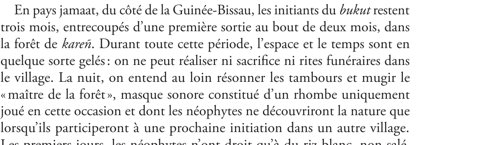
Farther west, Jóola Kujamaat boys spend three months in kareñ, the initiation forest. At night the master of the forest bellows through a bullroarer played only for bukut. The boys can graduate without discovering its source; they learn when helping initiate another village. Authority passes between forests through men who return as instructors. The sounding presence thus outlasts any one novice’s fear, binding a generation to a future obligation. 2
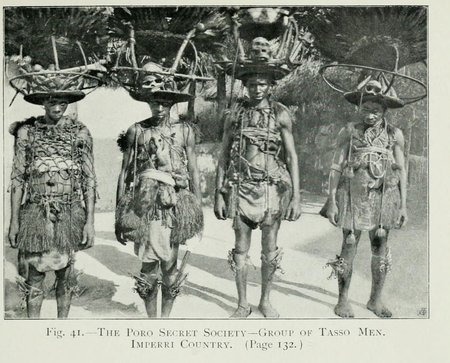
Gbunde Poro’s Big Devil had a whole escort of voices: pottery whistles, a deep horn sounded into a pot, membrane instruments and the bale wola roarer heralding emergence from the Bush. Teams could relay a song across villages, making listeners think the presence flew. The assistants made these calls and songs while the Big Devil supplied his speaking voice. A single being could be maintained by a company; the roarer was one powerful part of its performance. 1
The same concentration of a company into one audible presence occurs in the Igbo Ayakka night society. Around midnight its calls gathered members from the bush; the odegilligilli moaned as women and children hid, and the company advanced on the town. Basden placed these appearances in the January-to-March burning season, when fires were thought to quicken the dead. The society’s voice gave a dispersed membership a moment to assemble and a town a signal to withdraw. 13
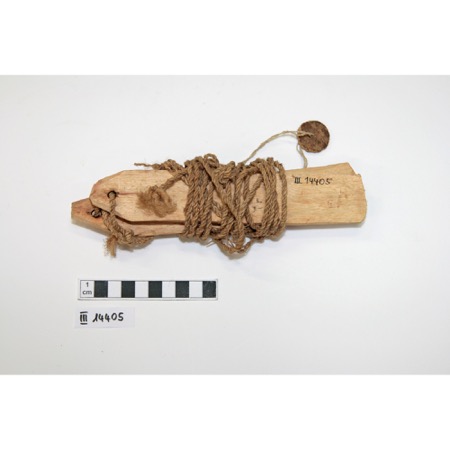
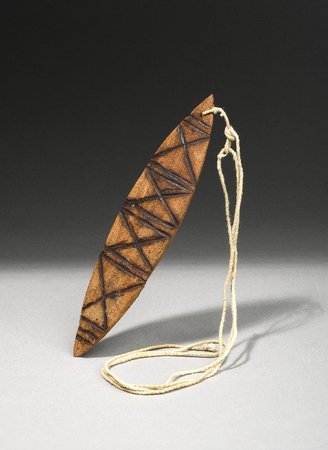
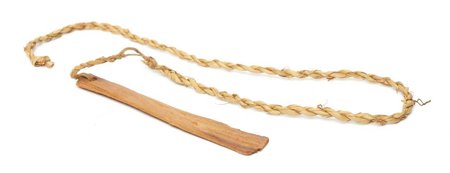
At Dogon Sanga the imina na belonged with the masks in their caves. It received millet beer, and its making belonged to initiated men. Ambara Sodamma called it the mother because it was the largest and received the sacrifices. A death brought its voice to the edge of the village at night; the men who knew the secret language encouraged the whirler. The mask society carried its authority in both a visible body and an audible one. 3
Frobenius’s upper-Niger expedition report gives this arrangement another scale. After gaining admission to a Mandé society, he described a company of associations including Komang or Koma, Nama and Kiwarra. Some emphasized circumcision, others a men’s league with political force. In that setting he called the roarer a sacred implement kept carefully hidden, and placed the festivals within both the individual life and the yearly cycle. The brief report attaches custody to a whole institutional world, without assigning its one sentence to a particular association. 15
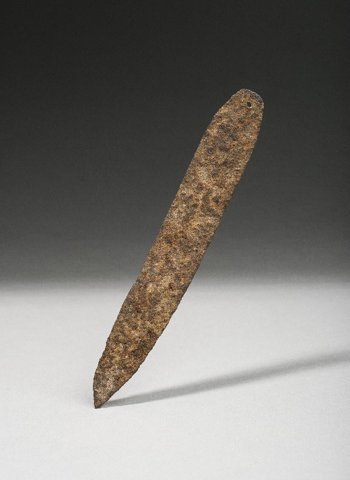
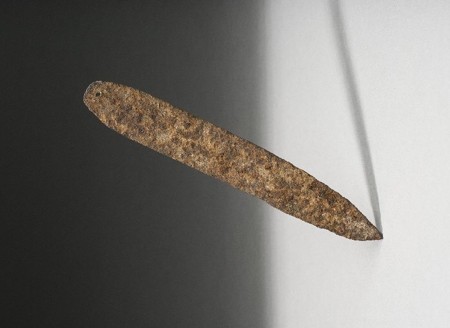
Among the Bwa of San, the forged-iron roarer was Do himself. Capron described an elliptical blade stored in a sheepskin pouch and sounded rarely by its priest. Other cries could carry Do through initiation; the great iron object went to the bush altar for the greatest sacrifices. Here the instrument did not merely announce the divinity’s arrival. Its material body was the presence people approached, kept and fed. Women bought Do and girls were initiated alongside boys: rank and admission made the boundary. 5
The Bobo Kwele Dwo story likewise puts a sounding object among the founding gifts of an institution. A hornbill perched on a baobab and ate children. A smith hid in a pit and wounded it; the bird revealed bow, quiver, arrows, rhombe and mask. At a funeral Le Moal photographed, these gifts lay before the molo mask, the metal roarer among them. The smith’s encounter brings dangerous bush power into the objects through which the community conducts its rites. 4
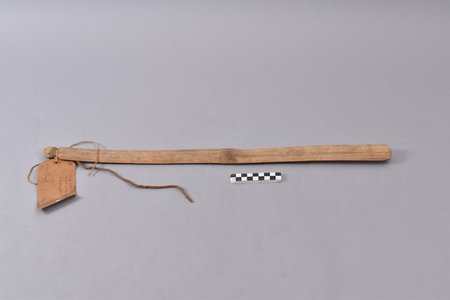
Gouin dogo makes iron’s authority particularly concrete. Dilo made the smith and forge before the rest of humanity; Dilo names God, sky and rain. The elongated triangular blade is kept at the forge or by the initiation head. To enter dogo is to receive an ancestor’s name and find a place on the ancestors’ road. Women can enter that road too. The face of God above the neophytes belongs to a wider institution of names, obligations and fertility. 6
That power crossed into village disputes. An earth priest or eldest smith stood between fighters and whirled the iron above their heads to end the battle. People swore innocence or reconciliation upon dogo at the forge. Smiths made small copies to protect compounds, orchards and fields from theft or witchcraft. One instrument joined instruction to judgment: its protected authority became a means of restoring relations among people who had fallen out of agreement. 6
Toura Goton announced a coming performance with whirled iron in the bush. The priests said Goton was speaking; then a stilt performer and two dancers appeared at dusk, before women and children as well as men. Among the Dogose, Zorhogo was itself a flat piece of iron housed in a sacred wood. Its keeper could circulate at night in ordinary clothes while the society pursued wrongdoers and sorcerers. The heard presence could give authority to a visible spectacle or to an otherwise unremarkable man. 8
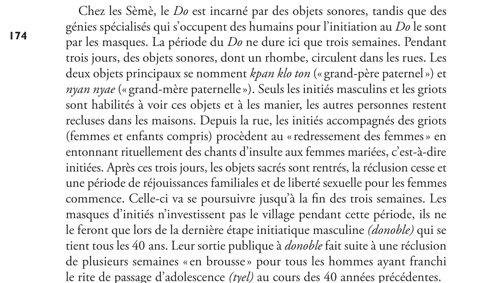
Among the Sèmè, Do walked through Orodara’s streets as sound objects for three days, a roarer among them. Initiated men and griots could handle the objects; griot women joined the company while other women remained indoors. The two principal objects were called Paternal Grandfather and Paternal Grandmother. Fournier and Devineau record the Sèmè account of receiving Do from Toussian neighbours. The broad family includes actual transfers as well as comparisons; its members preserve their own rights of access. 7
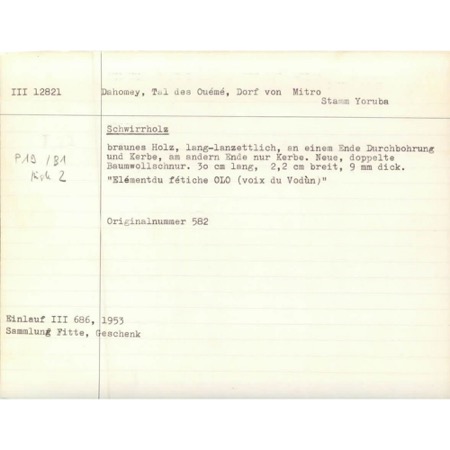
In a Yoruba Oro legend, the hunter himself explains the first voice. He cuts flesh from his forearm and gives it to men: swung on a thread, it will cry like him because it is part of him. A forbidden female witness makes the flesh fall silent; the eventual wooden replacement preserves the voice after Oro departs. This is one telling of how bodily presence became an instrument, alongside the institutional Orò whose sounding occupies streets and sends women indoors. 11, 12
Across northern Nigeria, the ancestral voice reached groves and graves. Morwa heard the dead crying in a sacred grove as the sign to begin their festival. Kurama men sounded makili at ancestral graves, honouring women as well as men among the dead. In Meek’s broader Dodo account, the tutelary being was principally the dead founder, appearing at circumcision; Gwana genii also governed rain at sowing and harvest. Each institution puts the dead to work in the community’s present obligations. 9, 10
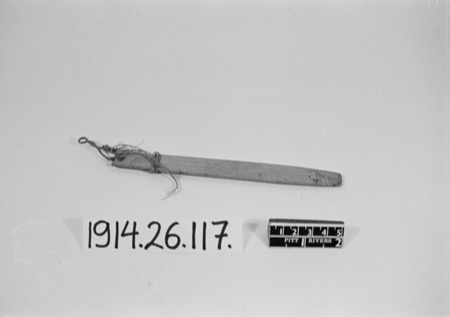
Idoma makes the social range visible in two objects existing together. The alekwu society keeps its fish-shaped plaque, forbidden to women; boys make ofukufuku from a school ruler or scrap of wood. The ordinary instrument belongs within the same regional craft as the ancestors’ instrument. It shows why a broad account can contain children’s play, working noisemakers and sacred bodies: the voice acquires its office through the people who keep it, the company that recognizes it and the occasions on which it may sound. 14
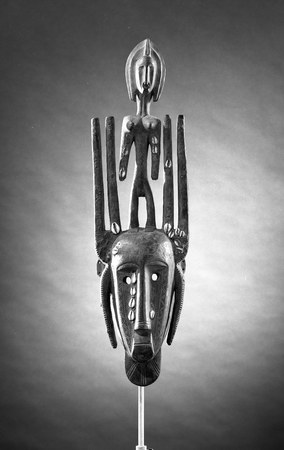
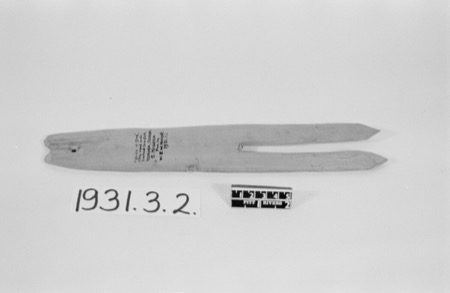
Three bullroarers are carved for each Sigui, the Dogon rite of every sixtieth year, and they bear the name of the carved serpent Great Mask of the Awa society: imina na. On the level of myth, Germaine Dieterlen recorded, each is a tongue — the Fox’s, cut with his larynx; the catfish’s, symbol of…
Royal Museum for Central Africa, Tervuren (MO.1967.17.2), via MIMO · CC BY-NC-SA 2.0 BE
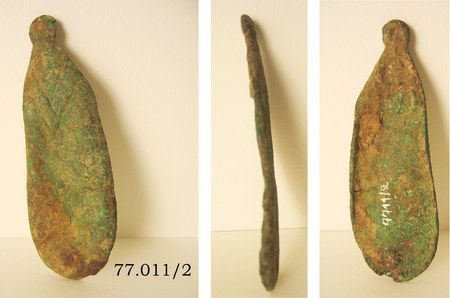
On the night of the initiation the neophytes lie face down in the dark, and over their heads the keeper of the dogo whirls a long triangle of iron until it vibrates. They must not look: it is the face of God. For the Gouin of southwest Burkina Faso, iron is the most direct road between God and…
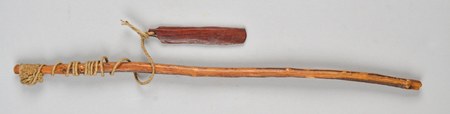
Representative — not this record’s object · A Tusia iron Do rhombe, a long tapering bar like the Gouin dogo.
Vu ni is a devil of the Ge Poro, and his only function is frightfulness. He "plays" only in the Poro Bush, speaks in a heavy voice, and uses a bull-roarer, whose name is his own: vu ni is the devil and his voice at once. When the boys of the Bush walk about at night he talks loudly, so that…
At the great sacrifices in Mali's San country, a Bwa priest carries a forged-iron blade out to the bush altar: Do himself, the divinity's own body and voice. Jean Capron called it "the divinity itself." The priest sounds it only rarely; korozo whistles stand in to carry Do's cry through the…
Representative — not this record’s object · Kassena bullroarer rig from Burkina Faso.
A. C. Haddon, "The bull-roarer" / The Study of Man (1898), pl. · Public domain
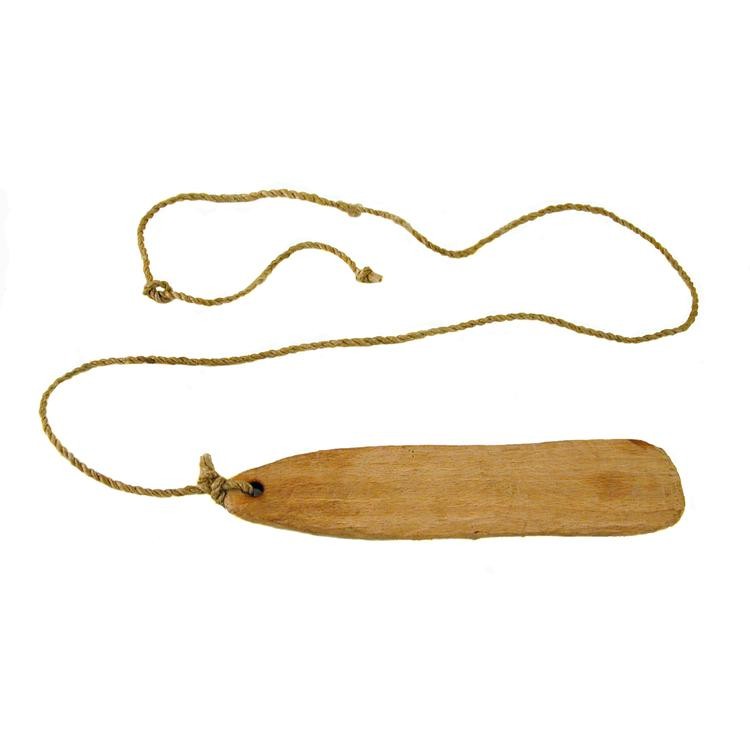
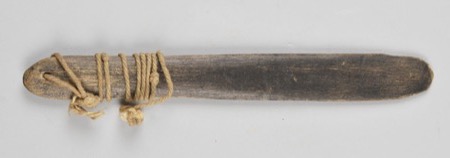
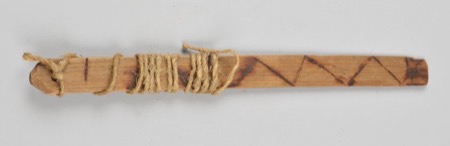
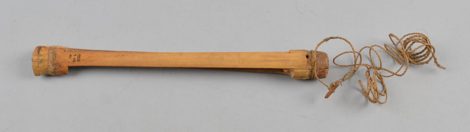
Across Yoruba country, the whirring roar from the forest was the voice of Oro, god of terror and vengeance bound up with civil authority. When Oro was abroad, women shut themselves indoors on pain of death — no woman might see the bull-roarer and live. At Ondo his festival, Oro Doko, lasted three…
Royal Museum for Central Africa, Tervuren (MO.1967.17.2), via MIMO; rotated 90° counterclockwise by The Bullroarer Atlas · CC BY-NC-SA 2.0 BE
A great hornbill perched on a baobab and ate the village's children. A blacksmith hid in a thatched pit and shot it. Wounded, the bird conjured a bow, quiver, arrows, rhombe and the head of the molo mask. Then one of its children put on the mask and passed three times over its body while its wives…
Representative — not this record’s object · Tusia Do-society iron bullroarer from Burkina Faso.
Pp.267–272, 280–281: Gbunde Big Devil repertoire, Ge vu ni and separate Gio Bɔ school; expedition material edited by George Harley, not independent second testimony.
L’Homme 239–240:169–202, §11 p.174, §24 p.182, nn.5 and14: Sèmè sound objects and griot women; reported Toussian transfer, not a proven diffusion route for all Do institutions.
Vol.I p.265: Gwari oath and bullroarer; vol.II pp.20–21: regional Dodo and Kagoma sound-makers; pp.66–67: Gwana weather genii. Keep the people attached to their particular accounts.
Pp.48–51, reprinting Man 1906 no.66: hunter’s forearm voice, fatal female witness and wooden replacement. This variant is separate from the Oyo homecoming story.
Ch.XXII, Ayakka: season, assembling cry, odegilligilli and boys’ rites; companion mouth voice is a distinct instrument. Jeffreys’s 1949 correction to agu is separate.
Zeitschrift für Ethnologie40:799–806, pp.800–801: admitted participant, named Mandé societies, sacred carefully hidden roarer, circumcision festivals in individual and annual cycles. No society-specific identification of the roarer.