No. HAD1898-006
Yoruba Oro voice bullroarer
Nigeria · West Africa
Restricted
Oro
Source term: Oro stick
Oro: a Yoruba god of terror and vengeance whose voice is the bull-roarer; also the cult and rite tied to civil authority, from which women were excluded on pain of death.
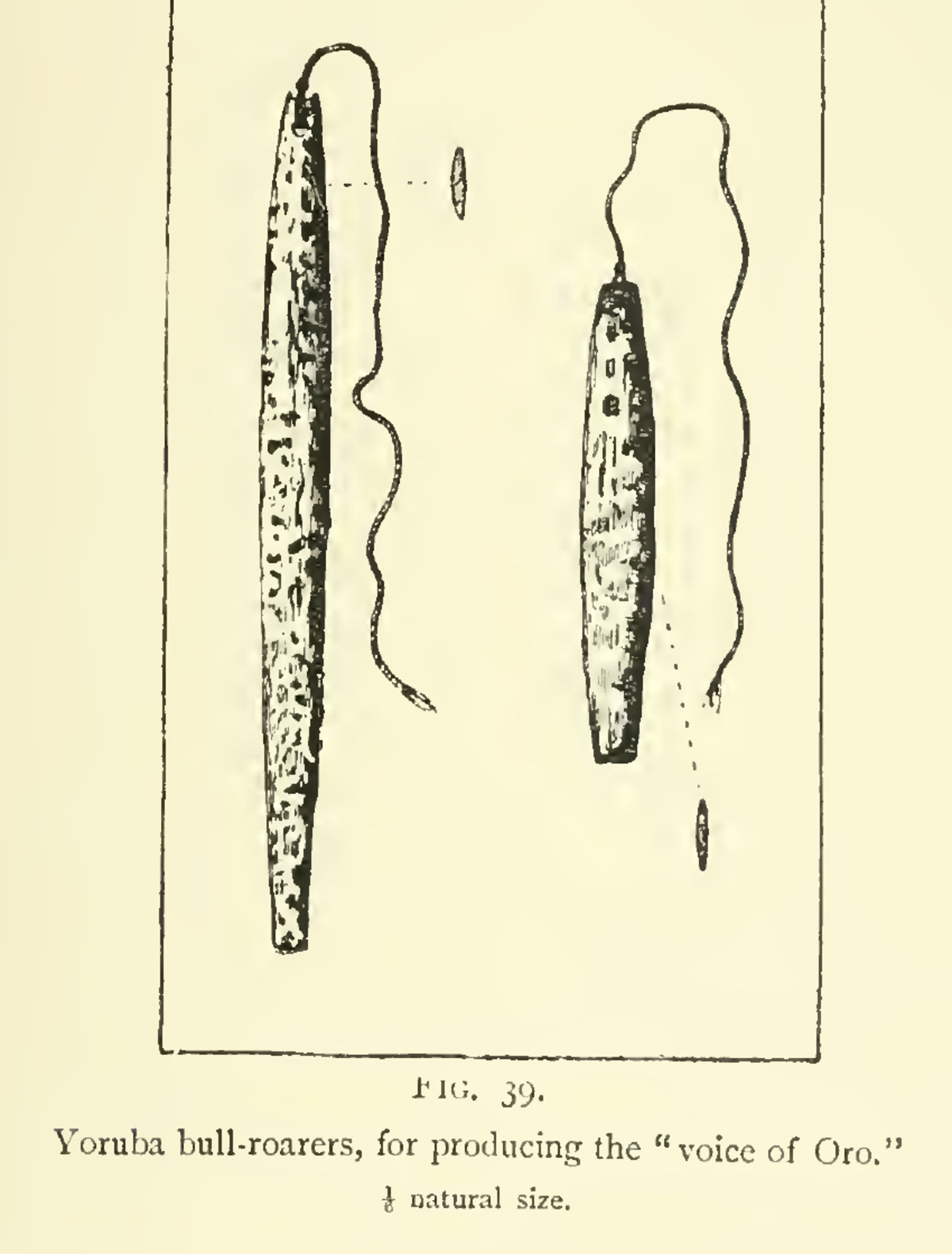
Etymology. Batty (1890), reproduced by Haddon, glosses the cult name Oro as "Torment" — a Yoruba god of terror and vengeance whose "voice" is the bull-roarer.
Across Yoruba country, the whirring roar from the forest was the voice of Oro, god of terror and vengeance bound up with civil authority. When Oro was abroad, women shut themselves indoors on pain of death — no woman might see the bull-roarer and live. At Ondo his festival, Oro Doko, lasted three lunar months, the women confined from daybreak to noon every ninth day while the men paraded the streets whirling the blades, dancing, and drumming; stray dogs and fowls were killed and feasted on. On the lower Niger it was said that heavy blades voiced the great-grandfathers, lighter ones the newly dead. Carvers gave the voice a body, too. Of seven Oro blades kept at the University of Ibadan, one bears a standing naked man and another a figure whose arms stretch from edge to edge; the most striking, some forty-five centimetres long, is covered by a single snake that zigzags the whole board, its tail at the cord hole.
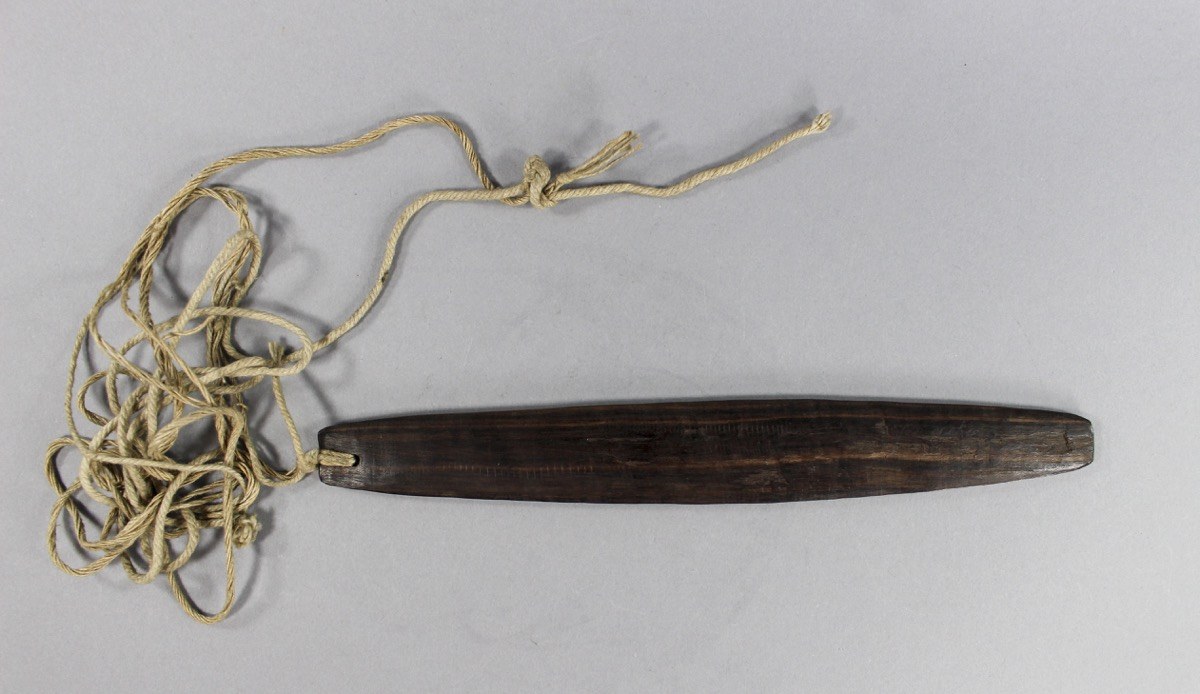
The voice of Oro is produced by whirling round and round a thin strip of wood, some 2½ inches broad, 12 inches long, and tapering at both ends, which is fastened to a stick by a long string. It is, in fact, the instrument known to English boys as the "bull-roarer."
A. B. Ellis, The Yoruba-Speaking Peoples of the Slave Coast of West Africa (1894), ch. VI, pp. 110-111
Particulars
- Object
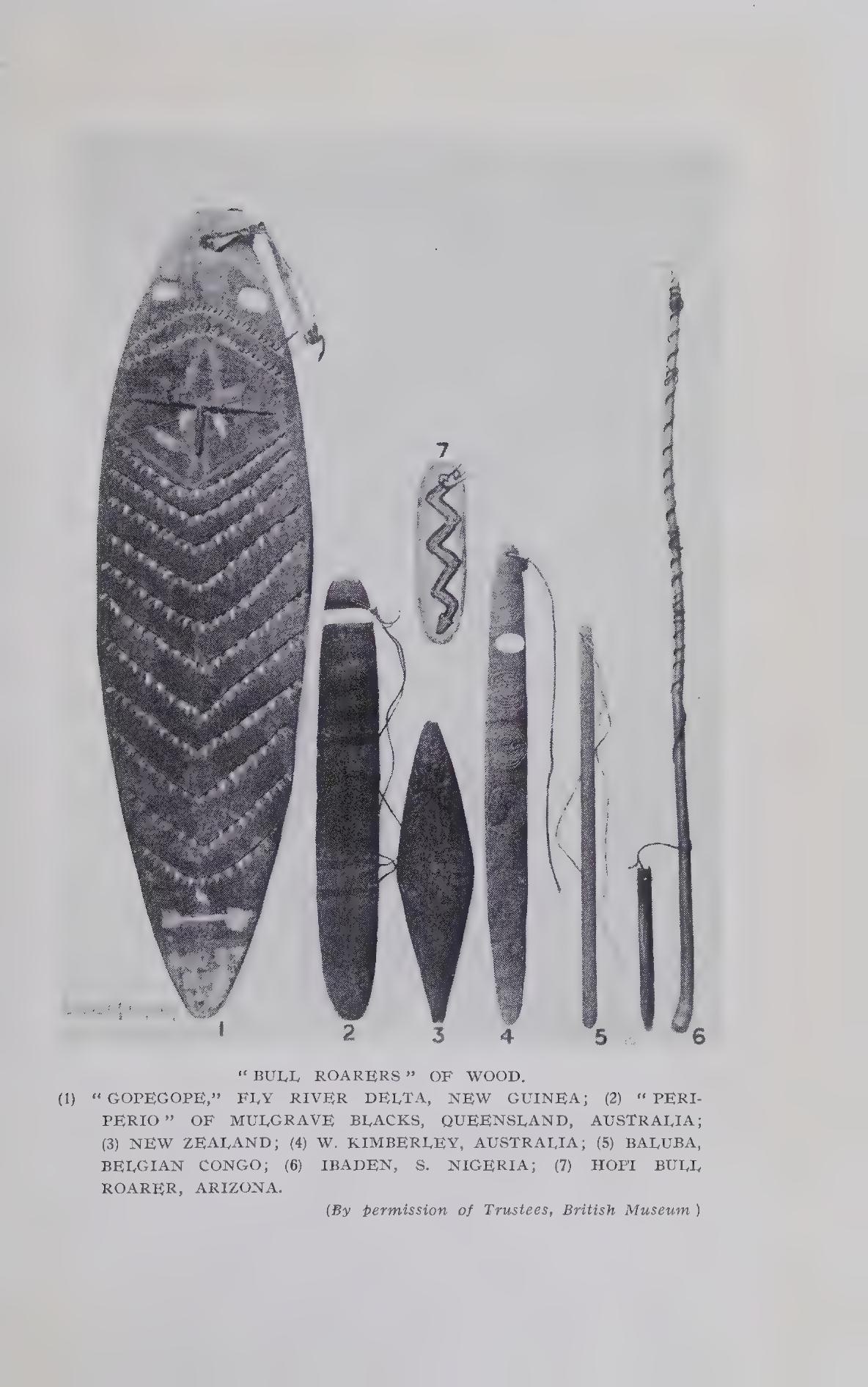
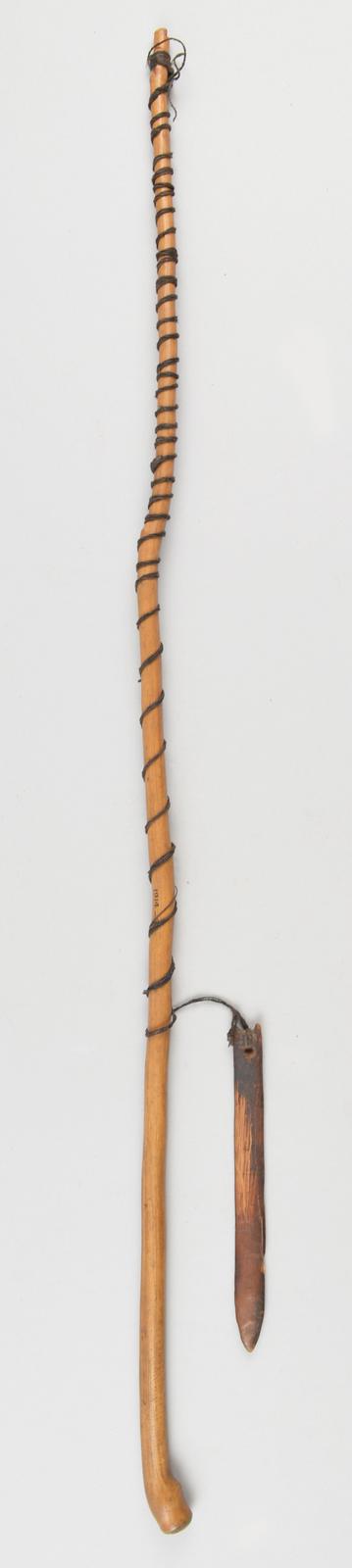
- A thin wooden blade tapering at each end, up to three feet long, slung from a pliable rod and whirled. Surviving Oro objects include MAA 1918.74 (Abeokuta, 'Voice of Oro'), PRM 1930.43.93 (Abeokuta), the forked PRM 1931.3.1-.2 (Oshogbo), a carved example at the Royal Museum for Central Africa, and British Museum Af1914,-.33, a complete Ibadan rig 71.1 cm overall, its narrow blade joined by cotton string to a long wooden handle. The British Museum also holds Af1962,17.70, a hard-wood strip 26.7 centimetres long and only 3.4 wide, its fibre line still threaded through the hole at one end. Seven carved Oro blades survive at the Institute of African Studies, University of Ibadan: one bears a standing naked man, one a figure with arms stretched across the blade, and one, about 45 cm long, a snake zigzagging its full length with the cord hole at its tail.
- Function
- The voice of Oro, sounded through the town while women stayed shut indoors.
Sources
- R. Braithwaite Batty, 'Notes on the Yoruba Country,' Journal of the Anthropological Institute of Great Britain and Ireland 19 (1890), pp. 160-164 View
- A. C. Haddon, The Study of Man (1898), pp. 289-290, fig. 39, reproducing Batty
- A. B. Ellis, The Yoruba-Speaking Peoples of the Slave Coast of West Africa (1894), ch. VI, pp. 110-111
- AfricaMuseum / RMCA, object MO.1977.27.1
- British Museum, object Af1914,-.33
- Museum of Archaeology and Anthropology, Cambridge, object 1918.74
- Pitt Rivers Museum, Oxford, objects 1930.43.93, 1931.3.1 and 1931.3.2
- O. I. Pogoson, A. Adeduntan and A. Akande, "Ritual, Art and/or Physics? Seven Rare Wooden Orò Bullroarers in the Collection of the Institute of African Studies, University of Ibadan, Nigeria," West African Journal of Archaeology 46 (2016): 235-248, pp. 239-246, plates 1-7 View · archived
- Edwin M. Loeb, 'Tribal Initiations and Secret Societies,' University of California Publications in American Archaeology and Ethnology 25(3) (1929), p. 263, citing Talbot, vol. 3, pp. 758-759