No. PEPPER1969-001
Ndut gum paxa that sends off the soul
Senegal · Arrondissement de Pambal, Departement de Tivaouane, Region de Thies · West Africa
Sacred / spirit
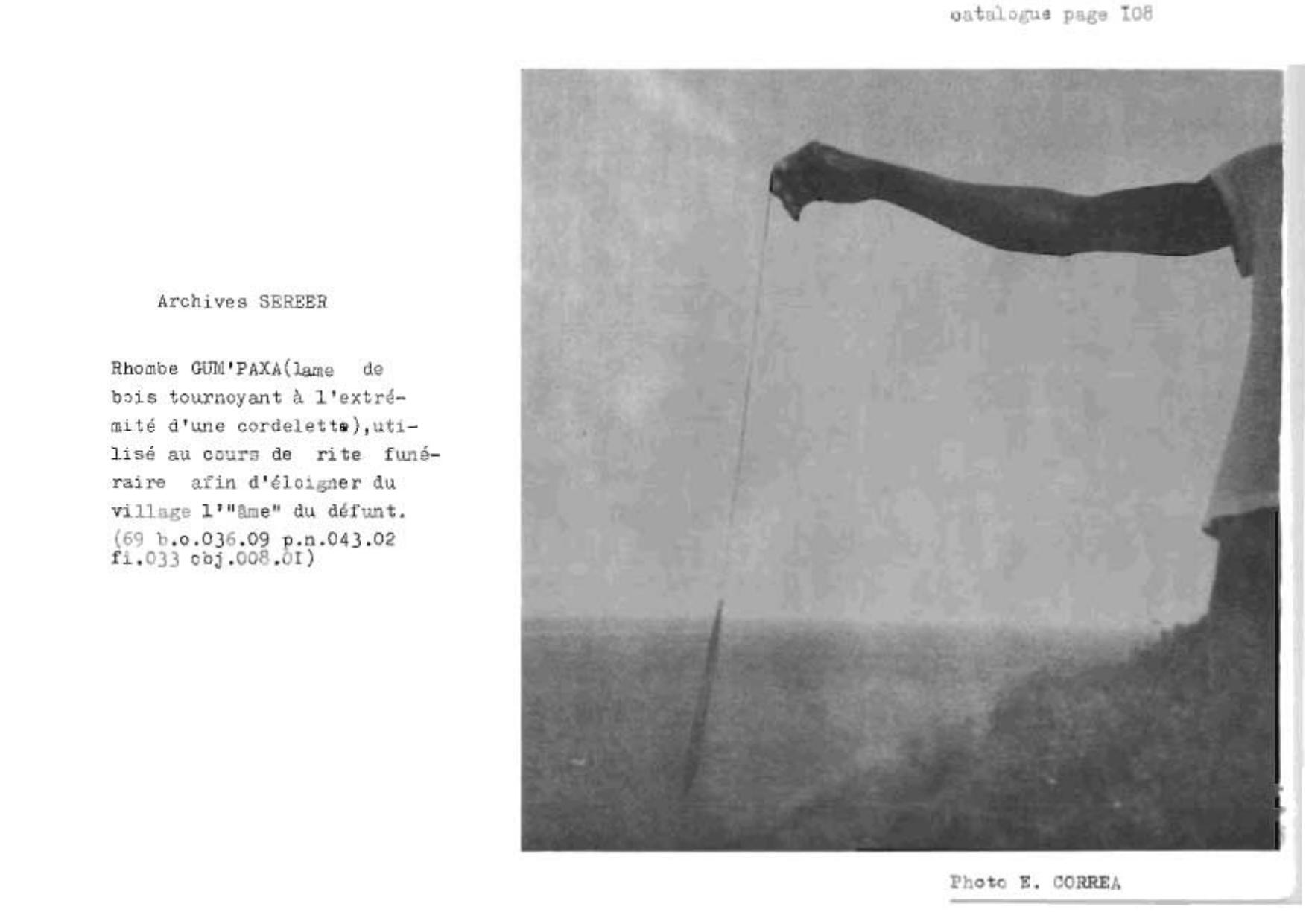
gum paxa
Source term: Rhombe GUM'PAXA (GUM'PAHA)
gum paxa: the Ndut Sereer name for the whirled blade.
At a Ndut Sereer funeral the gum paxa was whirled to drive the dead person's soul away from the village. The Ndut had reason to fear that soul. Each person, they held, carries two: a mortal amef that wanders in dreams and dies with the body, and an immortal cona that, like the undecomposed corpse, stays dangerous until it is settled. Funeral rites move it out of the house in stages, toward the first and then the second world of the dead. Its first home is one of the baobabs near the village, where it waits. When its chance comes it slips into a woman's womb as a current of air, helps a child to be conceived and leaves behind its own scent, though God gives the baby a soul of its own. Not all the dead keep their distance: the great lineage and village ancestors, the yul, can appear as large snakes dwelling in altars and great trees.
Rhombe GUM'PAXA (lame de bois tournoyant à l'extrémité d'une cordelette), utilisé au cours de rite funéraire afin d'éloigner du village l'âme du défunt.
Bullroarer GUM'PAXA (a blade of wood whirling at the end of a light cord), used during a funerary rite in order to drive the soul of the deceased away from the village.
Pepper, Archives culturelles du Senegal (ORSTOM, 1969), p. 108, plate caption (photo E. Correa)
Particulars
- Object
- Whirled wooden blade about 31 cm long, spun at the end of a light cord.
- Function
- Sounded in a funerary rite as an exorcism, to drive the soul of the deceased away from the village.
Sources
- Herbert Pepper, Archives culturelles du Sénégal: catalogue des collections audiovisuelles du 10.2.68 au 31.12.69 (Dakar: ORSTOM, 1969), p. 108 and facing plate View · archived
- Marguerite Dupire, “Nomination, réincarnation et/ou ancêtre tutélaire? Un mode de survie. L’exemple des Serer Ndout (Sénégal),” L’Homme 22(1) (1982): 5–31, especially 19–23. View · archived