No. SUBSAH-003
Odegilligilli, the night maw's summons
Southern Nigeria · Igbo country · West Africa
Restricted
odegilligilli / ode giligili (Basden); ogiligile / okilikile (Awka); agu manwu / onu manwu (Oreri); agu mmuo / agu mmonwu / agu mmanwu (modern Igbo)
Source term: bull-roarer
Igbo names for the bull-roarer. Basden gives odegilligilli (also ode giligili) for the notched slat whirled by the Ayakka night-spirit society. Jeffreys, working in 1930 among the Umundri Igbo around Awka, records the instrument at Oreri as agu manwu, 'the leopard of the manwu,' and also as onu manwu, 'the voice of the manwu'; at Awka it is ogiligile or okilikile, 'from a root which means, to circle, or whirl round and round.' Agu is one of the Igbo words for a leopard, and leopards are regarded 'either as animal familiars of chiefs or else as chiefs in leopard form.' Manwu (mmanwu, from mmo, the ghost) is both the masked dancer and the returning dead.
Etymology. Later Igbo names include agu mmuo, "leopard spirit" (agu "leopard" + mmuo "spirit"), framing the bull-roarer's reverberating voice as that of a leopard-spirit. Basden recorded the older name odegilligilli.
Towards midnight in the burning season, a clear ringing "cooee" fell out of the darkness around an Igbo town, answered from all sides of the bush; then came the blood-curdling moanings of the odegilligilli, and the women and children hid themselves. The Ayakka, the "night maw" society, walked only from January to March, when bush-fires were thought to quicken the spirits of the dead; the bullroarer's call gathered its scattered members to march on the town, any non-member caught in the dark was beaten and thrown into the bush, and no fire might show in any house. Boys entered at about ten through Iba na maw, "entering into the domain of spirit," chewing a goat's tooth as the "teeth of the ju-ju" and told they must pass through the hole of a tiny insect and cross a wide river on a thread. Only in the later ikpu-ani was the truth shown: a man put an igwe in his own mouth and made the voice of the ju-ju himself. Talbot had printed the Igbo roarer's name as Agu Manwu, "the Speaker of Maw," and set it beside the Yoruba Oro; M. D. W. Jeffreys, collecting the instrument's names across Igbo country a generation later, pointed out that agu is one of the Igbo words for a leopard.
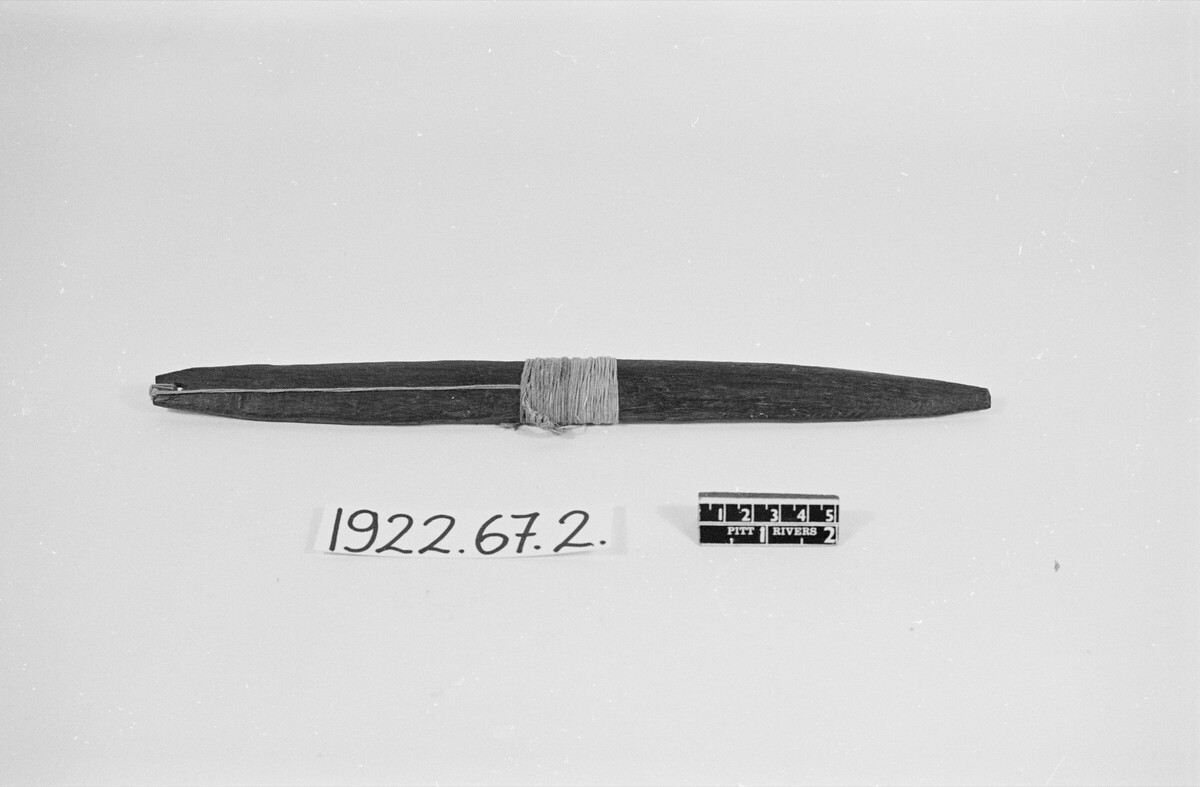
Presently the blood-curdling moanings of the odegilligilli reverberate and these sounds fill the women and children with terror and they quickly hide themselves. The odegilligilli is a thin strip of wood, twelve inches long by two or three inches in width, notched at the edges and attached to a cord by which it is whirled round in the air.
Basden 1921, Among the Ibos of Nigeria, ch. XXII, pp. 238-239
Particulars
- Object
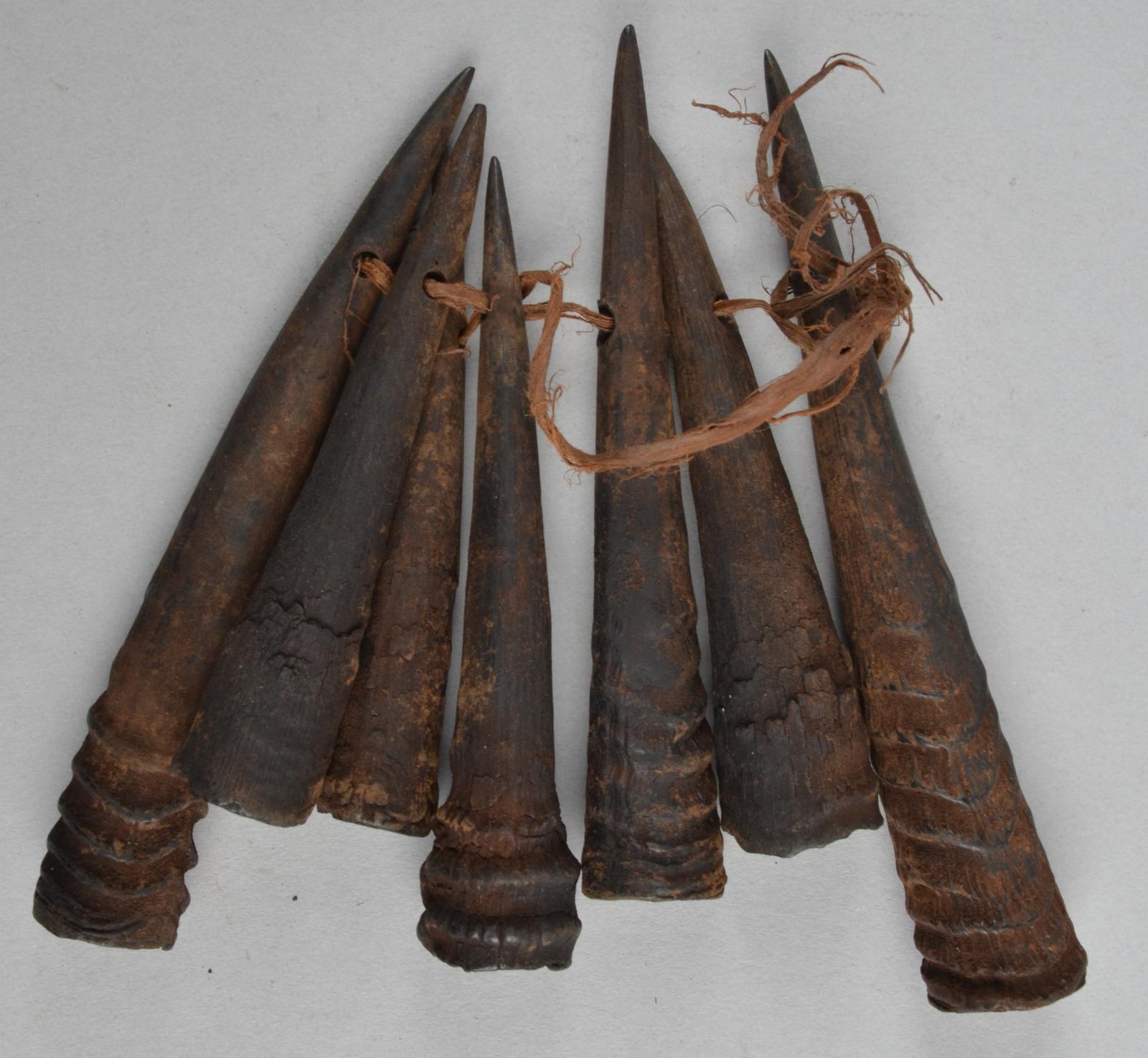
- A thin strip of wood, twelve inches by two or three, notched at the edges and whirled on a cord. Jeffreys gives the general Igbo form as 'a strip of wood about a foot long, an inch to four inches broad, and a quarter to one sixteenth of an inch thick, with a hole at one end, for the insertion of a cord or string which is then tied to a stick and vigorously twirled: the faster the twirling the higher the note.' Most are unornamented, and the markings that do occur follow no design and carry no meaning. The roarer travels with a second object: a hollow tube of bone or reed, stopped at the ends with bat's-wing membrane or spider egg-capsule and held across the mouth to disguise the voice as 'a thin chirping sound... the thin piping voice of the voiceless dead' — oduo atfalla at Oreri, okpili at Awka, igwe or nzu onu at Onitsha. PRM 1922.67.2, an Igbo blade 350 x 27 mm with its attached cord, was collected by P. Amaury Talbot and is held alongside a "spirits of the dead" mask from the same collection.
- Function
- Whirled by the Ayakka night-spirit society to gather its members and terrify women and children; boys were initiated into the society.
Sources
- G. T. Basden, Among the Ibos of Nigeria (London, 1921), ch. XXII, pp. 238–239 View
- M. D. W. Jeffreys, “The Bull-Roarer among the Ibo,” African Studies 8(1) (1949):23–34, pp. 24, 30, fig. 1 View
- Chike Okoye, “The Effects of Sound and Darkness: Peculiar Elements in the Igbo Night Mask Tradition,” Interdisciplinary Journal of African and Asian Studies 6(2) (2020) View · archived
- P. Amaury Talbot, The Peoples of Southern Nigeria, vol. 3 (1926), pp. 758, 769
- Pitt Rivers Museum, Oxford, 1922.67.2