No. HERREMAN1988-001
Mumuye night bullroarers for rain
Mumuye country, Taraba State (north-eastern Nigeria) · Africa
Weather / fertility magic
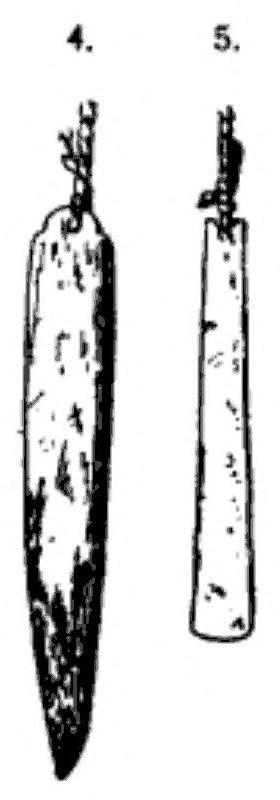
babong / babung
Source term: rhombe; rhombes de la nuit
babong / babung: bullroarer. tjozoza: the water-linked group, “does not become dry.” tjokwa: the blood-linked group (kwa, blood or red).
When rain was wanted at Kugong, it was the tjozoza who called it, whirling the babong, the bullroarers of the night. Mumuye society was split in two. The tjozoza belonged to water, and their name means “does not become dry”; the tjokwa belonged to blood and the colour red, and were held to be dangerous. While the tjozoza invoked the rain, no tjokwa might come near. Each half ruled its season, the tjokwa the dry months and the tjozoza the rains, for when the fire is too hot, it is the turn of the water to put it out.
Ils seraient les faiseurs de pluies à Kugong en faisant tourner les rhombes de la nuit.
They are said to be the rain-makers at Kugong, whirling the bullroarers of the night.
Herreman 1988, p. 60
Particulars
- Object
- Bullroarers called babong or babung, whirled at night; form and material not described.
Source
Frank Herreman, “Le masque de bovidé Mumuye (Nord-Est du Nigéria),” in L. Perrois (ed.), Anthropologie de l’art: formes et significations, fasc. 1 (ORSTOM, 1988), pp. 59–60