No. TREM1914-001
Hausa boys' bull-roarer, Daura
Daura, Katsina Emirate, Northern Nigeria · West Africa
Play / practical
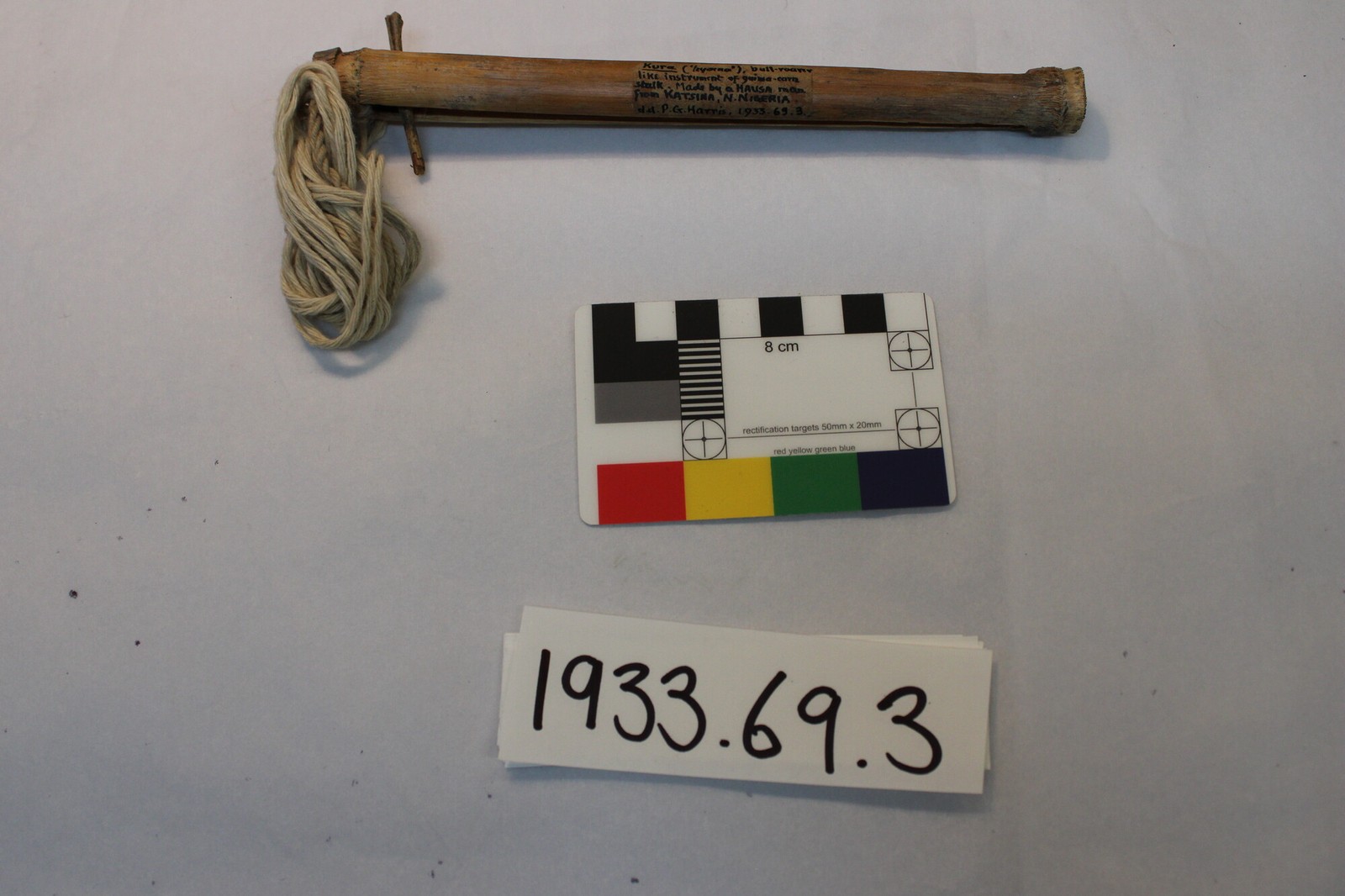
Source term: bull-roarer
Hausa boys around Daura swung a bull-roarer as a plaything. Before sowing-time the old men of the town went out among the farms and took up a position on an ant-hill, staying a week on flour and water and sour milk, offering a he-goat and fowls each day while the town carried food out to them. On the seventh day everyone else was sent away. Black cloths were hung round the sanctuary, and inside it the old men walked round and round slapping their loin-coverings and calling: "Uwar-Dawa, break up the ground, the time for sowing has come." The Mother of the Bush answered them, naming who would have much corn and who little, who would die and who would go mad. Her voice was not a bull-roarer. That was a thing for boys: a man who sounded one in her rite would offend her into a year's silence, and the crops would fail.
Uwar-Dawa's voice was not produced by a bull-roarer, "boys have something of the kind, but if a man did that sort of thing in a religious rite the spirit would be offended and would refuse to reply."
Tremearne 1914, The Ban of the Bori, p. 195
Particulars
- Object
- Not described.
- Function
- A boys' plaything. Its use in ritual is explicitly forbidden: the voice of Uwar-Dawa in the Daura sowing rite was not made with a bull-roarer, because the spirit would be offended and refuse to answer.
Source
A. J. N. Tremearne, The Ban of the Bori: Demons and Demon-Dancing in West and North Africa (London, 1914), p. 195