No. MUS2026-060
Oro's voice, worshipped as the god
Nigeria · Abeokuta (Egba) · West Africa
Restricted
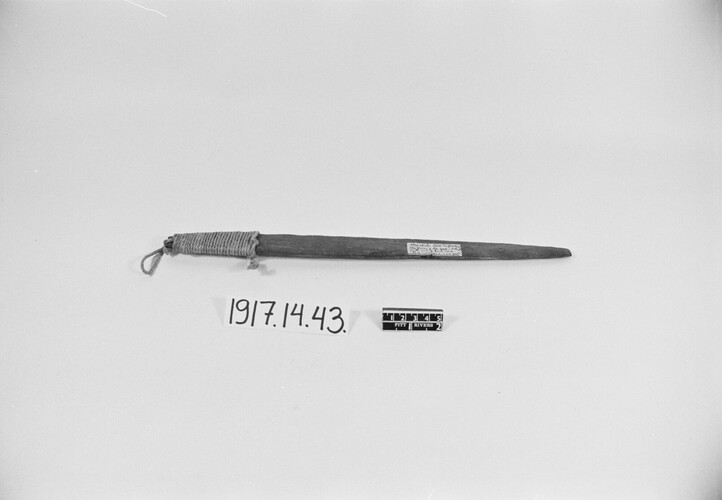
Source term: bull-roarer
Among the Egba of Abeokuta, in what is now southwestern Nigeria, the whirring of a slat of wood swung on a cord was held to be the actual voice of Oro, a god of vengeance, and A. B. Ellis, writing in 1894, recorded that the instrument itself was worshipped as the god. Oro carried out executions in the secrecy of his grove, and condemned criminals handed over to him were never seen again; no woman might see the object that made the sound and live. This Egba bull-roarer reached Oxford in 1917 as a gift from Mrs. Braithwaite Batty, and the Pitt Rivers Museum's accession register lists it in one breath with the next donation: "bull-roarer, the 'Voice of Oro,' Egba tribe, Abeokuta, W. Africa; Canadian Indian snow-shoes."
The voice of Oro is produced by whirling round and round a thin strip of wood, some 2½ inches broad, 12 inches long, and tapering at both ends, which is fastened to a stick by a long string. This instrument is known to English boys as the "bull-roarer."
A. B. Ellis, The Yoruba-Speaking Peoples of the Slave Coast of West Africa (1894), ch. VI
Particulars
- Object
- A long, slender blade tapering to a point, one end wound tight with cord that finishes in a small loop. An earlier Abeokuta blade in the Pitt Rivers Museum, 1889.3.1, carries the same name: 218 by 31 millimetres of hard streaky wood, fusiform with truncated ends, flat, its edges squared rather than sharpened, and its whirling cord still attached.
- Function
- Egba/Oro bull-roarer sounded as the voice of Oro; women were forbidden to see the object.