No. SOYINKA2006-001
A kola nut on Orò’s night
Benin · Tchaourou, Borgou department · West Africa
Restricted
Oro
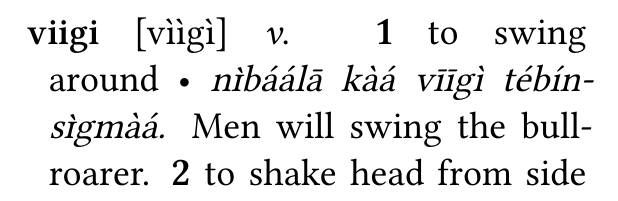
Source term: bullroarer
Oro: the Yoruba night spirit whose festival closes the town; its voice is the bullroarer.
Every lamp was dark when Wole Soyinka, escaping Nigeria’s military ruler on the back of a motorcycle in November 1994, reached the Benin border town of Tchaourou after midnight. It was the night of Orò: no one could be in the streets, no light or even a cigarette could be lit outdoors, and women above all must not be seen. From his host’s doorway he watched the masquerade pass from house to house giving blessings, while around him the whine of the bullroarer retreated and advanced. Then Orò turned toward the stranger, who quietly slipped his pistol under himself, and an attendant handed him a kola nut the spirit had whispered over. Soyinka bit into it and prayed alongside Orò that the peace of that night might last forever.
Around us, retreating and advancing, was the whine of the bullroarer.
Wole Soyinka, You Must Set Forth at Dawn (2006)
Particulars
- Object
- A bullroarer heard, not seen, during the town’s Orò festival.
- Function
- Sounded through the night of Tchaourou’s Orò festival, when no one could be in the streets, no outdoor light could burn and women above all must not be seen, while the Orò masquerade went from house to house giving blessings.
Source
Wole Soyinka, You Must Set Forth at Dawn: A Memoir (Random House, 2006)