No. RMCA2026-002
Tusia Do-society metal rhombe
Tusia · Toussian country, southwest Burkina Faso · West Africa
Restricted
Source term: rhombe en metal / bull-roarer
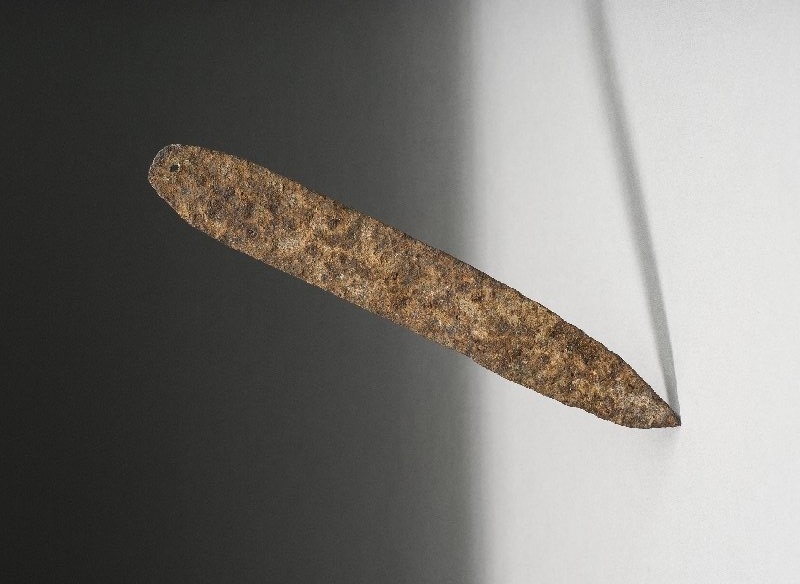
A long, narrow bar of iron, perforated at one end and tapering to a point at the other, with no decoration at all: among the rhombes at Tervuren, almost all of them carved wood, this is one of the few made of metal. It belongs to the Do, the secret society of the Tusia (Toussian) of southwest Burkina Faso, whose divinities are revealed only to initiates and are said to bring life, protection, fertility and good harvests. Swung on a cord it produces a buzzing roar; this piece was thrown from the top of a cliff in connection with holy water. It was collected in January 1967 by the Austrian art ethnologist Herta Haselberger, who studied the crafts of the old peoples of the far southwest of what was then Upper Volta. Which cliff, and which rite, went unnamed, and the object is placed no more exactly than the country.
Cet objet est lié à la Société Do et aurait été jeté du haut d'une falaise en lien avec l'eau bénite.
This object is connected with the Do society and is said to have been thrown from the top of a cliff in connection with the holy water.
RMCA/AfricaMuseum object record MO.1967.17.2 (rhombe en métal, Tusia)
Particulars
- Object
- A long narrow iron bar, perforated at one end and tapering to a point at the other, undecorated (RMCA MO.1967.17.2).
- Function
- Ritual sound instrument associated with the Do society; the museum note says it was swung on a string and thrown from a cliff in connection with holy water.
Source
Royal Museum for Central Africa (AfricaMuseum), Tervuren, MO.1967.17.2