No. BRAND2001-001
Wéménu kpe, the voice of Lo
Benin · Lower Ouémé valley · West Africa
Restricted
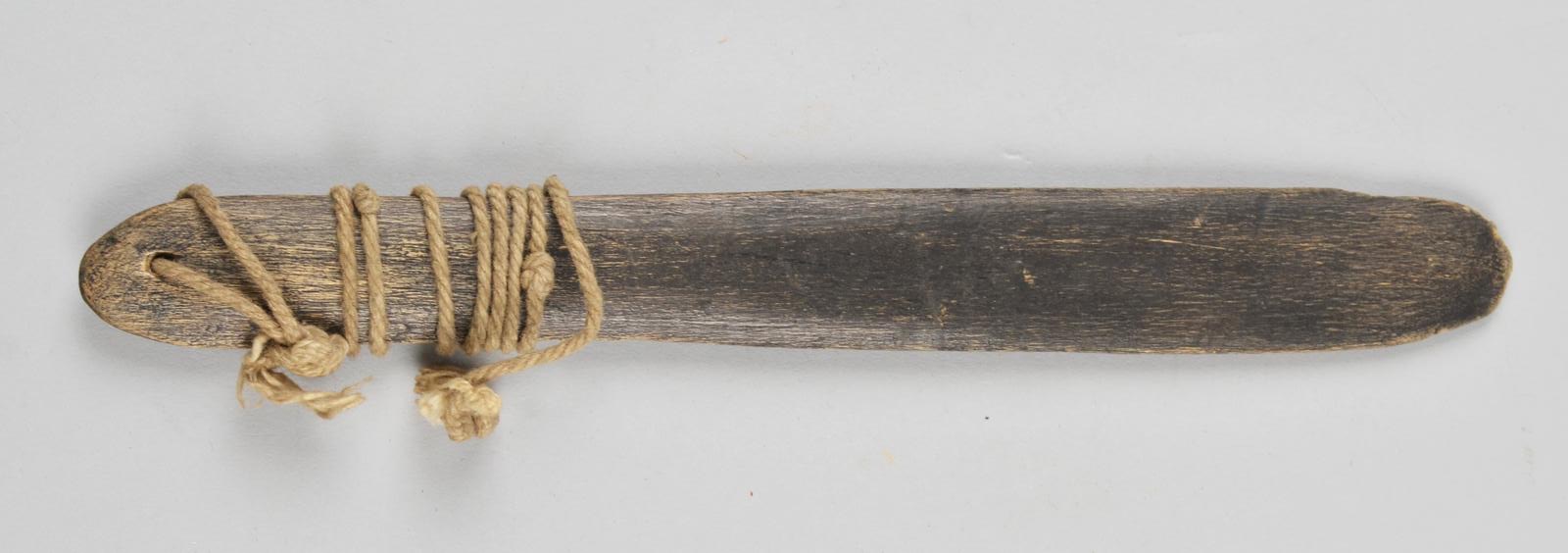
kpe
Wéménu kpe, the rhombe whose roar is the night voice of Lo — Oro in Yoruba.
At night in the villages of the lower Ouémé, an uneven, mournful roar moves through the dark: Lo is out. Lo is the Wéménu form of Oro, the Yoruba men's society, and his voice is the kpe — a flat board a forearm or more long, whirled fast on its cord. At the sound every man goes home, and women above all must hide: a woman who sees Lo, or speaks to him, will die a dreadful death.
Cette voix est produite par un instrument particulier, un rhombe, kpe... En le faisant tourner vivement en l'air, il produit un étrange grondement inégal et lugubre. À la voix de Lo, chacun retourne chez soi, et les femmes doivent se cacher car elles ne doivent en aucun cas le voir ni lui parler sans quoi elles mourront d'une mort affreuse.
This voice is produced by a particular instrument, a rhombe, the kpe... Spun rapidly in the air it produces a strange, uneven, mournful roar. At the voice of Lo everyone returns home, and the women must hide, for they must on no account see him or speak to him, or they will die a horrible death.
Roger Brand, 'Le vodoun chez les Wéménu', RFHOM 88 (2001), p. 285
Particulars
- Object
- A flat wooden board, 35-65 cm long and 5-7 cm wide, attached to one cord and spun rapidly in the air.
- Function
- Nocturnal voice of Lo, the Wéménu form of the Yoruba Oro society: at its roar everyone returns home and women must hide — a woman who sees or speaks to Lo dies.
Source
Roger Brand, 'Le vodoun chez les Wéménu' (Revue française d'histoire d'outre-mer 88, no. 330-331, 2001), p. 285