No. TALBOT1926-001
Ekkpe eastern Nigeria ceremony bull-roarer
Eastern Nigeria · Cross River-Calabar-Ibibio-Ekoi region · West Africa
Restricted
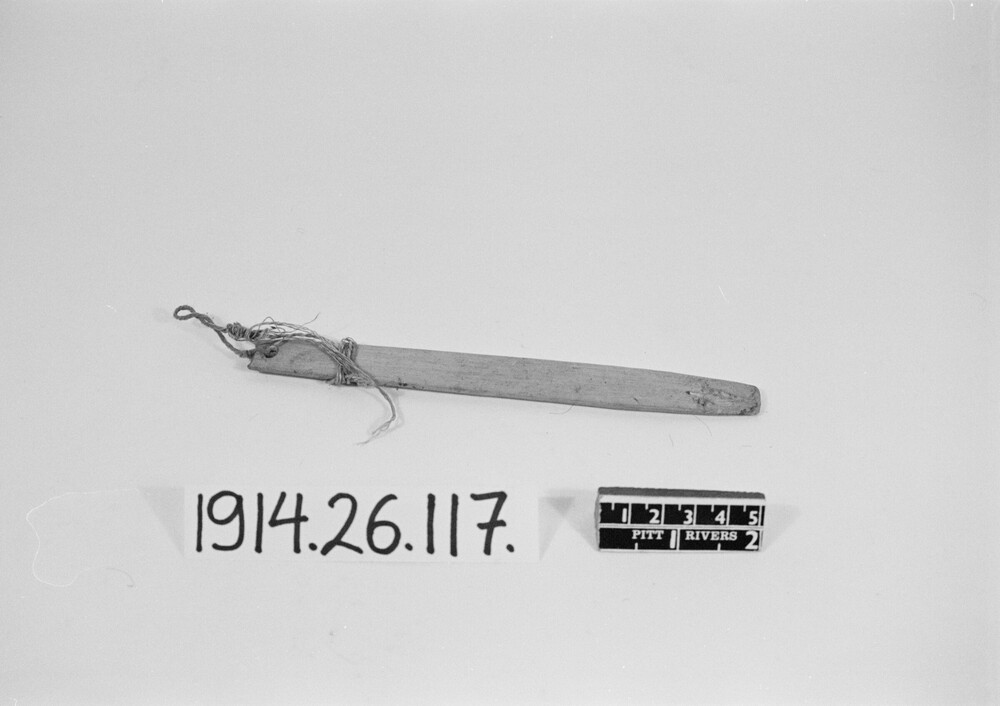
Source term: bull-roarer
The Ekkpe, the Leopard society of the Ibibio and their Semi-Bantu neighbours, grew into the wealthiest of the Egbo societies of eastern Nigeria — 'hostile to women,' Talbot wrote, 'and one of the chief male instruments to keep them in subjection.' 'The bull-roarer is always associated with the ceremonies,' though beside it sounded the Ekkpe voice, 'something quite different,' its secret held back through all seven grades of initiation; across the societies of this coast the roarer 'was usually considered to be the voice of the juju.' What initiation opened was another world. In the kindred Idiong rite the priest takes the aspirant's hand — 'Thou — art — dead' — and the man is laid out and mourned as a corpse, revived by seven strokes of a plantain stem, returning with a prophecy 'learnt during his sojourn in the realm of the dead'; at the seventh circle drawn on the ground he cries 'Now I see!' — the sham-death, ghost-world visit, and opening of the inner vision Talbot named as the mysteries' principal features.
The bull-roarer is always associated with the ceremonies, but in addition there is the Ekkpe voice, which appears to be something quite different and may be similar to the Zulu whistling spirit, the Umlozi.
Talbot, The Peoples of Southern Nigeria, vol. 3 (1926), p. 780
Particulars
- Object
- Talbot reports that in Ekkpe/Ekpe ceremonies the bull-roarer is always associated with the ceremonies; he treats it separately from the Ekkpe voice.
- Function
- Bull-roarer always associated with Ekkpe ceremonies (distinct from the 'Ekkpe voice'); regionally the roarer was usually considered the voice of the juju, held in awe by non-members and specially by women
Sources
- Percy Amaury Talbot, The Peoples of Southern Nigeria, vol. 3 (Oxford, 1926), pp. 757-758, 764-765, 769, 780, 794, 813 View
- Percy Amaury Talbot, Life in Southern Nigeria (1923), pp. 173-178 View
- Edwin M. Loeb, 'Tribal Initiations and Secret Societies,' University of California Publications in American Archaeology and Ethnology 25(3) (1929), pp. 263-264 (paraphrase of Talbot)