No. MUS2026-157
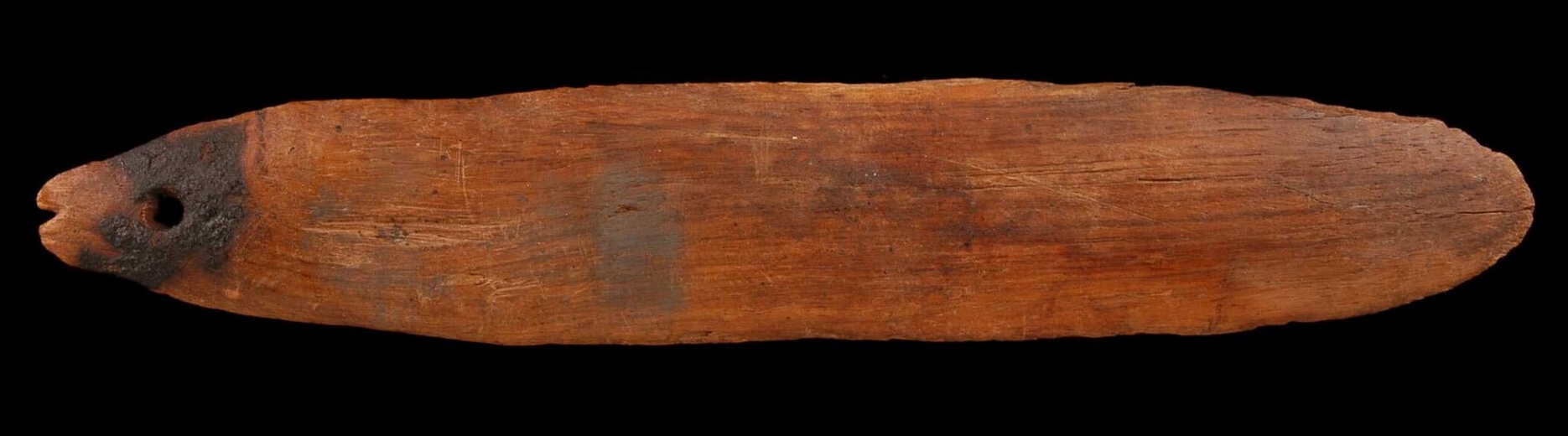
Dogon Songo veni bullroarer
Mali · Songo · Bandiagara escarpment · Mopti region · French Sudan · Africa
Restricted
Véni
Source term: Rhombe / bull-roarer
Veni: Dogon vernacular name catalogued for this bullroarer; no literal gloss recovered
Songo lies fifteen kilometres north-west of Bandiagara, in the country of the Dogon Pignari. Halfway up the east face of the old-village rock above the settlement, among the ruins on its summit, the mask confraternity’s gear had been laid away in the stones: masks, fibre costumes and rhombes together. Three wooden blades came down from there to the Dakar-Djibouti mission on 21 November 1931, two more the day before from the mask cave on the west side of the village. This 23-centimetre slat, called véni in the Pignari dialect, is one of the five. None was still in use: Songo had turned to Islam a few years before, no longer celebrated the Sigui, and brought out its masks only for European official holidays. A day’s walk east at Sanga the same instrument was still the mother of the mask. Michel Leiris, who published the blades three years later, set down its rules there: never to be seen by women or children, carved only by the fully initiated, hidden in the mask caves with its cord wound round the blade, and spun outside the village on the night a man died and every evening of the Sigui. Anyone who revealed it was cursed with death. The confraternity is the Awa, keeper of the Great Mask, carved anew for each sixty-year Sigui to embody the first ancestor, who died in the form of a serpent; the véni was spun for that serpent-ancestor’s rites.
auvents à graffiti et bull-roarers de bois en masse
rock shelters with graffiti and wooden bullroarers in quantity
Leiris field journal, 21 November 1931, quoted in Quai Branly object 71.1931.74.2072
Particulars
- Object
- Waye-wood slat, 23.2 x 4 x 1 cm and 44 g; elongated rounded blade with one terminal perforation and a small notched tip. No cord survives in the photograph.
- Function
- Rhombe of the Dogon Awa mask society, sounded at a man's death and on the evenings of the Sigui; the Songo blades were already retired when collected in 1931.