Ancestors, animal bodies and the novice who learns their source
From Cameroon’s ancestral shrines to Congo forest schools, named voices approach people in seclusion and give elders, beasts and ancestors a material presence. Roarers sound with whistles, pipes and masks; learning their source changes a novice’s place in a community. The same craft also serves children, dancers and hunters.
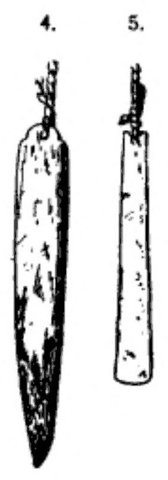
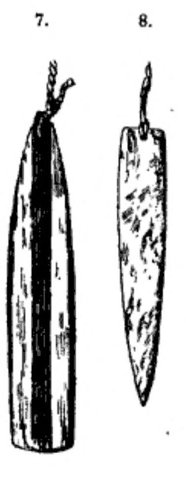
A Babali novice lies blindfolded while three elders divide an ordeal. One cuts marks into his belly, another supplies a bird’s cry, and the Maduali swings the mournful wooden voice above them. The sound belongs to a being; the hands belong to men who have already passed through the school. Across Central Africa, the roarer repeatedly joins those two identities. A powerful forest presence approaches the novice, and knowledge of how that presence speaks becomes part of the authority he is growing into. 4, 5
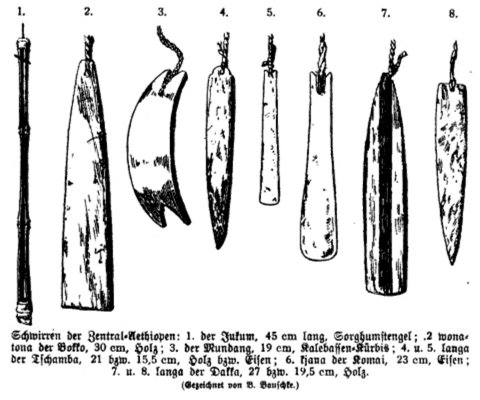
In the Cameroon–Nigeria uplands, the voices of fathers could be taken out and put away. Frobenius found wooden Sama Langa sounded on sacred days while iron examples remained in a shrine urn. At harvest, women and children stayed indoors; circumcision boys were told the old grandfathers were crying. Among the Longmo, wooden Uonatonajo hung in the Nahurga household shrine. At harvest, circumcision or an old man’s death, women heard dead fathers asking for food and tobacco. 1
These are ancestors whose demands enter the cycle of food and people. The Verre Do’os house held horns, a bagged stone, iron implements and metal and wooden baranga. At night in Nenga Kabusum, men sounded the wooden roarers with stones, gourds and pots while women remained indoors. Do’os threw hunger away into the bush. A kept voice could become a harvest action, giving the cult’s claim to health and good yields a presence people heard outside the house. 2
For Dii boys’ circumcision, the cry of zág the panther explained what was happening beyond the village. The men made rhombes for that cry, and a later informant described the deception bluntly: the operation was done with small knives. Yet Drønen also records the rhombes and knives as seats of ancestral spirits. Kept hidden, receiving sacrifices, the instruments held authority between performances as well as during them. An explanation of the sound’s making could coexist with reverence for the object. 3
Among the Mbum, wooden Djerr sounded at circumcision while women heard a leopard or lion abroad among the boys. Instruments waited in a mountain cave, and the initiates learned to operate them. Frobenius also describes Mundang elders sounding three materials after a king’s death: iron Mafalli, notched wooden Falliku and sorghum-stem Mafalli-serre. A new generation encountered voices with different registers. Wood, stalk and metal became resources for the same work of giving the institution more than one audible body. 1
The Babali ordeal placed tattooing, flute cry and roarer in separate elders’ hands. The voice did its work within an ensemble: the body was marked while a spirit was heard. Moeller traced related sound kits across the northeastern Congo, along with secluded camps, practical teaching about hunting and animals, secret formulas and the gradual sight of the spirits. The institution joined bodily change to knowledge, and drew the boy away from the ordinary access his family had once held to him. 4, 5
The words map a regional vocabulary without making every school identical. Komo circumcision had tuambi with kabili whistle and mokomo bird-pipe. Lega used tuamba with kabili and lokumu; Lokele used bandulu beside galagala. Ndaka circumcision used ngwe alone, while Ndaka mambela had maduali with whistle and bird-pipe. Among the Mbo the roarer likewise changed names with the rite. The recurring arrangement is an institution of voices, whose personnel, instrument combination and spoken identity remain locally precise. 5
At Balese Kalimoholo, Schebesta was told that Tore gave the sound instruments to the ancestors. During panda the painted, fur-clad leader played hudju, Grandfather, swinging pahudjuhudju as other elders sounded the rest. The sound kit could collectively be called Tore. Schebesta did not see a roarer there in use, but the account connects the instrument, ancestor persona and god within one performance. The village’s senior man could voice a presence older than himself while acquainting the boys with it. 6
The vocabulary thickens that relationship. A Lendu man, shown a roarer and asked what it was, answered that it was Tore. At Kilo, go named the roarer, iago the circumcision, and the deep pot-instrument glöi was its mother. At Geti, fomvokai stood beside fomvo, God. These are precisely situated accounts and words: identification, kinship between instruments, and related naming. Together they show how a sounding object could take a place in a family of spirits rather than merely accompany them. 6
The Nyanga place their circumcision roarer within a company of feared unseen spirits. Nyabungubungu is an ovoid bwayi-wood blade on raffia, handled only by a specialist. Percussion sticks, kazoos and a drum accompany its voice around the masked kirimu that leads boys away. Spirits pass through villages and gather at the lodge, while sight and handling carry their own permissions. The individual board takes its place within a much larger sound-world through which the community conducts a generation into the forest. 8
For the Bembe of South Kivu, Tembwe was both god and leopard, the bullroarer’s snarl carried into the rite that Gossiaux describes as killing and remaking the boys. In Ngbaka seclusion at Gemena, the ancestor Ya continued to cry through the vukuma after the boys had reached the knife. The shared sequence reaches from a frightening encounter into the time of recovery: the transformed body lives with a voice that tells it what institution, ancestors or dangerous beings now claim it. 9, 10
The Bushongo invention tale makes an elder’s claim wonderfully domestic. A son drank palm-wine with his mother and left his father none. The father followed him into the wood and, hidden, swung a wooden strip on a string. Terrified, the boy dropped his calabashes, fled, and begged forgiveness. The elders adopted the device to teach respect. In Nkanda seclusion, old men surrounded the camp at night with supernatural cries and palm-strip roarers, while the presiding official teased the boys for fearing ghosts. 7
The story carries both the terrifying effect and the knowledge of its manufacture. That double view is one reason a children’s instrument can remain intelligible beside an initiation voice. The same report that explains why boys fled lets experienced adults smile at how the sound was made. Central African accounts repeatedly put that change of position inside the rite itself: the listener comes to know the makers and, in some schools, becomes one of them. 7, 1
In the Lobaye, Aka hunters used a monkey whip and rhombe to imitate an eagle’s flight and frighten monkeys. The intended listener was an animal, with a predator’s approach supplied by human hands. At Kenyé, Sarno recorded a bullroarer inside elanda, a teenage dance with men and women singing interlocking parts and clapping; a burst of sound drew a cheer. Hunting and public music show the same craft answering to different companies. Its office comes from the relationship between a voice, those who make it and those expected to answer. 11, 12
Blindfolded Mombela novices lay on their backs while three initiated elders divided the ordeal. The Isumu cut tattoo marks into their bellies with a keen blade; the Nasasa mimicked the cry of the grey ibis on a flute; and the Maduali whirled a hollowed slat of wood on a cord above his head. The…
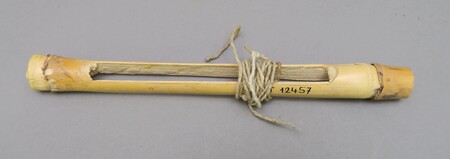
Representative — not this record’s object · a Kuba roarer from Lusambo (Pitt Rivers).
When a Balese wife bit her husband, the pahudjuhudju itself would start to hum in the night: she knew at once whose disobedience the sound named, and she owed her clan a gift in atonement. At Kalimoholo it took an evening of blunt questions and promised presents before the two Abitiri would stage…
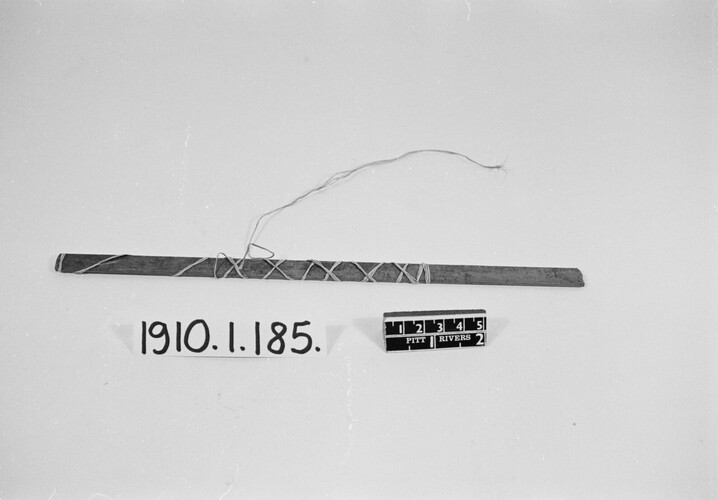
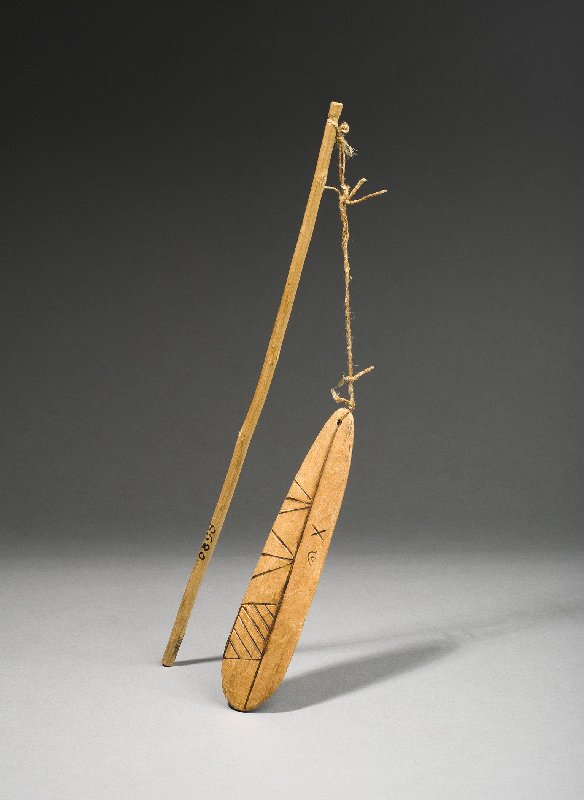
Representative — not this record’s object · Kuba bull-roarer ‘KOINAMBULA’, Pitt Rivers Museum (acc. 1910.1.185)
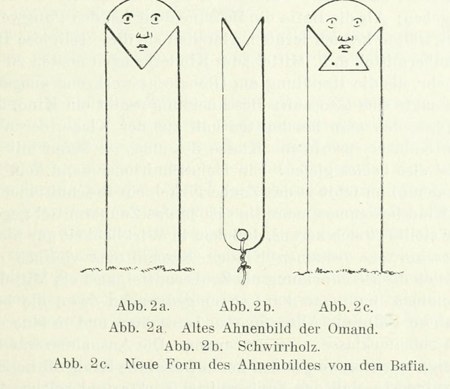
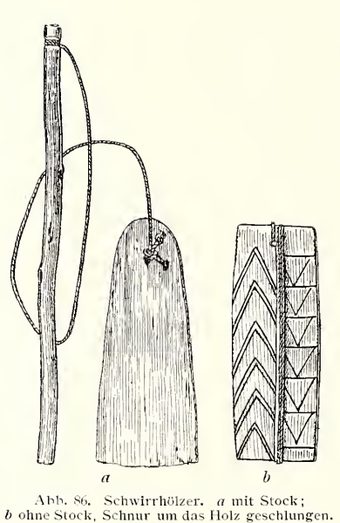
G. Tessmann, "Die Bafia," Zeitschrift für Ethnologie 51 (1919), Abb. 2 · Public domain
At Ngan-Ha the bullroarer entered the boys' circumcision at a moment of deliberate terror: as the niadok set it turning, women and the uncircumcised were ordered indoors and told that fe-mbaka, 'the devourer,' was abroad. Among the wider Mbum, Frobenius heard the same instruments called Djerr, Sirr…
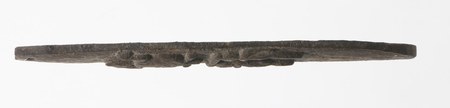
Representative — not this record’s object · Tessmann's 1919 drawing of Bafia blades
Among the Verre of Cholli, a settlement of smiths in the Adamawa highlands of Nigeria, the cult house called lug Do'os held five things: a stone inside a skin bag, a long deep-throated wooden horn, animal-horn pipes, iron ceremonial instruments, and bull-roarers of metal and wood known as baranga.…
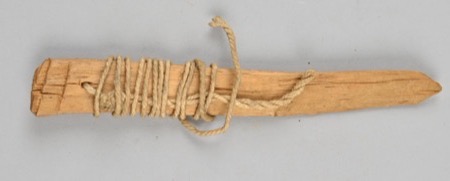
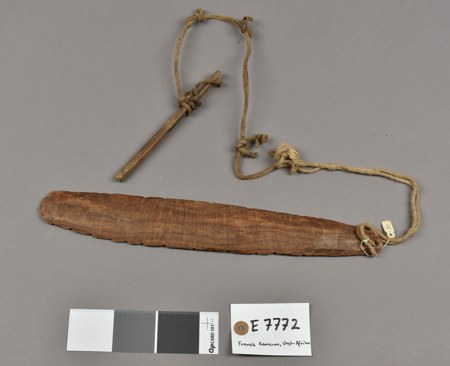
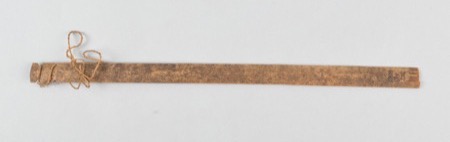
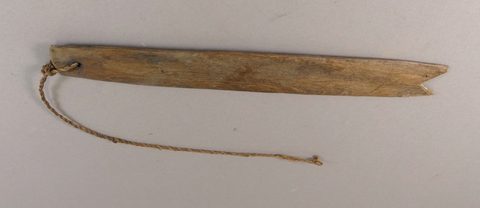
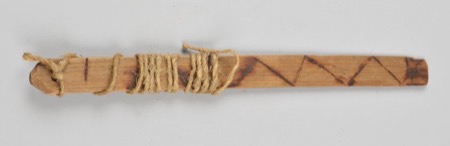
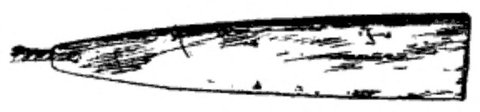
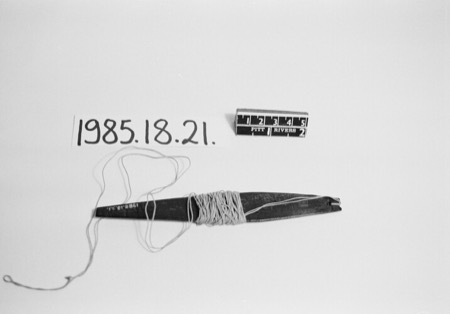
Representative — not this record’s object · Wooden blade with cord wound around its middle and a loose hank at the tip.
Among the western Bushongo of the Kuba kingdom, the bull-roarer was a thing of palm. Emil Torday, who spent 1907-09 in the Kasai for the British Museum, and his co-author T. A. Joyce recorded that the elders made it from very thin strips of palm-leaf rib tied to a cord; in the instrument survey of…
Representative — not this record’s object · a Kuba roarer from Lusambo (Pitt Rivers).
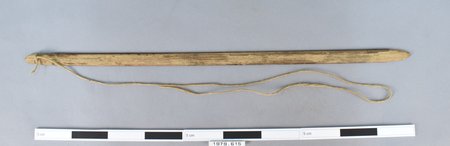
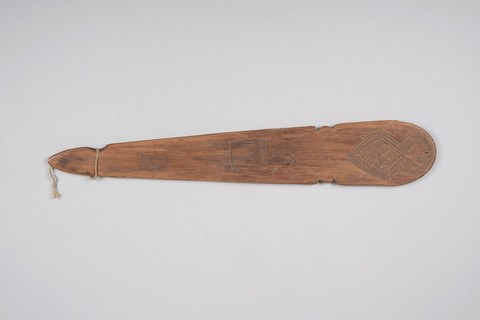
Museum of Archaeology and Anthropology, University of Cambridge (1979.615) · CC BY-NC-SA 4.0
When Nyabungubungu sounds through a Nyanga village, the women lock themselves indoors. It is an ovoid blade of bwayi wood on a raffia string, handled only by a specialist, and it speaks for a feared unseen spirit of the circumcision rites, in the company of percussion sticks, kazoos and a drum.…
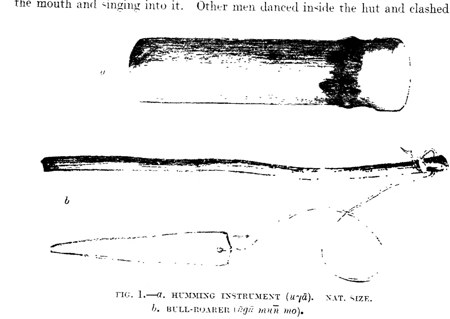
Representative — not this record’s object · a plain roarer from Yalemba, upper Congo
Drawing by Xénia Yellachich, after photographs by Herbert Pepper; Anthologie de la vie africaine (Congo-Gabon), 1958, booklet p. 16; CREM-CNRS · CC BY-NC-ND
Pp.550–552: forest initiation curriculum and sound-instrument table for Babali, Komo, Mbo, Ndaka, Lega and Lokele; names and ensembles belong to distinct rites.
Archiv für Religionswissenschaft30, pp.115–116,132–135: Bakango primordial father, Balese panda and voice of Tore; Lendu/Nyali vocabulary and Lendu object identification. He did not see Balese or Nyali instruments in use.
Pp.3,8 and the spirit/instrument accounts: nyabungubungu, ovoid bwayi-wood blade on raffia, specialist handling and the wider circumcision sound kit; Congo fieldwork1952–1956. Wife identity omitted: p.3 and p.8 conflict internally.
CREM-CNRS CNRSMH_I_2020_084_009_02: Engedi/Kenga,1November1976; whip and rhombe imitate eagle flight to frighten monkeys. Whip’s tòmbó name is not assigned to the roarer.