No. SCHAEFFNER1951-001
Kissi initiation and ancestor-voice bullroarer
Kissidougou-Guéckédou · Forest Guinea · Africa
Restricted
Source term: Rhombe
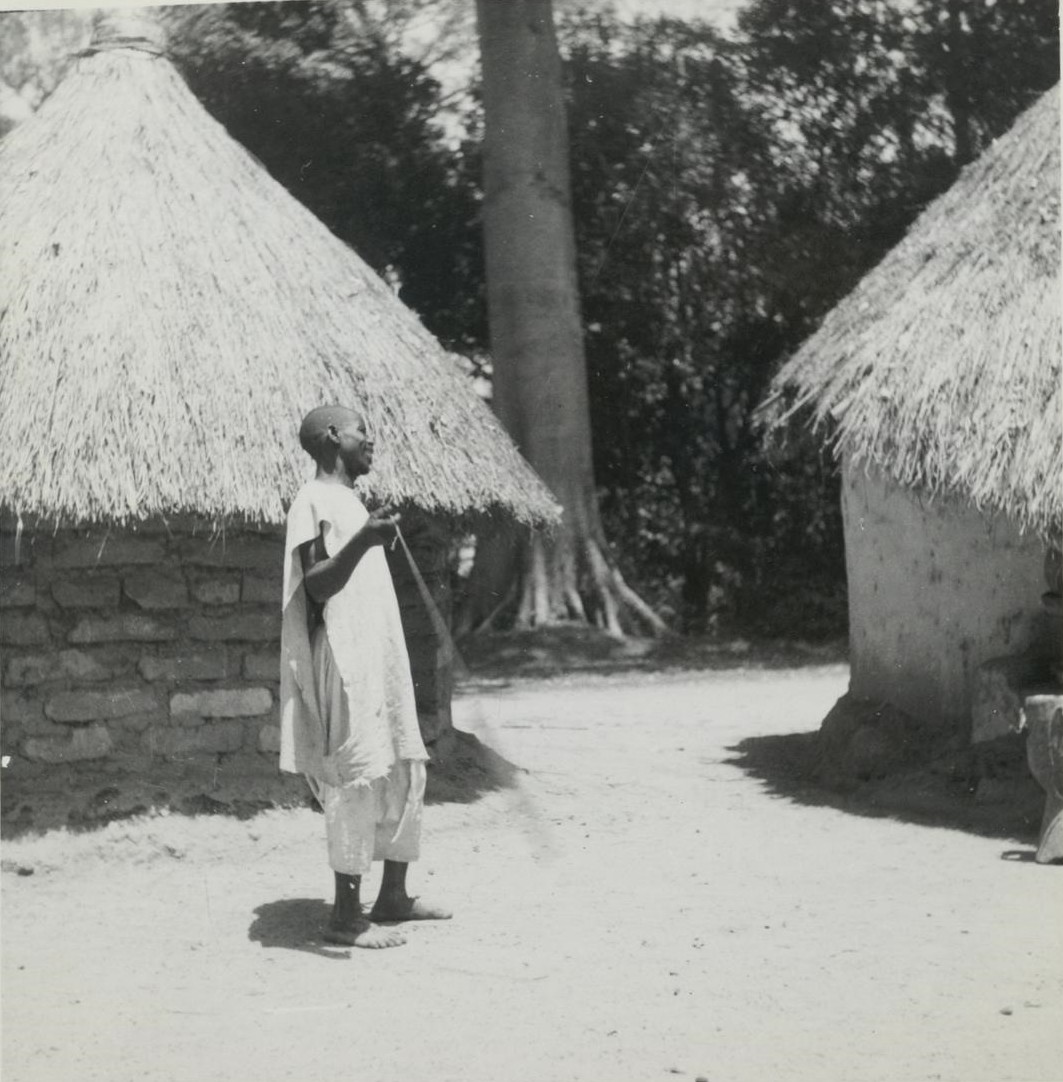
Through the young men's seclusion, Kissi bullroarers turned morning and evening as the voice of the ancestors. Women were kept from the initiates' route. Some villages burned the instruments when seclusion ended; elsewhere they were kept or remade in the forest. In 1947 Schaeffner photographed the Kosoa rite at the village of Kenéma Pombo: a man in profile between two thatched houses, cord in hand, turning the rhombe.
… le ronflement qu'elles entendent est le rugissement d'une grosse bête féroce (nyewonde), tombée du ciel et qui dévore leurs enfants dans la forêt sacrée.
… the drone they [the women] hear is the roar of a great ferocious beast (nyewonde), fallen from the sky, that devours their children in the sacred forest.
Schaeffner 1951:75
Particulars
- Object
- Bullroarer identified as a rhombe that turns; no material, dimensions, cord, perforation, blade shape, handle, or object figure is supplied.
- Function
- Whirled through the young men's initiation seclusion: to women the roar of a child-devouring beast, to initiates the voice of the ancestors.
Source
André Schaeffner, Les Kissi: Une société noire et ses instruments de musique (1951), Rhombe et diable