No. HAUMANT1929-001Africa
The buffalo's bellow that announces Dyoro
Burkina Faso · Lobi country on the Black Volta (Gaoua, Batié), Upper Volta · West Africa
Restricted
- Spirit voice
- Initiation rite
- Death and rebirth
- Forbidden to women
- Women-linked
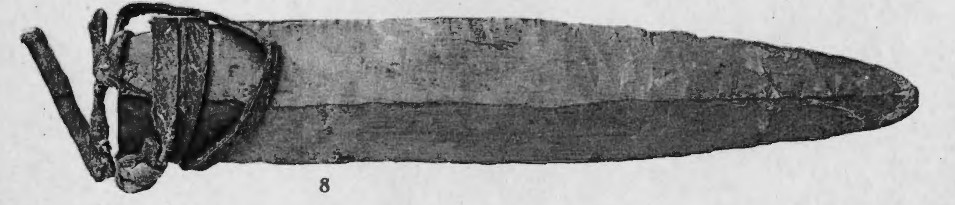
Source term: rhombe
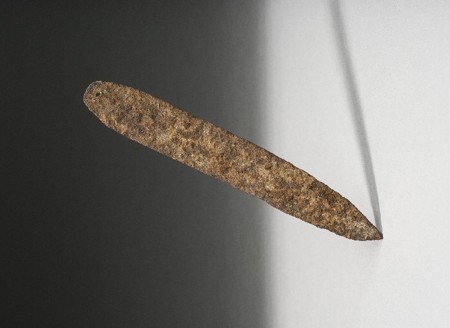
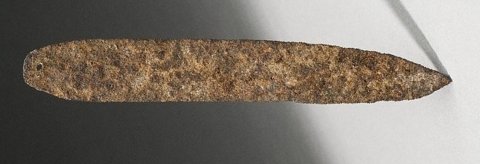
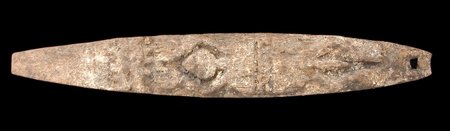
Every seven years, in the dry season, the Lobi take their children down to the Black Volta to be initiated, boys and girls together. At night something bellows in the dark, a lion roaring or a buffalo lowing, and the novices, lying under mats with their eyes shut, are struck with holy fear: it announces Dyoro, a power of the Earth. The uninitiated child dies there. Those initiated to Dyoro are bound, on pain of death, to forget their first names: they must not turn round when called by them and must never say them. They take a third name, revealed only at the end of the rites, once they have “entered into their new personality.” Then the river must take the newborn. On the march to Batié-Nord each group goes to the stretch of bank its ancestors always used; two old men or two old women stand in the water to sprinkle them, and a priest on a rock begs the river to accept those in its bosom who belong to it. The novices smear themselves with its mud, and their elders carry clay home to feed the village altars. Months later, elders hidden on a roof sound the blade three times, then show it. Young men and young women alike may look at it; only initiated men may whirl it.
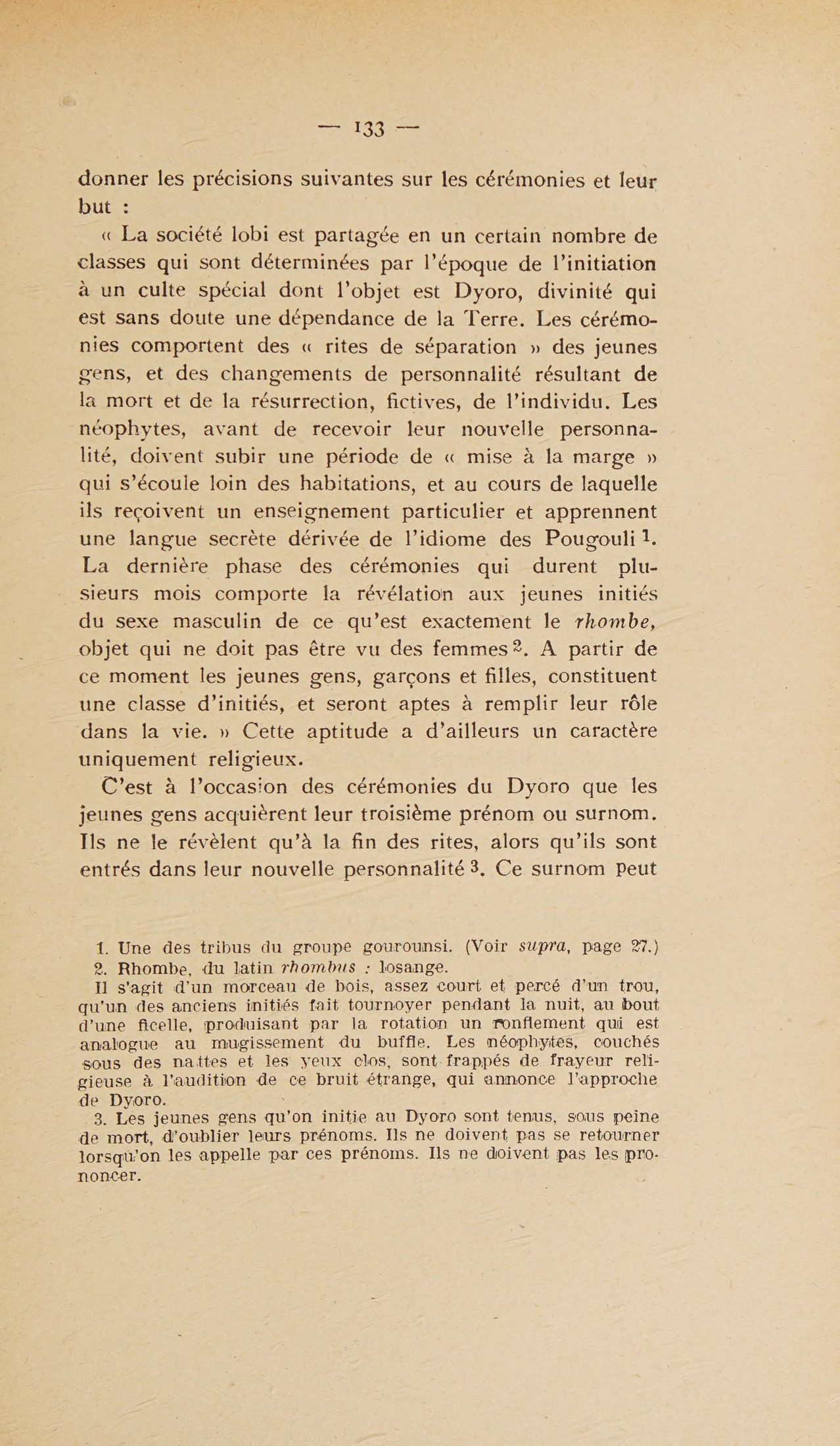
Seul le mugissement du rhombe continue à troubler leur sommeil pendant la nuit.
The bellowing of the rhombe alone still troubles their sleep in the night.
Tô Joseph-Antoine Kambou, « Histoire d'un rite de passage : le jɔrɔ lobi » (1993), p. 366
2 more plates
Particulars
- Object
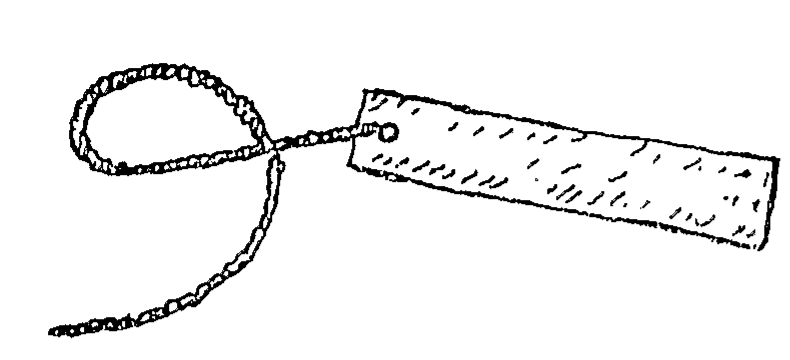
- A short blade pierced at one end and whirled overhead on a string, of wood or, most often, a flat iron plate 20–30 cm long and 5 cm wide.
- Function
- Sounded at night through the seven-yearly Dyoro (jɔrɔ) initiation as the approach of the god, and beside the house of an initiated elder who dies before the rite is complete; at the final revelation it is shown to girls and boys alike, but only initiated men may handle and sound it.
Discussed in one essay
 Taught Again Like a Child
Sources
- Jean-Camille Haumant, Les Lobi et leur coutume (Paris: Presses Universitaires de France, 1929), pp. 132–134, quoting Henri Labouret View
- Henri Labouret, Les tribus du rameau Lobi (Paris: Institut d’Ethnologie, 1931), pp. 432–434 and pl. XVII fig. 8 View
- Tô Joseph-Antoine Kambou, “Histoire d’un rite de passage : le jɔrɔ lobi,” in M. Fiéloux, J. Lombard and J.-M. Kambou-Ferrand (eds), Images d’Afrique et sciences sociales : les pays lobi, birifor et dagara (Paris: Karthala / ORSTOM, 1993):360–367, pp. 361–367 View · archived
Nearby in the atlas
 Bobo, the hornbill's giftsBurkina Faso · Bobo-Dioulasso region, western Burkina Faso · Restricted
 Dorhosie Zorhogo, the iron that hunts sorcerersBurkina Faso · Cercle de Bobo-Dioulasso, former Haute-Volta / French Sudan · Restricted
 Sèmè Do, the spirit that walks as soundBurkina Faso · Orodara, Kénédougou province, western Burkina Faso · Restricted
 Gouin dogo, the face of GodBurkina Faso · Province de Banfora (now Comoé), southwest Upper Volta / Burkina Faso · Restricted
 Solenzo Do, the smith's voiceBurkina Faso · Solenzo commune, Banwa Province, Boucle du Mouhoun · Restricted
- Gan sᴐrᴐ, the voice over the face-down boysBurkina Faso · Southwest Burkina Faso / Loropeni Department · Restricted