FROBENIUS1913-001 - ethnographic attestation
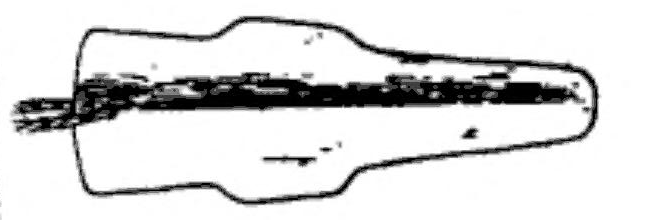
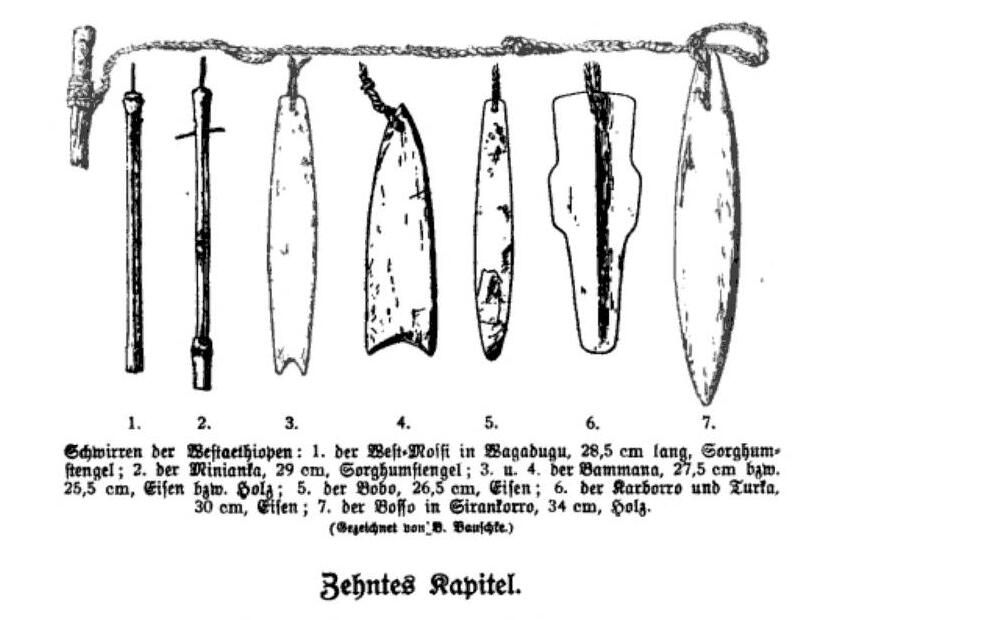
Shouldered iron of the Karaboro and Turka
Burkina Faso - Banfora–Tiéfora country (now Comoé province), southwest Upper Volta - West Africa
Restricted
Source term: Schwirre (Eisen)
The bullroarer of the Karaboro and Turka, farming peoples of the Banfora country in southwest Burkina Faso, is a blade of forged iron thirty centimetres long, broad-shouldered at the head and tapering to a tail. Their Gouin neighbours whirl such an iron, the dogo, over the heads of boys on the night of initiation, and the Turka and Karaboro have one as well. Leo Frobenius counted both peoples in the Bobo group, and across that group the iron opened the sorghum harvest. A hereditary priest sounded the first one and the women were chased away: they could look at the irons at rest, never while they swung. Lineages locked in feud had to make peace the moment it sounded. Once the grain was in, the priest planted iron roarers in forked sticks out in the fields.
Denn vorher mögen die einzelnen Sukalen untereinander in heftiger Fehde liegen, sobald das Eisen schwirrt, tritt Friede ein.
For the lineages may have been locked in bitter feud before; as soon as the iron whirrs, peace follows.
Leo Frobenius, Und Afrika sprach… III (1913), p. 306
- Object
- A forged iron blade 30 cm long, broad-shouldered at the head and narrowing to a tapering tail, its cord bound through the top.
- Source
- Leo Frobenius, Und Afrika sprach…, Bd. III: Unter den unsträflichen Äthiopen (Berlin: Vita, 1913), p. 297 fig. 6 (drawn by B. Bauschke), p. 300 and pp. 306–307; Michèle Dacher, « Dans le malheur on ne peut pas être seul avec Dieu », Systèmes de pensée en Afrique noire 8 (1987): 69–110, at p. 75
- Source location
Page references
Frobenius 1913 p. 297 fig. 6, p. 300, pp. 306–307; Dacher 1987 p. 75 (§17)
- Source confidence
- high
- Location note
- Shared anchor between Banfora (Turka) and Tiéfora (Karaboro); Frobenius attributes one drawn specimen to both peoples and gives no collection village.
Regions: Africa · West Africa
- Initiation rite
- Agriculture / crop magic