No. MUS2026-035
Abume, whirled to scare spirits
Nigeria · Benue valley · West Africa
Weather / fertility magic
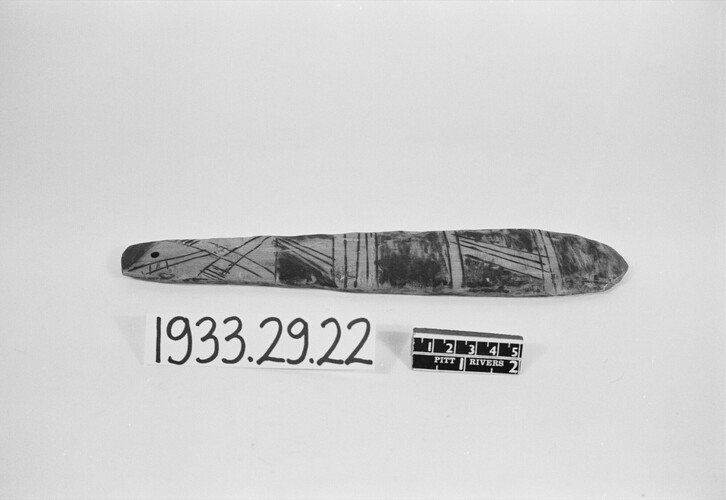
abume
Source term: bull-roarer
This abume reached Oxford in 1933 as one piece of a large collection from the Tiv (the colonial-era "Munshi") of the Benue valley in northern Nigeria, presented by Captain R.M. Downes, the colonial officer who later wrote a study of Tiv religion. The bull-roarer arrived among a whole apparatus of spirit-work: a very large musical rasp with a wooden-tray resonator (ivu-ul), rasped with a cow's jaw and used in ritual to expel evil spirits; the single-membrane gbande drum played with it; pottery human heads made to house ancestral spirits; carved male and female atsuku figures, smeared with cam-wood powder, used in hunting rituals; and divining chains of snakes' vertebrae strung with crocodile scutes and beads, read by inspecting the scutes when thrown. The Grove Dictionary of Musical Instruments records the Tiv abume more narrowly, as the bull-roarer used in the agbande rite for a pregnant woman.
abume bull-roarer to scare evil spirits
Pitt Rivers Museum, Annual Report 1933-34 (Capt. R.M. Downes donation, acc. 1933.29.22)
Particulars
- Function
- Whirled to scare evil spirits; used in the agbande rite for a pregnant woman.
Source
Pitt Rivers Museum, Oxford, acc. 1933.29.22