No. MUS2026-337
Bamana blood-crusted cult Boli
Mali · French Sudan collection context · West Africa
Sacred / spirit
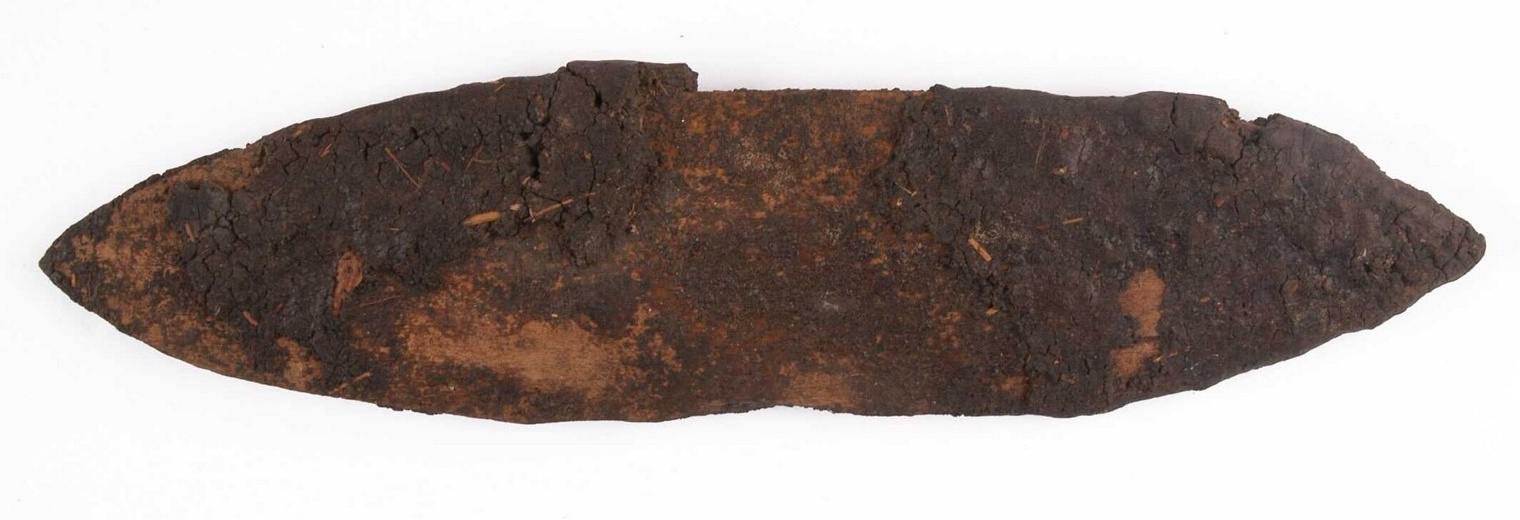
Boli
Source term: Rhombe
boli (pl. boliw): a Bamana power object, built up by repeated sacrificial offerings so as to accumulate and control nyama, the life force.
Layer on layer of sacrificial blood has all but swallowed this blade. A boli is made that way on purpose: a form built up by repeated offerings until the crust accumulates and directs nyama, the life force that acts on the world, and the original contours vanish under it. This one began as thirty-two centimetres of whirled wood, and the Bamana men's societies of Ndomo, Korè and Komo kept it. What the offerings gave it in power they took from it in voice. Komo’s night hyena also manifests Faaro, the great serpent of creation, while initiates dance its zigzag: the blood-fed blade belongs to that serpent-linked society.
Rhombe recouvert d'une patine crouteuse de sang coagulé.
Bullroarer covered with a crusty patina of coagulated blood.
Musée du quai Branly — Jacques Chirac, object record 71.1902.12.14
Particulars
- Object
- A 32-centimetre wooden rhombus almost covered by a crust of coagulated sacrificial blood.
- Function
- A protective object used in the cults of the Ndomo, Korè and Komo societies; repeated blood offerings transformed its surface.
Sources
- Musée du quai Branly — Jacques Chirac, Paris, online collection catalogue: rhombe (boli), Bamana, Mali, wood and blood, given by Louis Archinard in 1902. View · archived
- Frederick J. Lamp, You Haven’t Seen the Wild Beast: a Manding Headdress (Komo Kun), in See the Music, Hear the Dance (2004), paragraphs on Faaro and the bard View