No. TAUXIER1931-003
Dan Goton and the stilt-dancers of Bouafle
Dan (Yacouba) country around Man, western Cote d'Ivoire · West Africa
Sacred / spirit
Goton / Godon
Source term: Goton ou Godon
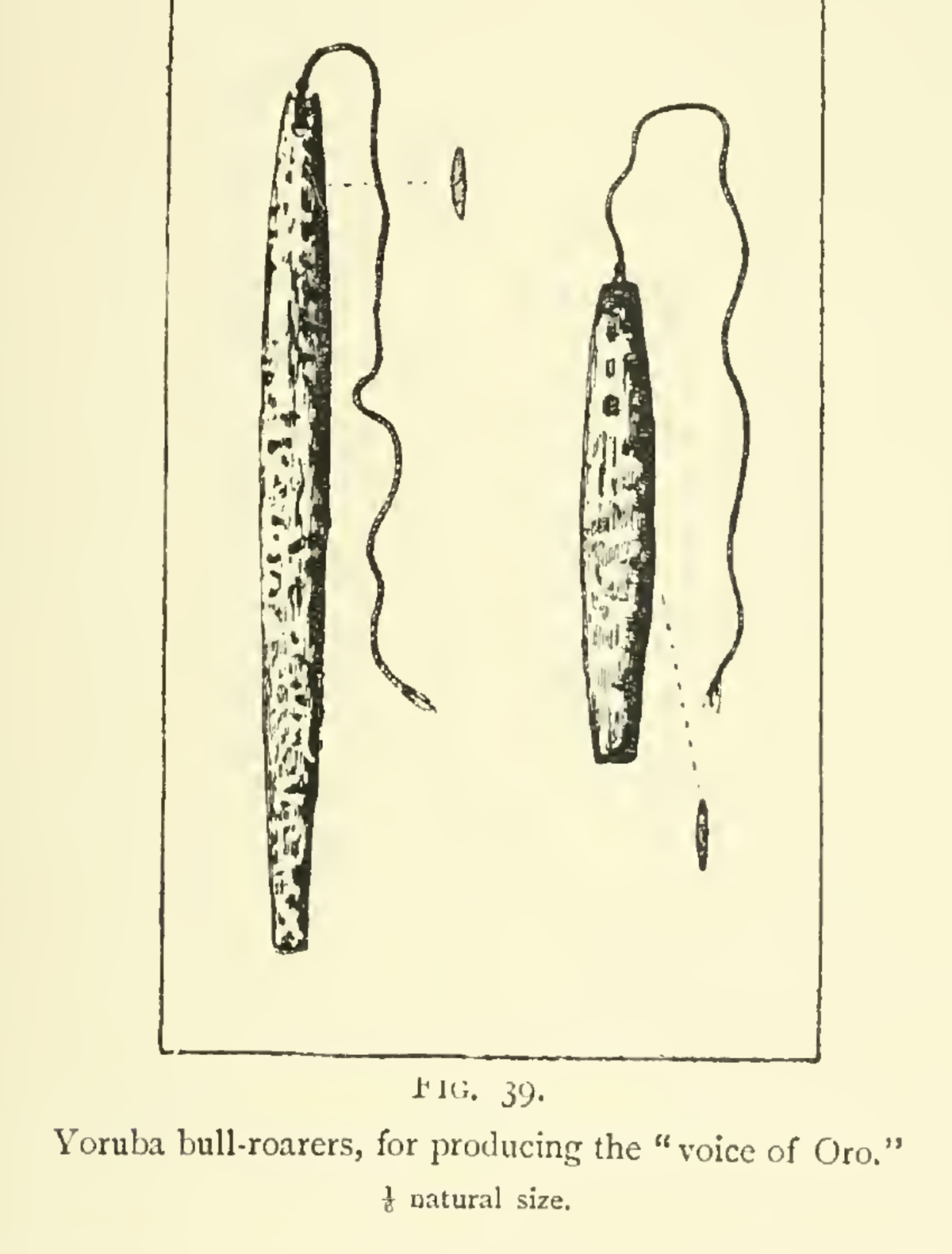
Among the Dan the iron god Goton comes out as he does among their Toura neighbours: the whirled iron speaks first, then the stilts appear. Tauxier had seen the spectacle himself - at Bouafle in December 1922 he watched a troupe of Dan stilt-dancers, newly home from performing in France, and judged it very probable that these were Goton's own dancers. The Dan keep other roarers that no non-initiate may ever see; Goton is the public one, watched by women and children as he stalks out above the crowd.
Le Goton se trouve à la fois chez nos Touras et chez les Dyos ou Dans.
The Goton is found at once among our Touras and among the Dyos or Dans.
Louis Tauxier, 'La religion des Touras,' Journal de la Societe des Africanistes 1 (1931), printed p. 266
Particulars
- Object
- A piece of iron whirled at the end of a cord - the same Goton cult and object as among the neighbouring Toura, with the fetisher titled gotonzan.
- Function
- The voice of the divinity Goton announcing his own coming-out, paired with the stilt masquerade, shared by the Toura and the Dan. Women and children may see it.
Source
Louis Tauxier, 'La religion des Touras,' Journal de la Société des Africanistes 1(2) (1931): 259-280, at p. 266 and n. 2