No. MUS2026-334
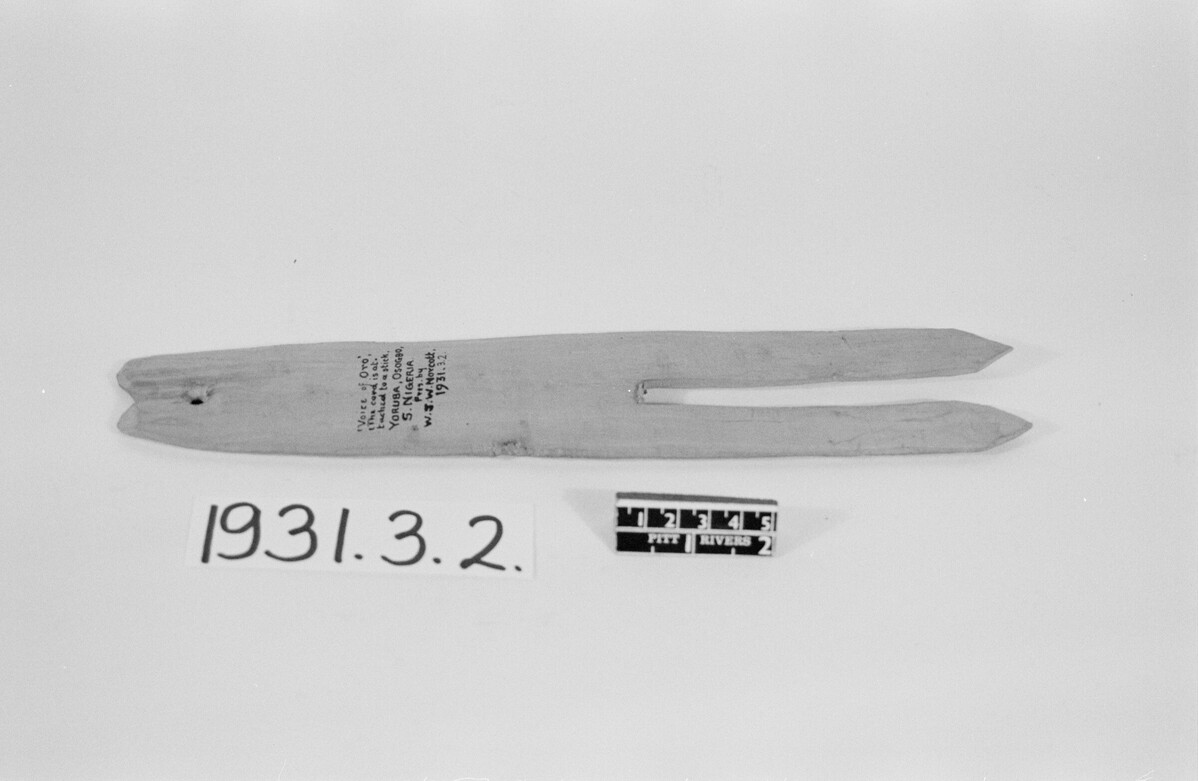
Fork-ended Oshogbo Yoruba blade
Oshogbo, Nigeria · West Africa
Sacred / spirit
Source term: Bullroarer
A deep fork splits the lower end of this thirty-centimetre blade from Oshogbo — an odd finish on an instrument usually cut as a plain slat tapering to a point at both ends. The Yoruba told Leo Frobenius how the whirring boards began. Once, when every woman in the land lay sick and could not sleep, a poor man went into the forest, cut flat boards of iroko, ire and oshurun wood, bored a hole in each and whirled it round his head. He called it Oro: it rushes, it hums. He taught his boys to swing the boards in secret, laid them on the ground of his compound as 'my great father', and poured over them the blood of rams and a dog, because a dog had once shown the great father his way home. At sunset the women bolted their doors, and the boys leapt through the dark with the boards while the people cried that the dead grandfather himself was abroad; a slender stick weighted with an old stone axe was his dog, barking now here, now there. Women may see an Oro board lying still on the ground, never one in flight.
Particulars
- Object
- A fork-ended wooden bullroarer measuring 308 × 56 mm.
- Function
- Ritual and status object; no named ceremony recorded.
Source
Pitt Rivers Museum, Oxford, 1931.3.2; Leo Frobenius, Monumenta Africana: Der Geist eines Erdteils (Weimar: Böhlau, 1929; reprint 1939), pp. 115-119 (Yoruba Oro and its origin legend)