No. SUBSAH-036
Atakpamé painted Yoruba blade
German Togoland (central plateau, Atakpame country); modern central Togo · West Africa
Function not recorded
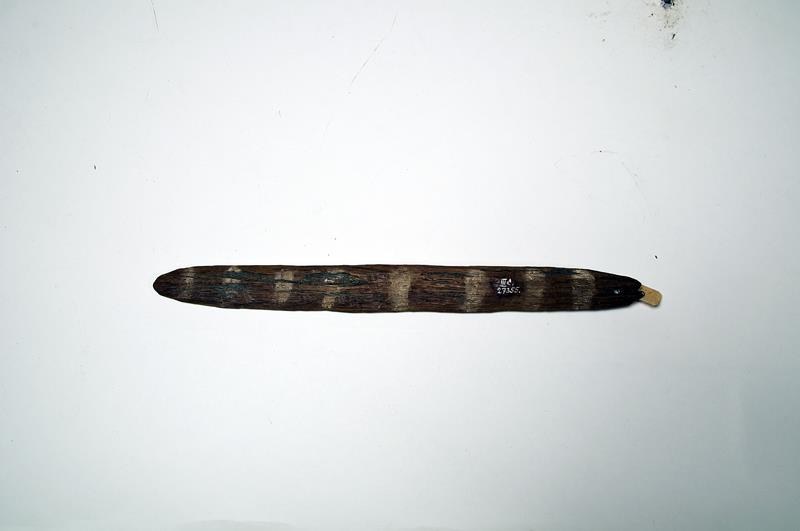
Source term: Bull roarer
Among the Yoruba the whirring blade is the voice of Orò, the ancestral spirit of judgment who appears as sound and never as a body. When it rose over a town a curfew fell -- women and the uninitiated barred their doors, for a woman who saw the thing that made the voice was said to die for it. This painted blade came out of Togoland, from the westernmost Yoruba, the Ana around Atakpamé. A Yoruba bullroarer is Orò's.
Bull roarer. Jorubas, Togoland, Africa. 279049. Collected by Leipzig Museum of Ethnology.
The Exhibits of the Smithsonian Institution at the Panama-Pacific International Exposition, 1915, p. 59
Particulars
- Object
- A painted bull-roarer in the Smithsonian's ethnology collection, exhibited in 1915 among African musical instruments as "Bull roarer. Jorubas, Togoland."
- Function
- Function not recorded; the object is classed only as a musical instrument in the museum index and the 1915 exhibition catalogue.
Source
Smithsonian National Museum of Natural History, Department of Anthropology, catalog E279049-0, "Bull Roarer" (accession 055702, 1913). Published in The Exhibits of the Smithsonian Institution at the Panama-Pacific International Exposition, San Francisco, California, 1915 (Smithsonian, 1915), p. 59: "Bull roarer; Jorubas, Togoland, Africa. 279049. Collected by Leipzig Museum of Ethnology."