No. AFR-004
Verre Momi Do'os harvest bullroarers
Nigeria · Adamawa · Cholli Verre region · Africa
Restricted
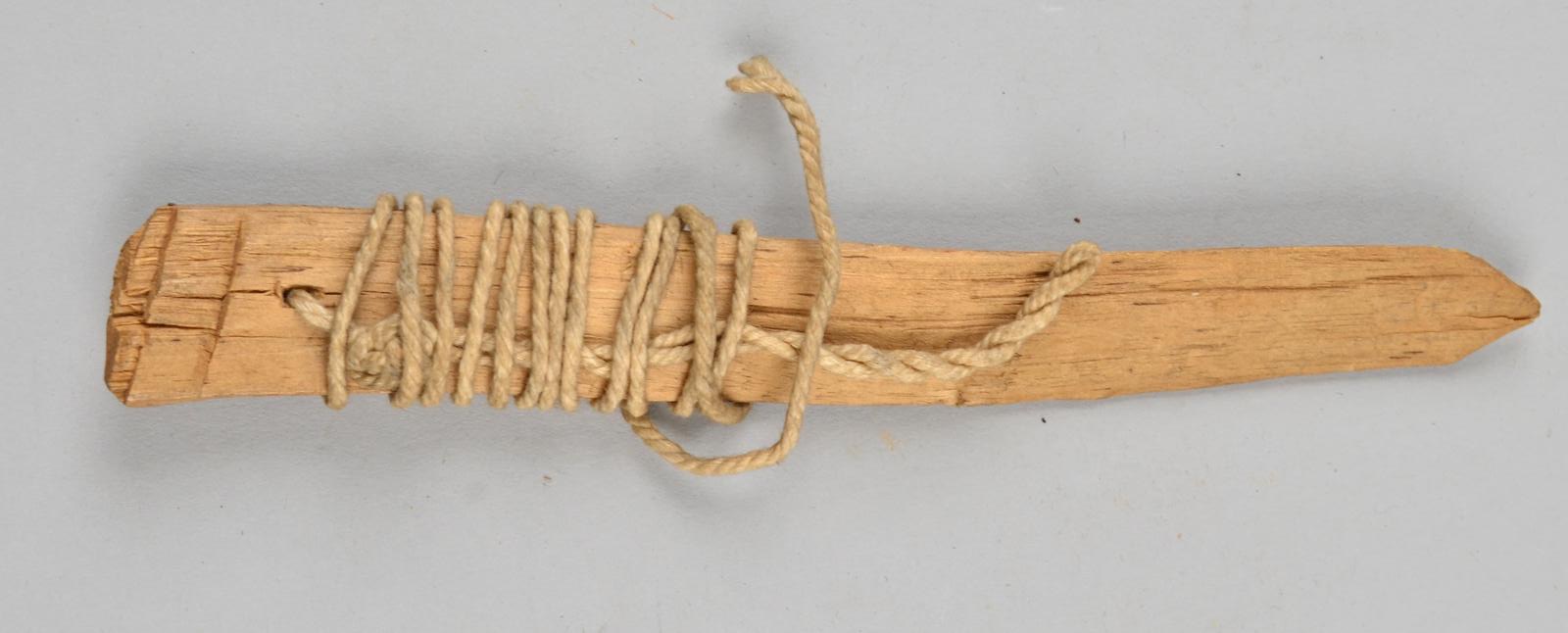
baranga; Nenga Kabusum
Source term: baranga; wooden bull-roarers
baranga (pl.): the Verre term for the metal and wooden bullroarers kept among the Do'os cult objects, whirled at the night harvest rite Nenga Kabusum.
Among the Verre of Cholli, a settlement of smiths in the Adamawa highlands of Nigeria, the cult house called lug Do'os held five things: a stone inside a skin bag, a long deep-throated wooden horn, animal-horn pipes, iron ceremonial instruments, and bull-roarers of metal and wood known as baranga. The wooden ones were whirled in Nenga Kabusum, a penultimate stage of the harvest-cycle of festivals that took place at night, "when the Do'os 'takes hunger and throws it away into the bush'"; women had to remain indoors throughout, while the men beat stones, gourds, and pots and sounded the bull-roarers in the dark. Do'os was the men's cult complex held to be the direct source of good crop yields, health, and age-grade status — "secret from women and children," in the words of Clement Wiu, a Verre seminarian who wrote on it for a theology thesis. An earlier observer, C. K. Meek, had recorded the smiths' night rites in his 1931 account, when whirring iron bull-roarers and iron rattles accompanied the horns — instruments Meek judged identical to those of the neighbouring Chamba Leko voma cults. Tim Chappel collected from this community in 1966.
The things used for worship and sacrifice are also do’os, the things used are also gods because they are to be kept secret
Clement Wiu (2000), quoted in Chappel, Fardon & Piepel 2021, "Surviving Works: context in Verre arts," Vestiges 7(1), p. 79
Particulars
- Object
- Wooden bullroarers are whirled in Nenga Kabusum, a nocturnal harvest-cycle rite of the Do'os complex.
- Function
- Whirled at night in the Do’os harvest rites, when hunger is thrown into the bush; Meek found the baranga specially employed in rain-making rites.
Sources
- Chappel, Fardon and Piepel, “Surviving Works: context in Verre arts,” Vestiges 7(1) (2021), chs. 1.1 and 1.3, glossary app. 3; Clement Wiu (2000), quoted at p. 79 View · archived
- C. K. Meek, Tribal Studies in Northern Nigeria (1931), vol. I, p. 434
- Roger Blench with A. C. Edwards, Dictionary of the Momi Language (draft, 1988), via Chappel, Fardon and Piepel (2021)
- Roger Blench, “Power and the environment in Momi [Vere] society” (draft typescript, 1993), via Chappel, Fardon and Piepel (2021)