No. TALBOT1926-003
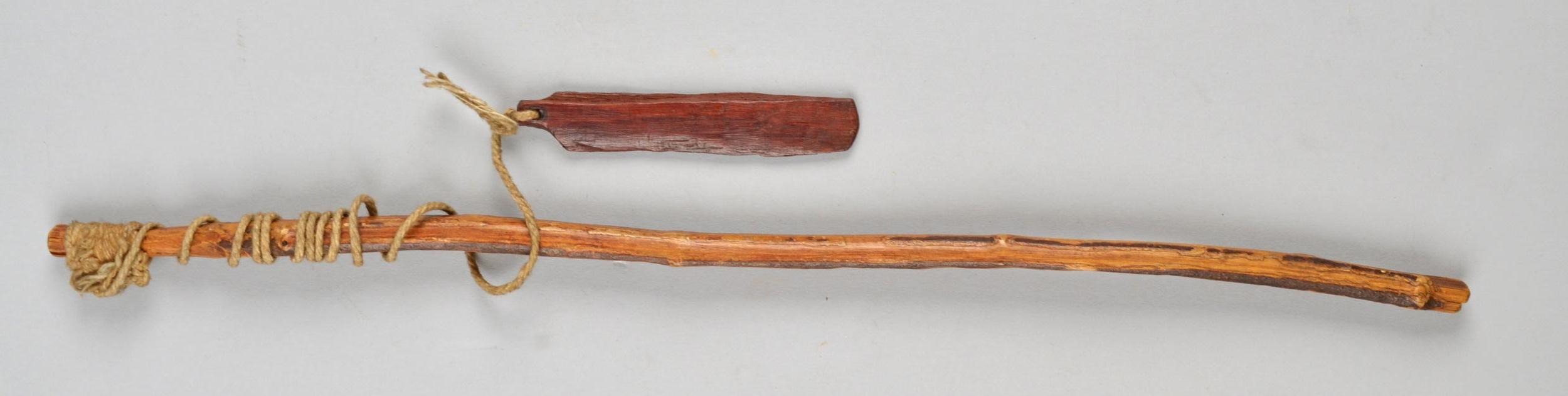
Lower Ijaw Noin-nama bull-roarer
Nigeria · Central Niger Delta · Ijo (Ijaw) country · West Africa
Restricted
Noin-nama (the cult)
Source term: Noin-nama
Noin-nama: the juju/cult of the Beletiama people at Brass; Tepowa states it is "equivalent to the Yoruba term Oro." Aiye: the prince's name in the origin story, and per Tepowa also 'wealth or opulence'. Iya: his dog's name, and also 'sorrow or misfortune'.
The Ijo lived by the water of the Niger Delta, moving through the mangrove creeks between fishing camps, and bound themselves into societies: the Sakapu that staged the great Owu water-spirit plays, the Peri of the manslayers, the Suku Ogbo of men who had made the pilgrimage to the Aro oracle. Among them, at Brass, the Beletiama kept the juju called Noin-nama, and the Brass people at large swore their oaths on it — the same thing, said Adebiyi Tepowa, who saw it played, that the Yoruba call Oro. To explain its beginning, Tepowa told this story. A certain king had one son, Aiye, whom he doted on. Aiye was a hunter, and he had a dog named Iya that would not leave him. One day Aiye shot an animal and the dog ran it down with his master behind him, and both of them went into a ditch they could not climb out of, and died there. The town searched five days. When they found them the bodies were dreadfully burnt, and nobody could think how to tell the king. The old men sat in council, and one of them, a farmer, made a thing: a strip of wood a foot long and half an inch broad, holed at one end, corded to a stick three yards long. Swung, it vibrated and made a dreadful noise, and the noise was to be read as a sentence — Aiye jona pelu Iya, Aiye and Iya are both burnt to death by fire. The king was asked to come out in state, and came, with his wives. The deputation processed, one man twirling the farmer's contrivance, and at the sound the women fled into the houses. No woman has been allowed to see the play of Noin-nama since. The old farmer finished his errand by comforting the king with the other meaning of the two names: Aiye is wealth, Iya is sorrow, and in this world they walk always hand in hand.
By means of the old farmer’s simple contrivance, the king was able to read the full meaning of the information conveyed.
Adebiyi Tepowa, "A Short History of Brass and Its People," Journal of the African Society VII (1907), p. 72.
Particulars
- Object
- In Tepowa’s origin story, a wooden strip 9–12 inches long and half an inch broad, holed at one end and corded to a stick two or three yards long.
- Function
- Sounded at Noin-nama rites and used by the Brass people for oath-swearing; women were forbidden to see it played. In Tepowa’s origin story, its sound carries a Yoruba sentence announcing a death.
Source
Adebiyi Tepowa, 'A Short History of Brass and Its People,' Journal of the African Society 7(25) (1907): 32-88, at pp. 71-72; P. Amaury Talbot, The Peoples of Southern Nigeria (1926), vol. 3, p. 765