Orò could take possession of a Yoruba town: doors closed, the Ogboni council acted, and an unseen power carried away the condemned. Its origin stories turn on a hunter’s flesh, a king’s hidden wife and a woman who heard a wood chip whizz. The Wéménu of Benin carried it into their river villages as Lo, and in Cuba it lived on as a secret devotion whose roarers were often carved to stay silent.
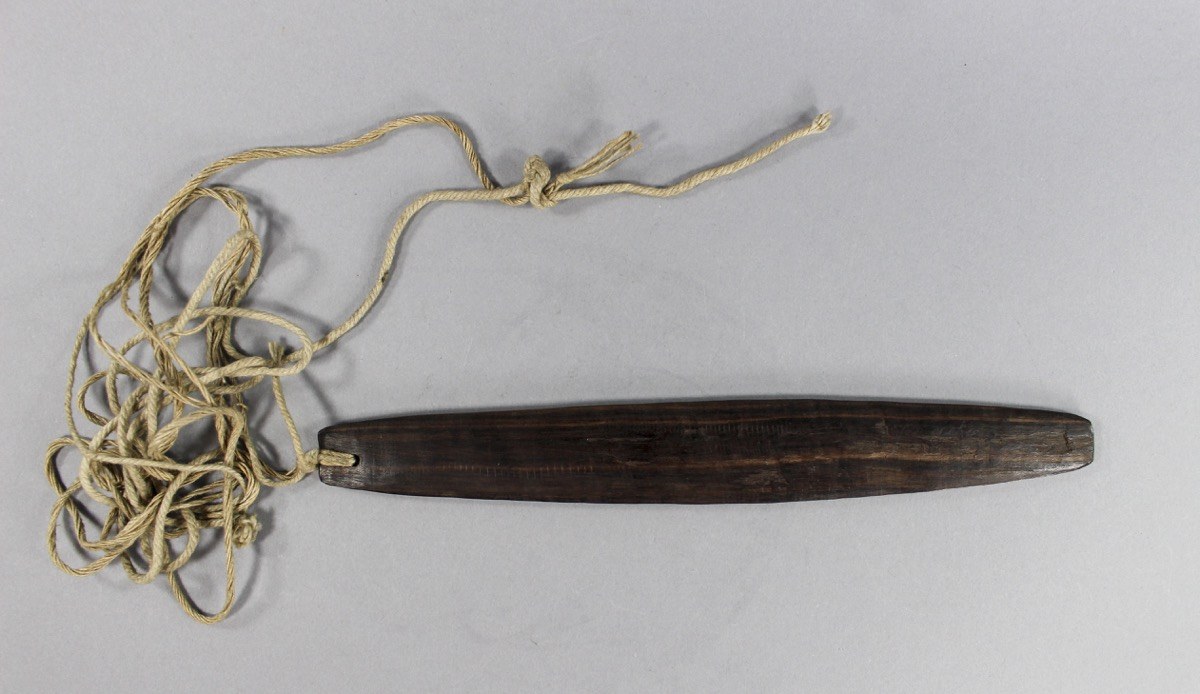
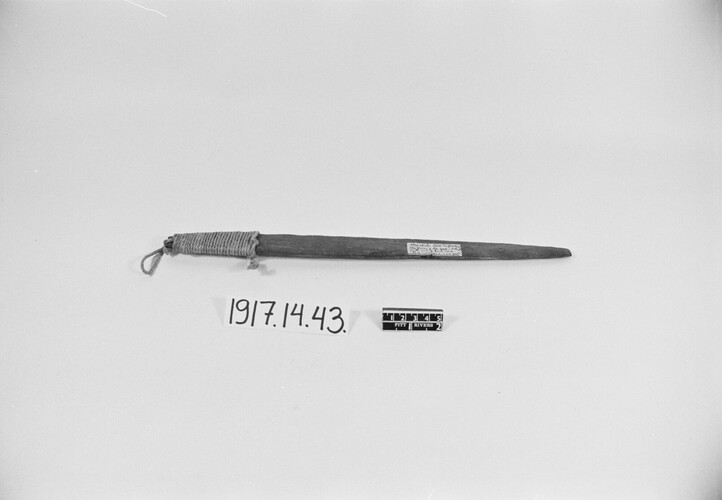
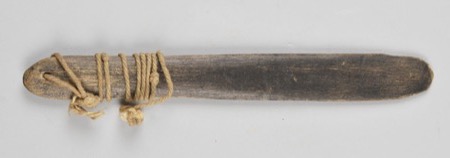
Yoruba countryThe Abeokuta 'Voice of Oro' itself — a small dark blade on its long tangled fibre cord, its paper label still reading 'The Voice of Oro'.Egba (Yoruba)The 'Voice of Oro': an Egba bull-roarer from Abeokuta.
A king wants his beloved wife to hear what men hear in the grove. He has a chair built with a hiding place inside and carries her to the ceremony. But the piece of the hunter Orò’s flesh, which always cries when it is whirled on a thread, makes no sound. The elders break open the chair. Even a king cannot carry his wife into the secret. 2
In the Yoruba towns of southwestern Nigeria, the approaching roar made women shut their doors and stop looking out. Orò acted for the Ogboni council. A condemned person could vanish into its custody, and clothes hung high in a tree told the town that Orò had carried the body away. 1
Each town kept its own calendar. At Ondo, Orò Doko lasted three lunar months: every ninth day the women stayed indoors from dawn until noon while the men went through the streets with roarers, drums, singing and dancing, and stray dogs and fowls became the company’s feast. At Abeokuta, the granite height of Olumo was sacred to Orò. 1
In one Yoruba legend, six men settle in a place already haunted by a terrifying cry, and their children die despite every sacrifice. Orò arrives as a hunter and says the place is his. He has them clear a meeting ground and bring food every seven days. At last he explains the cry: it is his own. Too old to keep making the journey, he cuts flesh from his forearm and gives it to the men. Pierced and whirled on a thread, it will cry like him, being part of him. After each ceremony they must bury it in the grove. The children stop dying. 2
The king’s hidden wife breaks the bargain. When the chair is opened and the flesh swung again, the thread snaps and the flying fragment cuts her throat. It returns to the hunter to report the breach. Orò cuts a stick, ties a string to it and leaves the wooden substitute in the ground before he withdraws from the world. He went into the camwood tree, the teller adds, and so camwood is the wood for the instrument. 2
Another telling starts at Orun, an Egba town. A woman splitting firewood sends a chip flying, and its whizzing catches her ear. She shows it to her husband, who works it into the instrument with his companions. Among Orun people resettled at Abeokuta, a woman still heralded the annual Orò festival: the society whose secret men keep from women was opened by a woman. 2
Orò also kept the dead. At Olokemeji, women mourning the hunter Ogbola stamped and sang that their father had gone and they were looking for him. The Orò funeral rite made a dead person into an ancestor who could be called on later, and a tree stripped of its leaves, with cloth hung high above, marked the spirit’s passage. 2
The lower Ouémé valley in Benin was built by refugees: Yoruba, Aïzo, Adja-Fon and Tofinu movements that became the Wéménu. Some villages stood on piles over the water or lined the riverbank; others followed the foot of the plateau. They never formed one polity, and lineage heads, cults and associations competed for influence. Here Yoruba Orò became Lo. 3
Lo’s kpe was a flat wooden blade 35 to 65 centimetres long. Its uneven night roar sent people home, and women could neither see nor speak to the approaching power. Lo hunted theft from crops and fish holes and people accused of sorcery. It could close whole villages for days and force lineages to perform ceremonies they owed their dead. The men’s society drew its strength from dead women, above all women who had died violently or been called witches. 3
A married Wéménu woman still belonged to her father’s lineage and had to attend its funerals, staying away a week or several months. Funerals were a chance to meet old friends, take a lover or begin another marriage. A husband who felt his place slipping could call on Lo. Its members demanded public confessions, asou xixa, and fines. 3
In Cuba the Orò cult crossed into orisha worship. The company that had executed criminals and witches for the councils of Yoruba towns became a secret devotion, Oru or Orun. Its roarer stayed the emblem, and was often built so that it could not sound. Elsewhere on the island a roarer still sounded in funeral and dead-veneration liturgies among Africans and their descendants, rites already rarely held by the 1940s. 4, 5
Across Yoruba country, the whirring roar from the forest was the voice of Oro, god of terror and vengeance bound up with civil authority. When Oro was abroad, women shut themselves indoors on pain of death — no woman might see the bull-roarer and live. At Ondo his festival, Oro Doko, lasted three…
Among the Egba of Abeokuta, the whirring of a slat of wood swung on a cord was the voice of Oro, and when it sounded the town's streets closed: women withdrew indoors and were forbidden to look out while the men held the public space. The Ogboni council could hand a condemned criminal over to Oro,…
At night in the villages of the lower Ouémé, an uneven, mournful roar moves through the dark: Lo is out. Lo is the Wéménu form of Oro, the Yoruba men's society, and his voice is the kpe — a flat board a forearm or more long, whirled fast on its cord. At the sound every man goes home, and women…
Representative — not this record’s object · A black-stained Yoruba blade with its cord wound on.
A wooden fish, carved and tied to a cord, beats against the air: in Cuba that roar, the oro or zumbador, calls Echu Chikua bú. He is one of the many paths of Elegguá, out of Oyó, and he makes the world and ends it; he is the world's beginning, and he eats dogs. The Cuban roarer also served the…
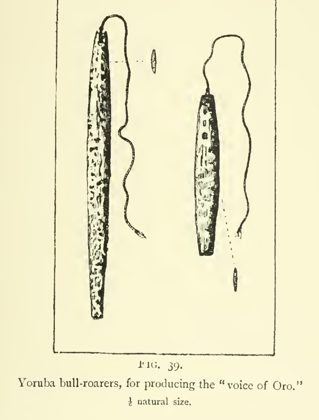
Representative — not this record’s object · Yoruba Oro bullroarers figured by Haddon in 1898.
Chapter VI, printed pp.110–112: voice, Ogboni executions, Ondo calendar and Olumo. Historical description; Ellis’s speculative reconstruction of an original male mystery is not adopted.
Pp.28–29: tree rite and funeral interpretation, Adesola; pp.45–51: Parkinson’s two legends, reprinted from Man 1906 no.66; pp.51–52 note: Orun chip-discovery account and woman herald; p.59: witnessed mourning for Ogbola. The variants remain separate.
Outre-Mers 88(330–331):269–297; pp.270–271: valley, settlement and migration map; abstract: mixed refugee society and competing authorities; pp.285–286: Yoruba origin of Lo, kpe, dead women, village closures, crops and fish holes, funeral journeys, confessions and fines.
Latin American Music Review 31(2):151–181. Published author abstract: proposed Yoruba/Cuban historical links, change from state executions to devotional cult, deliberately muted construction.
Chapter III, pp.107–128 in the cited edition; primary chapter reproduction, paragraph beginning “La bramadera se ha usado”: rare Cuban funeral and dead-veneration liturgies. Reproduction has no individual folio breaks.