No. SUBSAH-034
Imina na, the great mask
Mali · Yougo Dogorou, Bandiagara escarpment, Mopti region (French Sudan at the time of the Dakar-Djibouti mission) · West Africa
Restricted
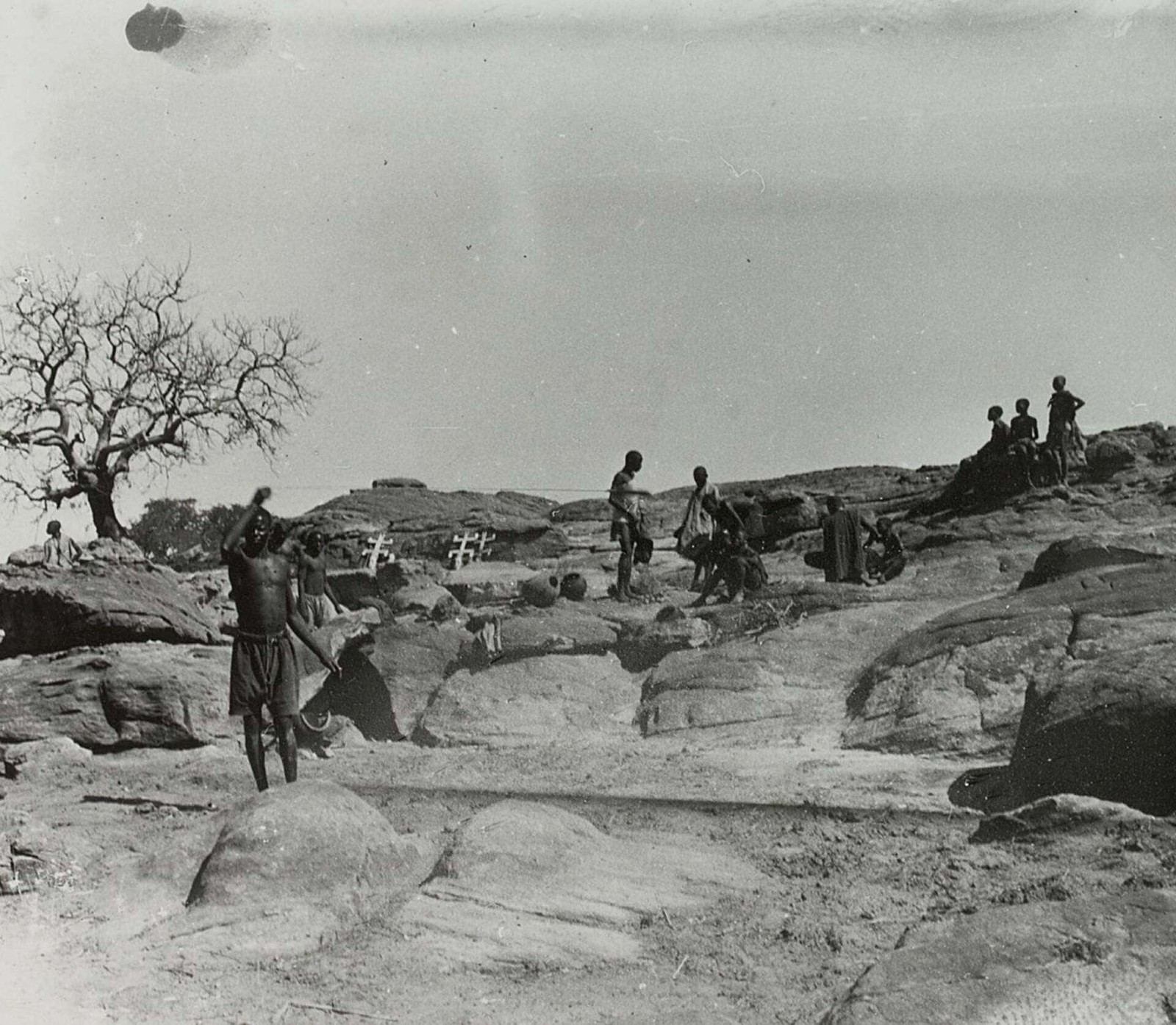
imina na
Source term: rhombe
imina na: Dogon for "great mask" (lit. "mother of masks"), the carved serpent Great Mask of the Awa society sculpted for the Sigui; imina is the Dogon word for mask.
At Yougo Dogorou the story is told of how human beings got the masks and the roaring wood. Two women of the village heard drumming and the whirring of a rhombe and crept close: the Andoumboulou, small beings of the country's first age, were dancing and drinking millet beer around an earthen mound where the great mask stood propped, an old man named Albarga sitting guard on an iron seat. One woman's husband told her to drive them off with stones, and the Andoumboulou fled, leaving everything behind — skirts, hoods, the wooden mask, and a rhombe of iron; the men seized the abandoned gear and kept it as their means of dominion over the women who had found it, and iron bullroarers are still forged now and then in memory of that first metal one. Yougo is where the masks are said to have been found, and when the sixty-year cycle comes round it is the first village to hold the Sigui. Apillèn of Yougo Dogorou told Michel Leiris that at the Sigui the newly secluded olubaréné carve a rhombe and consecrate it by laying it on the male of the two Andoumboulou altars, at the moment those altars receive their sacrifice of cocks and a dog. Through their stay in the cave they sound it; afterwards it is kept in the house of the master of the cave, and is spun again only when a man dies who has lived to see the Sigui twice. Whirled on its cord until it roars, the slat is the voice of the first ancestor, who died in serpent form; men of the Awa mask society raise its drone to open the masked ceremonies, and a man spins it at the approach of women, who must keep clear of anything to do with the masks. Its name, imina na, “great mask,” it shares with the carved serpent remade every sixty years for the Sigui, the procession that sets out from Yougo Dogorou.
Autrefois, raconte-t-il, la population de Yougo Dogolou s'élevait à trente hommes ; une femme qui se trouvait en brousse rencontra un mâle et une femelle andumbulu et leur jeta de la terre : ils s'enfuirent dans leur caverne, abandonnant leur costume de fibre rouge, ainsi que le rhombe ; la femme donna ces objets à son mari, qui construisit sur les lieux deux autels de boue séchée, l'un mâle, l'autre femelle, auxquels on donne le nom d'andumbulu.
Long ago, he says, the people of Yougo Dogorou numbered thirty men; a woman out in the bush came upon a male and a female Andoumboulou and threw earth at them: they fled into their cave, leaving behind their costume of red fibre and the bullroarer too; the woman gave these things to her husband, who built on the spot two altars of dried mud, one male, the other female, which are called Andoumboulou.
Apillèn of Yougo Dogorou, in Michel Leiris, 'Rhombes dogon et dogon pignari,' Bulletin du Musée d'Ethnographie du Trocadéro 7 (1934), p. 10 n. 14
Particulars
- Object
- An enye-wood blade with sisal-fiber cord, 44.5 x 4.5 x 4 cm, made by Ambara Dolo as a reconstruction of the great bullroarer of Yougo and acquired at Yougo Dogorou on 11 November 1931 (Quai Branly 71.1931.74.1994).
- Function
- A whirled slat sounded by men of the Awa mask society; the Dogon hear its roar as the voice of the first ancestor, who died in the form of a serpent and from whom all Dogon are descended. It announces the masked ceremonies that culminate in the Sigui, the once-in-sixty-years rite whose procession sets out from Yougo Dogorou.
Sources
- Musée du quai Branly – Jacques Chirac, Lacharrière collection, “Black monkey” zoomorphic mask notice View · archived
- Musée du quai Branly – Jacques Chirac, object 71.1931.74.1994 / ccObjectID 212084, Mission Dakar-Djibouti View · archived
- Michel Leiris, 'Rhombes dogon et dogon pignari,' Bulletin du Musée d’Ethnographie du Trocadéro 7 (1934), p. 10 n. 14 (Apillèn of Yougo Dogorou)