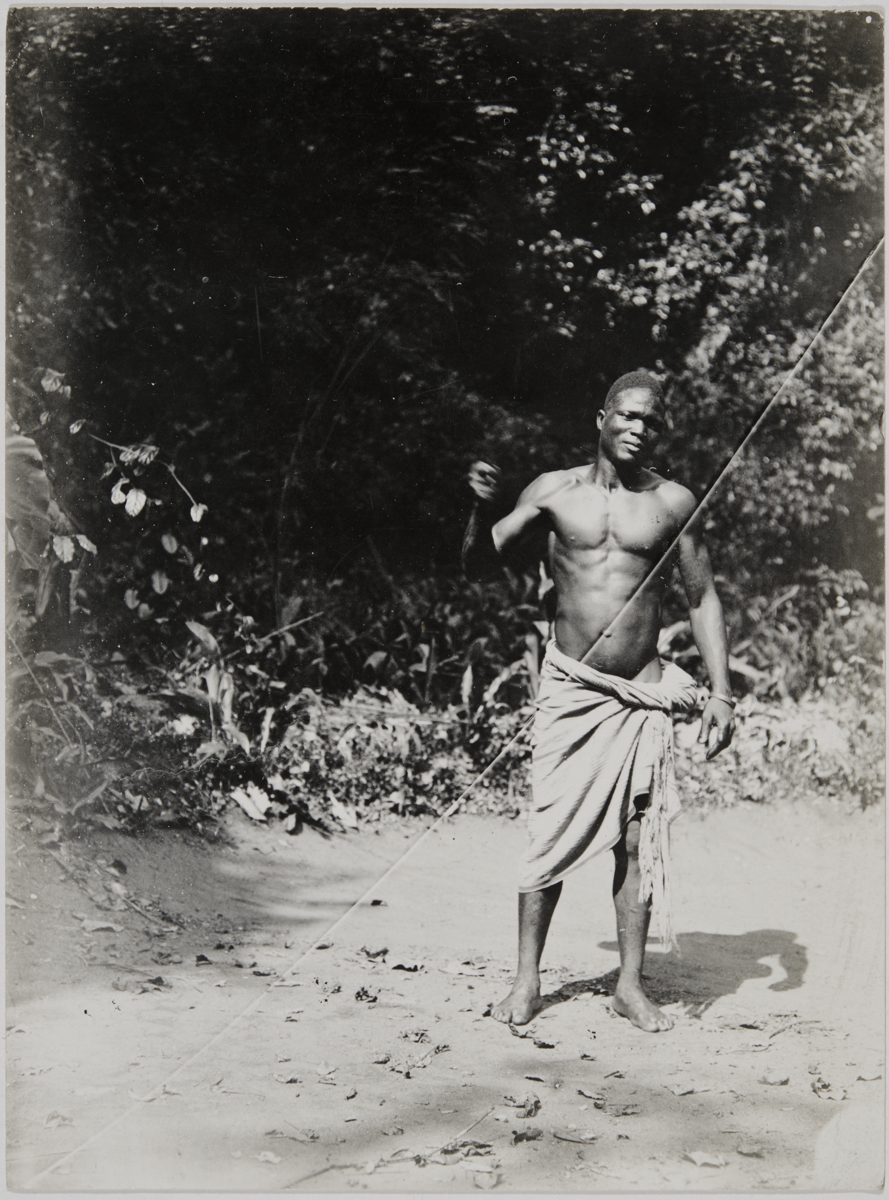
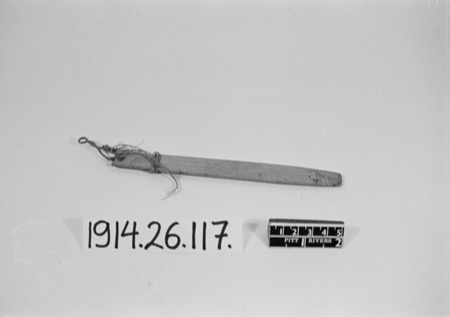
A voice approaches from the forest, and the people who may not see its owner must get out of the way. Among the Gbunde and Ge of Liberia, the bullroarer helped make Poro authority audible beyond its sacred grove. Its sound carried the boundary of initiation into the village: outsiders heard a powerful being, while those inside gradually learned who stood behind the voice. 1
Gbunde (Schwab's spelling), Poro society · Ge (Dan), Mano-Ge border country, Poro Bush
The Big Devil has several voices
The Gbunde called the bullroarer bale wola, the devil’s voice. It belonged to a much larger sound world. The Poro Big Devil spoke in a thin, wavering falsetto through a wooden tube whose side openings were covered with spiders’ nest membranes. His singing came from three to five assistants blowing pottery whistles, accompanied by an eland horn sounded into a pot. That bass note was called the old woman or the devil’s wife. Membrane-covered cow horns, a night-bird imitation and the roarer supplied further voices. Apart from the Big Devil’s own speaking voice, the sounds were made by his escort. 1
There he flies
Several teams could make the singing travel. One was heard in a village half a mile away; seconds later the sound approached along the road, then passed into the distance and reached another settlement. Women and children hearing this rapid succession called out that the devil was flying. The apparent movement joined places into one performance. A being who could not be seen seemed to cross the countryside in moments, while an organized company of men supplied the sound. The bale wola was one voice in this repertoire, rather than the instrument that made all of it. 1
A heavy voice on the night path
In the Ge account, vu ni had a narrower and more frightening office. He played only inside the Poro Bush and spoke with a heavy voice. When the pupils walked about at night, his bullroarer sounded loudly enough for everyone to hear and leave their path. Even the boys under instruction could not see him until they were ready to come out. The name belonged both to the devil and to the instrument: vu ni was the voice of a Bush devil, and also the being whose presence that voice announced. 1
Knowledge comes in stages
Hearing a devil was only the beginning. In the Big Devil’s graduation scene, the boys at last saw a man they had known all their lives. He acknowledged them as his sons. The revelation changed their relationship to an authority that had previously reached them as an unseen voice. Poro instruction could therefore guard knowledge even from the pupils already living inside its grove. The enclosure separated initiates from outsiders, but time and rank determined what an initiate could know. 1
The stages differed locally. In Mano country, one account distinguished a circumcision Bush from the fuller Devil’s Bush, where scarification preceded the Big Devil’s revelation. Ge and Gio country did not have that second Bush: completing the circumcision school made a full initiate. The same regional vocabulary of Bush, devil and guarded sound could work within different courses of instruction. 1
Men without their masks
Among the Mano, vu ni was also sounded early in the Poro session, particularly at night when high-ranking men walked without masks. They told George Harley frankly that its purpose was to terrify women and keep them under control. Here the roarer protected the hidden human performers themselves. Alongside it, three or four men could make the spirit ge na sing through separate pottery whistles. A sacred voice might be a whole company, with each performer contributing a part. 2
A neighboring sound couple
Nearby in the Kono country around Lola, guèyoumo brought a whirled wooden blade together with percussion. Its male figure swung the roarer; its female figure was another man, wearing wooden clogs and beating two wooden blocks against the ground. Both performers, as well as the blade, bore the name guèyoumo. The ensemble resembles Poro’s way of giving a spirit several human contributors. Holas treated it as a separate institution: Holas’s informants disputed a role in Poro ceremonies, although an uninitiated man who saw it could be compelled to join the next Poro intake. 3