No. BABALOLA2026-001
Iya l’Orò greets each Orò by name
Benin · Former Sàbé (Savè) kingdom: Kilibo (Ouèssè commune, Collines) and Kaboua (Savè commune) · West Africa
Restricted
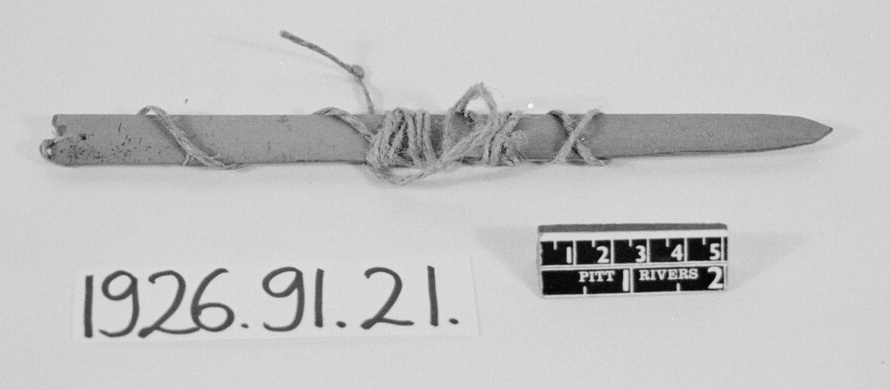
Orò
Source term: spatule ... fit tournoyer en l’air (origin story)
Iya l’Orò (Iya loro): “Mother of Orò,” the woman of the society who receives the visiting Orò. oriki: praise poem. Akunyun: “father of the Orò.” Fa: the Fon and Yoruba divination oracle (Ifa).
Bound to split wood for a half-human creature of the forest, a hunter struck a dead tree seven times, and at the seventh blow a chip flew off with a terrifying noise. The women in the fields and at the stream fled. A hunter who saw it took the chip, tied a cord to it, hid behind a thicket outside the village at nightfall and whirled it, and now the men fled too. Fa, the oracle, declared it a kindly god who would drive every evil spirit from the village: so, in one telling, Orò was born, the spirit of the wind. In Benin’s Sàbé country the Orò still visit their Mother, Iya l’Orò, who greets each one with its own praise poem. At Kilibo in 2013 a 65-year-old Mother of the society recited hers to Akunyun, father of the Orò, who uproots a tree without a leaf falling and comes in through the roof to carry off a witch: “wind that cries here, cries over there.”
Celle-ci accueille chaque Oro par la déclinaison de son « oriki ».
She welcomes each Orò by reciting its praise poem.
Babalola and Yayi 2026, p. 68
Particulars
- Object
- A chip of wood tied to a cord and whirled in the air, in the Orò origin story; no local object is described.
- Function
- Voice of Orò, the wind spirit, during the annual cult; in Sàbé the Orò visit Iya l’Orò, the Mother of Orò, who welcomes each with its praise poem; the cult purifies the community and drives out evil spirits and sorcerers.
Source
Babalola Oba-Nsola Agnila Léonard Clément and Yayi Bio Sourou Oladélé, “Pour une herméneutique des oriki de la divinité Oro” (Éditions Francophones Universitaires d’Afrique, 2026), pp. 64-84