No. BAYILI1998-001Africa
Voice of the Lyela night masks
Burkina Faso · Réo, Sanguié province, central-western Burkina Faso · West Africa
Restricted
- Spirit voice
- Death and rebirth
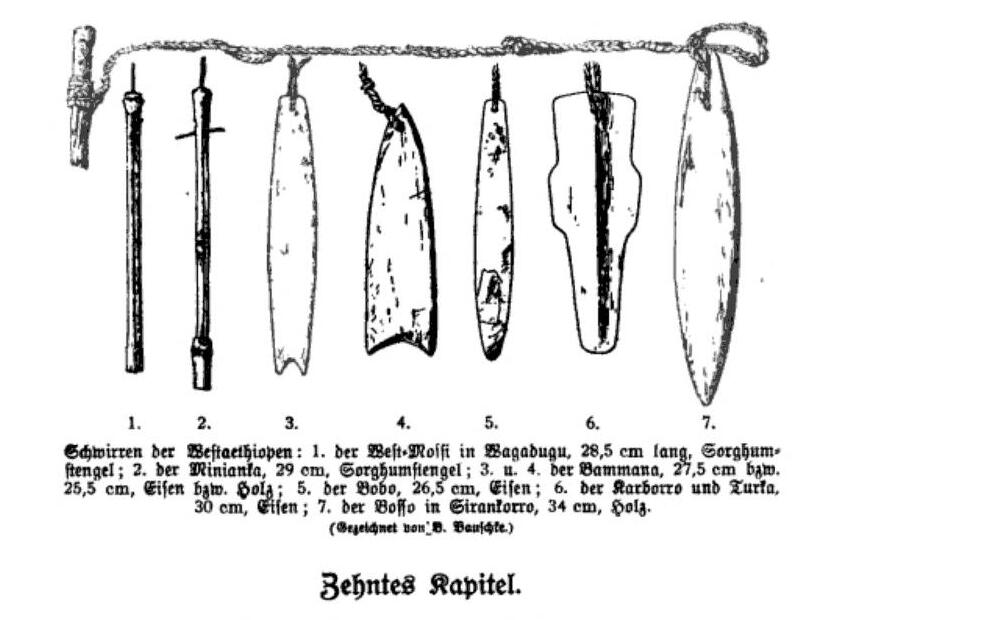
Source term: rhombe
nyannɛ nábá: "mother masks", also called shishɔn nyannɛ, "night masks"; the rhombe is their voice.
Masks come from the bush. The elders of Goundi tell how a man once surprised a bush spirit in the middle of performing the ceremonies of the mask, and forced it to share what they meant and what they could do. The masks belong to shù, the first religion of the Lyela around Réo, and the oldest and mightiest of them are made of leaves and come out only at night. They are the nyannɛ nábá, the "mother masks", and they walk at the cult's yearly commemoration, at certain funerals, and on raids to punish a wrongdoer. Their children, the small day masks, go ahead to announce them coming in from the bush. Anyone who sets eyes on them, apart from the clansmen who escort them, dies a sudden and mysterious death. No one may shine a light on them, and no one may imitate their voice, the roar of a blade whirled on a string. In a sense they are the first form of God himself, Yi.
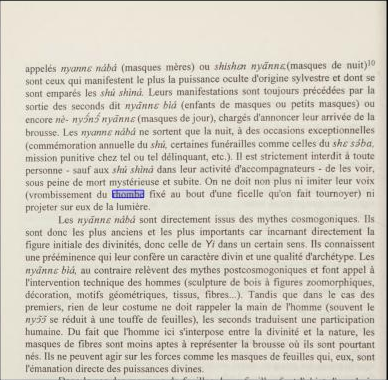
On ne doit non plus ni imiter leur voix (vrombissement du rhombe fixé au bout d'une ficelle qu'on fait tournoyer) ni projeter sur eux de la lumière.
Nor may anyone imitate their voice (the roar of the rhombe fixed to the end of a string that is whirled) or shine a light on them.
Blaise Bayili, Religion, droit et pouvoir au Burkina Faso (1998), p. 244
One more plate
Particulars
- Object
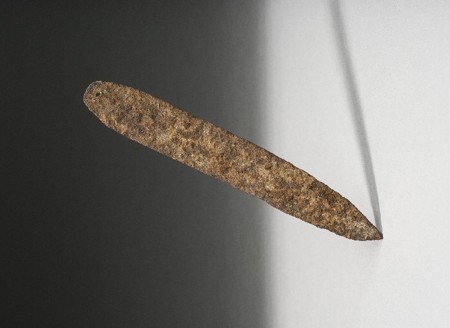
- A rhombe fixed to the end of a string and whirled; a ritual object of the night masks alone.
- Function
- The voice of the nyannɛ nábá, the night masks of the shù cult, which come out for its annual commemoration, certain funerals and punitive raids; anyone outside the owning clans who sees them dies.
Discussed in one essay
 The Bullroarer’s Younger Brothers
Source
Blaise Bayili, Religion, droit et pouvoir au Burkina Faso : les Lyèlé du Burkina Faso (Paris: L'Harmattan, 1998), pp. 244–245; Pierre Bamony, « Anthropologie de pratiques culturelles chez les Lyéla du Burkina Faso : activités socio-économiques et loisirs » (pierrebamony.com, 18 October 2019), section « e) Masques et sculptures »,
Nearby in the atlas
 Bobo, the hornbill's giftsBurkina Faso · Bobo-Dioulasso region, western Burkina Faso · Restricted
 The buffalo's bellow that announces DyoroBurkina Faso · Lobi country on the Black Volta (Gaoua, Batié), Upper Volta / Burkina Faso · Restricted
 Patamaso’s iron from the termite moundBurkina Faso · Patamaso, Bobo country, western Burkina Faso · Restricted
 Solenzo Do, the smith's voiceBurkina Faso · Solenzo commune, Banwa Province, Boucle du Mouhoun · Restricted
 Dorhosie Zorhogo, the iron that hunts sorcerersBurkina Faso · Cercle de Bobo-Dioulasso, former Haute-Volta / French Sudan · Restricted
- Gan sᴐrᴐ, the voice over the face-down boysBurkina Faso · Southwest Burkina Faso / Loropeni Department · Restricted