No. SUBSAH-035
Wasman's private anti-thief alarm
Katsa, a Kede · Nupe creek-side trading village near Egga on the Niger, Bida Emirate, Niger Province, Northern Nigeria (now Niger State) · West Africa
Sacred / spirit
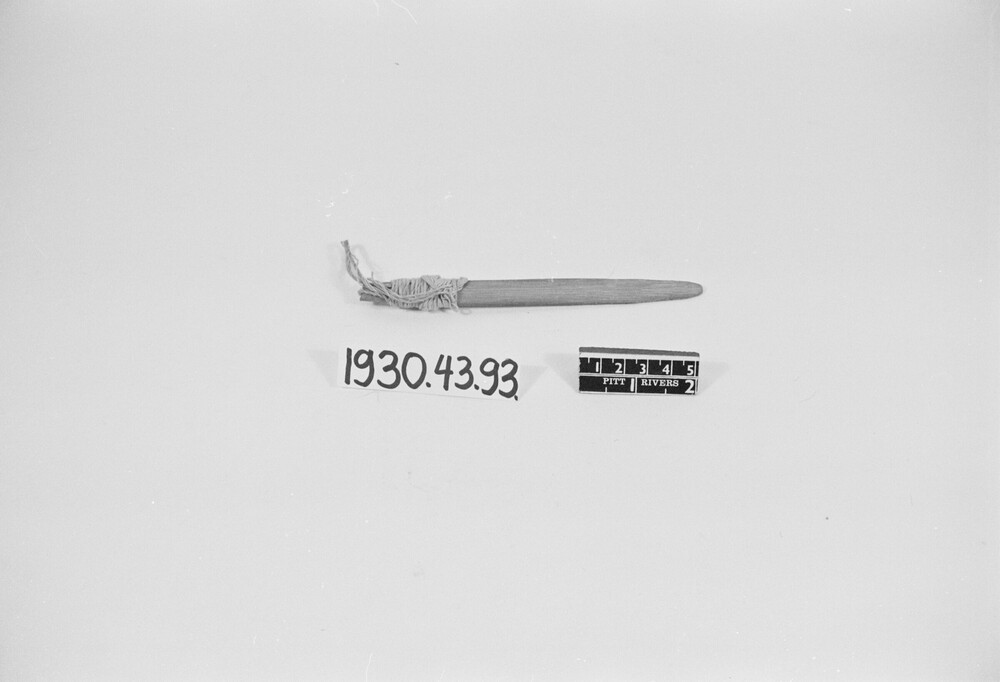
Source term: vugu-vugu
Not a vernacular word but Nadel's own coinage: while at the Gwari town of Kuta he adopted "vugu-vugu" for the bullroarer to avoid confusion between Abwagi (the rite) and Bwagi (the instrument); his Gwari hosts found it apt and soon used it themselves. The genuine Gwari terms he records are Bwagi / Bwari (the bullroarer) and Abwagi (the rite).
On the night of 2 February 1936, working among the riverine Nupe at the creek-side trading village of Katsa, the anthropologist S. F. Nadel was woken by what sounded like a bullroarer. By morning he had the story: the Yoruba watchman of John Holt's trading canteen, known locally as "Wasman," whirled a bullroarer on nights when he was afraid, its roar serving as a private alarm against thieves. Nadel noted it as a "lovely private alarm" - a sacred-sounding instrument turned to wholly practical use at a colonial trading post. The same diaries record the instrument's more familiar life two months later among the Gwari at Kuta, where the cult head whirls it in the Abwagi rite and at funerals and the people call it Bwagi; to spare confusion between the rite and the thing Nadel took to calling it "vugu-vugu," a nickname his Gwari hosts found apt and soon adopted themselves.
The Yoruba watchman of John Holt's Canteen (called "Wasman") plays the bullroarer some nights, when he is afraid, against thieves. Lovely private alarm
S. F. Nadel, Nigeria field diaries 1935-36, entry 2 Feb. 1936 (ed. Blench 2006, typescript p. 66)
Particulars
- Object
- A wooden bullroarer whose night-time roar Nadel heard at Katsa before learning its source; he never inspected the watchman's instrument itself. In the same diaries he separately handled the Gwari bullroarer at Kuta, a "Small wooden thing" the cult head whirls in the Abwagi rite and which the Gwari call Bwagi or Bwari.
- Function
- At Katsa a Yoruba migrant employed as night watchman ("Wasman") at the John Holt company's trading canteen whirled a bullroarer on nights when he was frightened, using its roar as a private alarm to scare off thieves. Nadel separately records, among the Gwari at Kuta in the same district, the ritual Abwagi/Kakayu use of the bullroarer.
Source
S. F. Nadel, Nigerian field diaries 1935-36, ed. Roger Blench (typescript, 2006), entries for 2 February 1936 (p. 66) and 16 April 1936 (pp. 125-127)