No. MUS2026-089
Bassari akotikoti
Senegal · Etyolo, Kedougou · Africa
Restricted
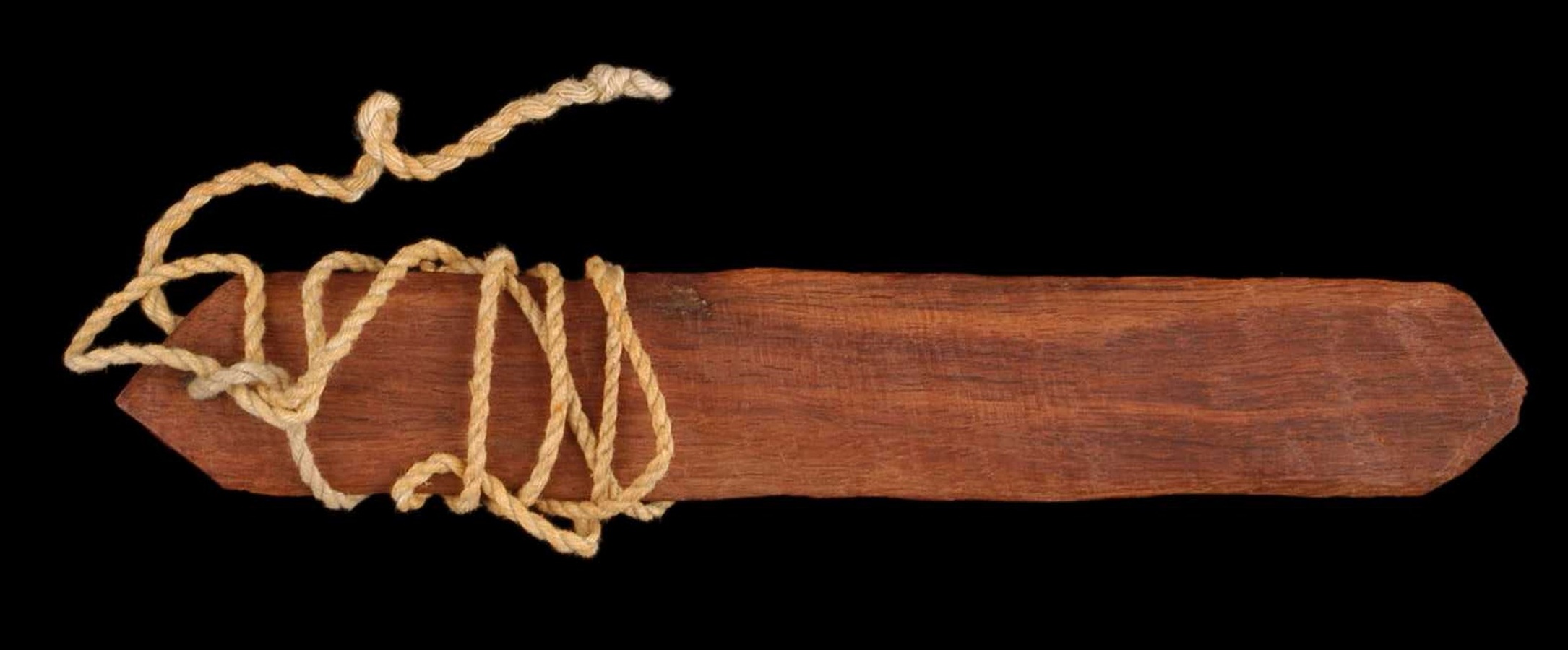
akotikoti
Source term: bull-roarer
akotikoti is the Bassari vernacular name recorded for the rhombe (bull-roarer); the museum classifies it generically as "rhombe" / "Instrument de musique."
A Bassari bull-roarer, locally called akotikoti, collected at Etyolo in eastern Senegal by the ethnographer Monique Gessain and published in the 1976 Musée de l'Homme catalogue of Bassari collections. It is a slender blade of Pterocarpus erinaceus wood, about 24 centimetres long, swung on a cotton cord. Viviana Pâques, writing of the Tenda peoples to whom the Bassari belong, records a religion organised inside the totemic clan with an initiation in which the rhombe plays an important part. The masks and flutes of the Bassari initiation cycle carry its spirit voices; the akotikoti had its own place in the same rite.
Instrument de musique.
Musical instrument.
Musée du quai Branly – Jacques Chirac, inv. 71.1988.29.25
Particulars
- Object
- Bassari rhombe from Etyolo, local name akotikoti (Quai Branly 71.1988.29.25).
Sources
- Musée du quai Branly – Jacques Chirac, inv. 71.1988.29.25 (ex-Musée de l'Homme), Bassari rhombe akotikoti, Etyolo (Kédougou, Senegal), collected and donated by Monique Gessain View · archived
- M.-T. de Lestrange & M. Gessain, Collections Bassari du Musée de l'Homme (Catalogues du Musée de l'Homme, Série C, Afrique Noire II), Paris, 1976, pp. 244–258
- Viviana Pâques, Les peuples de l'Afrique, Tenda/Coniagui-Bassari section, citing M. de Lestrange, Les Coniagui et les Bassari (PUF, 1955) View · archived