No. SUBSAH-025
Nungu
Nassarawa Province, Northern Nigeria · West Africa
Play / practical
Juju
Juju — the masked spirit and its secret dances among the Nungu, which women were forbidden to see.
Among the Nungu of the Nassarawa hill country in Northern Nigeria, the bull-roarer was heard under the din of a Juju dance. Those Juju dances women were forbidden to see. The man who represented the Juju wore a closely meshed net enclosing him from the crown of his head to the thighs, a short kilt of dried grasses, porcupine quills or pieces of grass thrust through nose and ears, and a headdress shaped like a guardsman's busby made of monkey skin; the rattles were bottle-shaped calabashes in loose string nets, strung with small pieces of bone and hard wood. Should a rattle break in the course of a dance, everything stopped until a chicken had been sacrificed to the Juju, after which the dancing resumed.
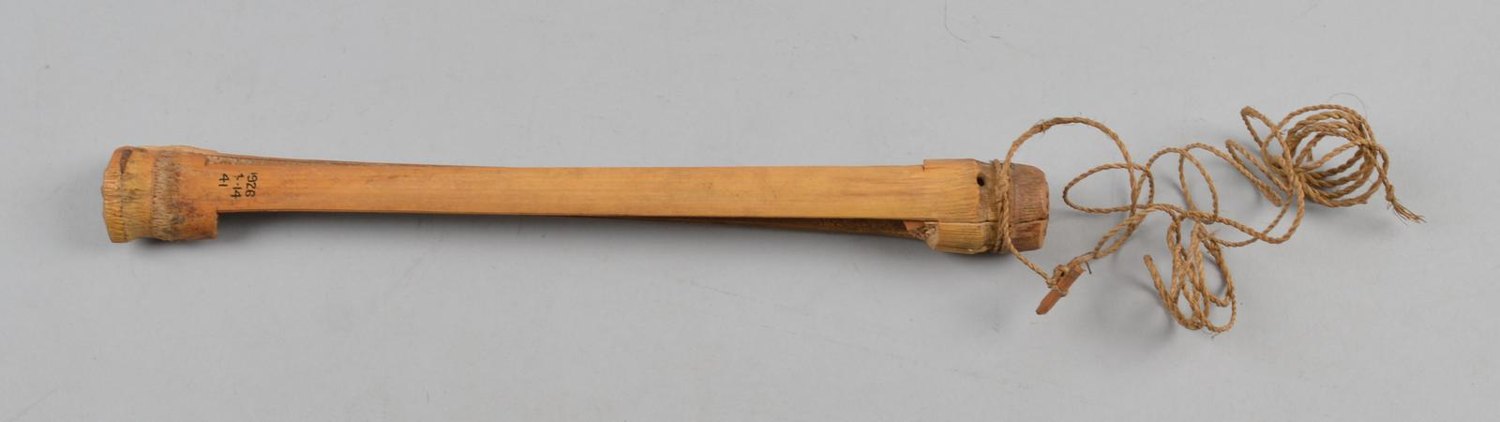
The bull-roarer is also known. I was informed that it is used only as a toy, or to scare monkeys and birds from the crops, but I have heard it in the distance, combined with all the other noises of a Juju dance, and therefore think it very probable that it possesses magical attributes.
H. F. Mathews, "Notes on the Nungu Tribe, Nassarawa Province, Northern Nigeria," Varia Africana I (Harvard African Studies 1, 1917), p. 90
Particulars
- Object
- Whirled bull-roarer; informants described it as a toy or crop animal-scarer.
- Function
- Used as a toy and to scare monkeys and birds from the crops.
Source
H. F. Mathews, "Notes on the Nungu Tribe, Nassarawa Province, Northern Nigeria," Varia Africana I (Harvard African Studies 1, 1917), pp. 83-94