No. SCHEBESTA1933-002
Balese (Kalimoholo) pahudjuhudju bullroarer
Democratic Republic of the Congo · Kilo-Geti goldfields district · Ituri Forest, Belgian Congo · Central Africa
Restricted
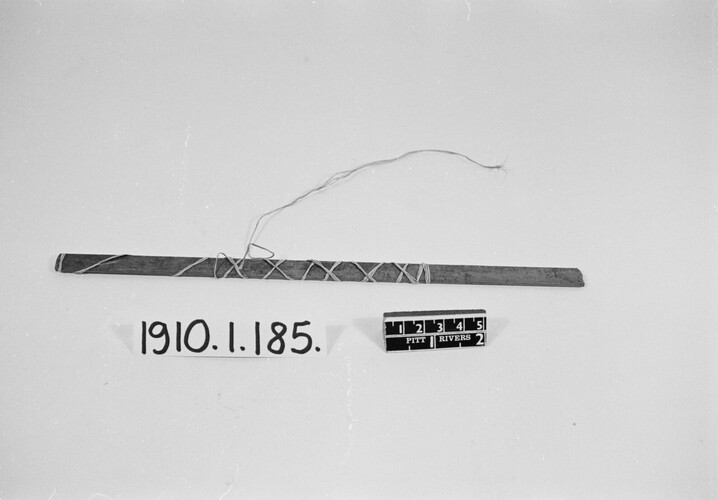
pahudjuhudju
Source term: Schwirrholz
pahudjuhudju: the Kalimoholo Balese/Efe name for the initiation bullroarer; Schebesta guessed it meant "father hudju" (hudju = grandfather, the initiation leader's assumed role while swinging it).
When a Balese wife bit her husband, the pahudjuhudju itself would start to hum in the night: she knew at once whose disobedience the sound named, and she owed her clan a gift in atonement. At Kalimoholo it took an evening of blunt questions and promised presents before the two Abitiri would stage panda, the secret initiation, for Paul Schebesta — fur caps, painted faces, green branches, a windbreak hut in the tall grass. There he learned what swung inside it. The bullroarer belonged to Tore, the god who had handed it down to the ancestors; the disguised elder, playing 'grandfather,' swung it as Tore's own voice, and the initiation boys who lived on alone in the forest were reckoned Tore's messengers, owed food wherever they hung a green branch on a hut. The novices called that elder hudju, grandfather, and Schebesta guessed the instrument's own name meant something like 'father hudju' — the roar of the god and of the ancestor in one object. He never laid eyes on the thing itself — only on everything it commanded.
Das Schwirrholz ist die Stimme Tores.
The bullroarer is the voice of Tore.
Schebesta 1933:134
Particulars
- Object
- Not recorded.
- Function
- Swung by the disguised initiation leader (abitiri, playing "grandfather") during the Balese panda initiation at Kalimoholo; called the voice of the high god Tore, who gave the instrument to the ancestors; also reported to sound at night to name a wife's disobedience toward her husband.
Source
Paul Schebesta, Religiöse Ideen und Kulte der Ituri-Pygmäen (Belgisch-Kongo), Archiv für Religionswissenschaft 30 (1933), pp. 132–134