No. EXH2026-020
Lokele bandulu
Democratic Republic of the Congo · NE Congo (Babali initiation belt) · Central Africa
Restricted
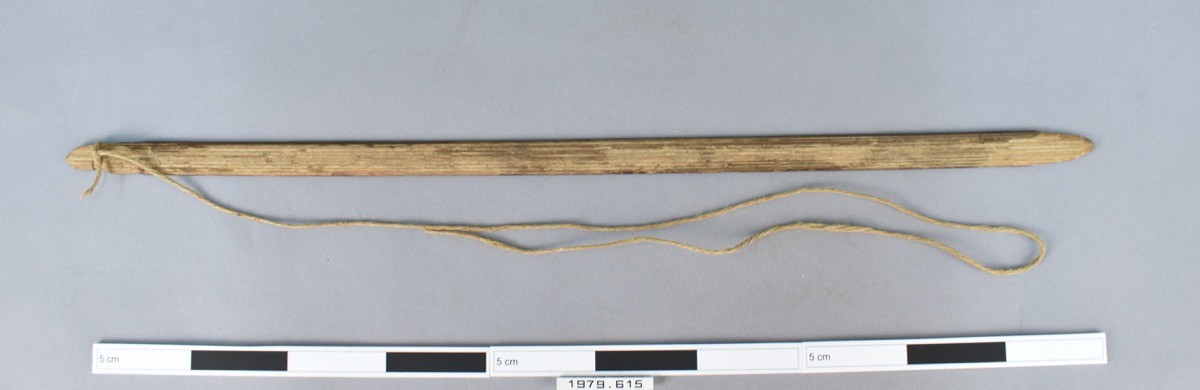
bandulu
Source term: Bandulu (rhombe)
bandulu: the Lokele name for the bullroarer sounded at circumcision, listed with the bird-pipe galagala; Moeller's table gives the Lokele no whistle.
The Lokele are the middle-Congo fishing people whose talking drums John Carrington spent decades learning to read, a language of pitch that carried news for miles along the river. Their bullroarer has a name too: bandulu, swung at the boys' circumcision, and beside it a pipe called galagala -- no whistle, where their neighbours upriver had one. Adolphe Moeller set the Lokele at the foot of a table of the Oriental Province initiations, each people with its own words for the same few instruments, and described the type under its Babali name, maduali: a simple oblong plank fastened to the end of a string, which, whirling, makes a noise like an engine roaring. The rites ran to a pattern he numbered point by point -- seclusion in an isolated place, a ban on speaking to women or to the uninitiated, practical teaching in hunting and fishing and the ways of animals, esoteric formulas, the sight of the 'spirits', the surrender by parents of their rights over their children, and the exclusion of women. Édouard de Jonghe had already counted the Lokele among the Babali's neighbours who shared the complex. Moeller supplies the word they used for it.
Tous ces points sont communs au mambela des Babali et à l'initiation des peuplades pratiquant la circoncision.
All these points are common to the mambela of the Babali and to the initiation of the peoples who practise circumcision.
Moeller 1936:551
Particulars
- Object
- A simple oblong plank of wood fixed to the end of a string and whirled in free air. Moeller describes the type-object under the Babali name maduali and states that his table names the same three instruments in other tongues; no Lokele specimen is described, so material, dimensions, cord and perforation are unrecorded.
- Function
- Sounded at the boys' circumcision rite, listed with the bird-pipe galagala and no whistle; one of the 'spirits of initiation' that initiates were forbidden to speak of to the uninitiated, in a rite whose shared features included seclusion in an isolated place, a ban on speaking to women, and the exclusion of women.
Source
A. Moeller, Les grandes lignes des migrations des Bantous de la Province Orientale du Congo Belge (Bruxelles, 1936), pp. 551-552; E. de Jonghe, 'Formations récentes de sociétés secrètes au Congo belge,' Africa 9(1) (1936), pp. 62-63, quoted in Bertil Söderberg, Les instruments de musique au Bas-Congo et dans les régions avoisinantes (1956), pp. 184-185