No. SUBSAH-014
Fang (Pangwe)
Rio Muni · N Gabon · S Kamerun · Central Africa
Sacred / spirit
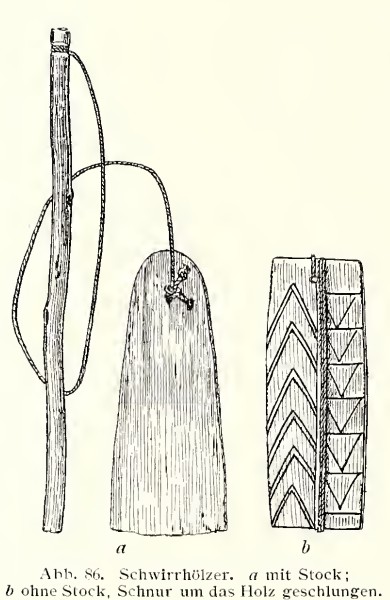
edžībŏ'ngo (Kinderfresser / child-eater)
Etymology. edžībŏ'ngo is literally child-eater; the Fang name for the bullroarer is shared with the devouring bogey of children's tales.
Among the Fang of Rio Muni, northern Gabon, and southern Cameroon, the bullroarer was called edžībŏ'ngo, the child-eater. Günter Tessmann, who recorded it during the 1907-1909 Lübeck Pangwe expedition, placed it in his chapter on raising children, among the Schreckmittel — things to frighten the small ones. Its uncanny droning, he wrote, was an even more effective fright-device than the stamping, clapper-struck noise-stick: men and older boys used it to terrify the younger ones. The same name belonged to a devouring bogey, the Edschibongo of the tales mothers told, which kept children in fear and instructed them at once. Tessmann's plate (Abb. 86) shows two forms — one mounted on a stick, the other a bare slat with the cord wound around the wood.
Das Verfahren besteht darin, daß abends oder nachts ein Verwandter vor dem Hause irgendwelchen Lärm macht. Der Kleine, der unartig ist oder schreit, wird dann von den Leuten vor dem bösen Manne dort draußen gewarnt.
The method is that in the evening or at night a relative makes some kind of noise in front of the house. The little one who is naughty or crying is then warned by the people about the bad man out there.
Tessmann, Die Pangwe, Bd. II (1913), p. 287
Particulars
- Object
- A flat whirled slat of wood on a cord.
- Function
- Its uncanny booming is used by men and older boys to scare the little ones, as the dreaded child-eater bogey.
Source
Tessmann, Die Pangwe, Bd. II (1913), Abb. 86