No. AFR-005
Dii panther-rhombe of the circumcision bush
French Cameroon · Adamaoua highlands · Africa
Restricted
Jer
Source term: svirrebrett; Jer
Zág: panther, in Dii — the animal the rhombe's roar was said to be, and also the name given to the circumcision knives. Jer: the name the Bergen museum catalogue gives this blade. Svirrebrett: the Norwegian museum-catalog word for a bullroarer, literally "whirring board".
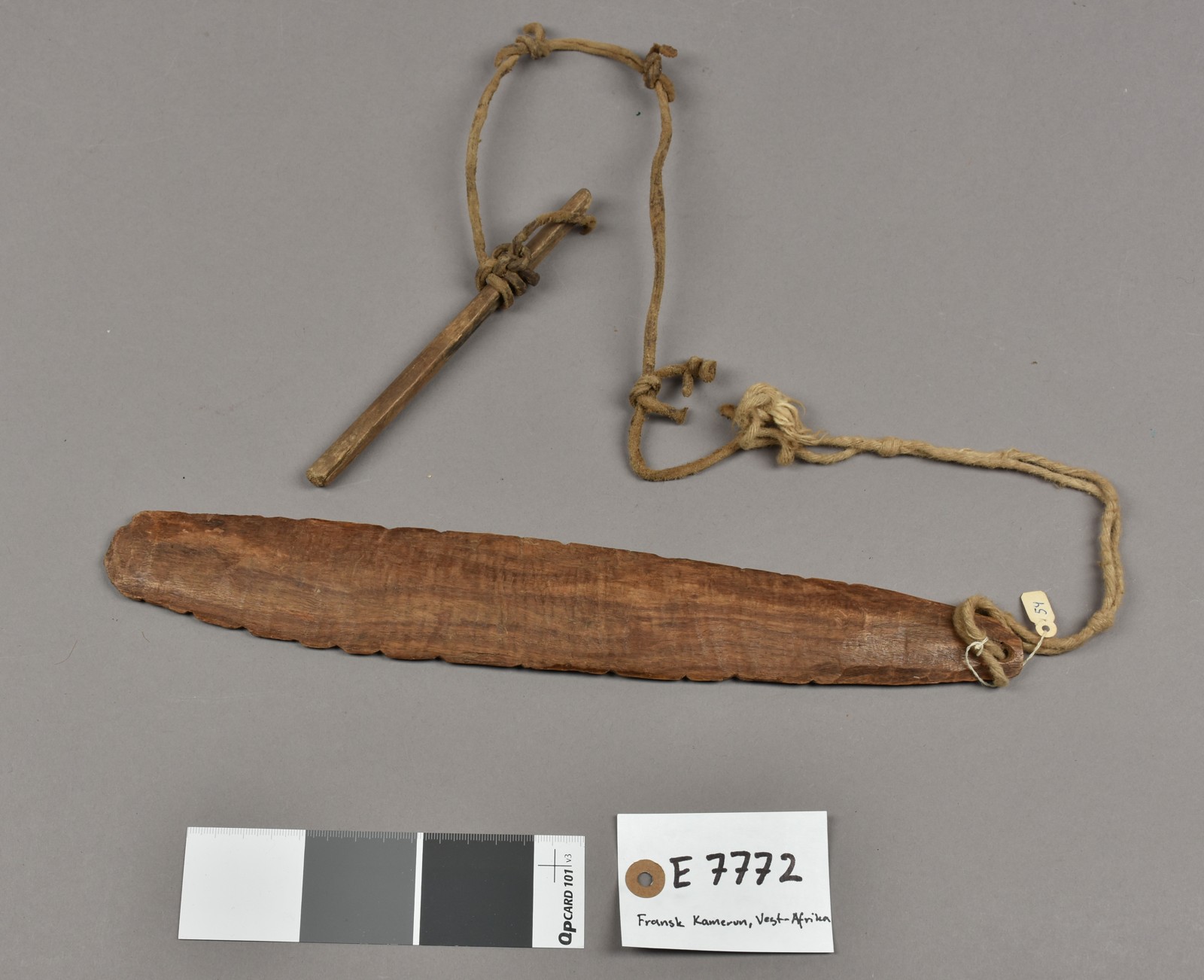
Dii boys were circumcised out in the bush, and the danger of it was explained to the women at home as a panther. Tied to a rope and turned quickly in the air, the rhombes gave off the cry of the zág; one of Tomas Drønen's informants called it "a pure lie, since the circumcision is performed with small knives." The knives were themselves called zág, and with the rhombes they were seats of the ancestral spirits, hidden in jars in the mountain and given sacrifices. The rite made chiefs as well as men. A new chief, though circumcised long before, was taken to the circumcision ground and cut a second time, so that he would be the man who had suffered most. It was meant to make him kâ'ad, cool: patient, measured in speech, master of himself. In seclusion the elders told him to listen to everyone, be generous, and never think himself more important than anyone else. This blade in Bergen, catalogued as Duru, the neighbours' name for the Dii, still carries its cord and the slim wooden toggle its whirler held.
The fabricated rhombes were tied to a rope, and when quickly turned around in the air, they made a noise that resembled the cry of the panther.
Tomas Sundnes Drønen, Communication and Conversion in Northern Cameroon (Brill, 2009), p. 127
Particulars
- Object
- Leaf-shaped wooden bullroarer blade, 34.3 x 5 cm, with finely notched edges and a single perforation at one end, retaining its original cord and a slim wooden toggle handle (16.1 x 1 cm); University Museum of Bergen E 7772, accession card labelled "Fransk Kamerun, Vest-Afrika". Catalog title: "Svirrebrett. Jer".
- Function
- Whirled on a rope at the Dii boys' circumcision in the bush, its roar presented to the women left in the village as the cry of the panther (zág) said to live out there; the rhombes were also venerated with the circumcision knives as material seats of the ancestral spirits (yóõóõb), stored in hidden jars and given sacrifices. The same circumcision institution installed chiefs, each of whom was first cut a second time on its ground. In some guum villages, boys carried miniature ‘little dog’ bullroarers in their caps after circumcision.
Sources
- Tomas Sundnes Drønen, Communication and Conversion in Northern Cameroon (Leiden: Brill, 2009), pp. 125 n. 27, 127–128, 131 View
- Jean-Claude Muller, “Circoncision et régicide. Thème et variations chez les Dìì, les Chamba et les Moundang des confins de la Bénoué et du Tchad,” L’Homme 37 (141) (1997):7–24, pp. 9–13 View
- Jean-Claude Muller, Les rites initiatiques des Dìì de l'Adamaoua (2002), p. 100 View · archived
- Jean-Claude Muller, Les chefferies dii de l'Adamaoua (2006), introduction View · archived
- University Museum of Bergen, E 7772 View · archived