No. MOELLER1936-001
Ndaka bullroarer, the voice of Asobé
Democratic Republic of the Congo · Ituri forest, Province Orientale (Babali initiation belt) · Central Africa
Restricted
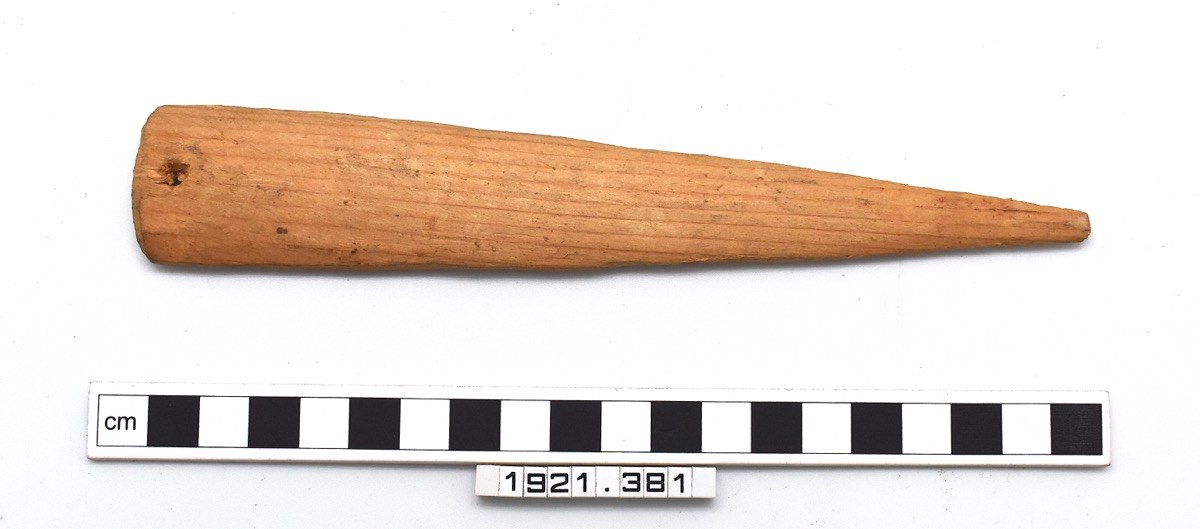
ngwe; maduali
Source term: Ngwe; Maduali (rhombe)
ngwe: the Ndaka (Moeller's Bandaka) name for the bullroarer swung at circumcision; the same people call it maduali — zizi ya mambela, 'spirit of the mambela' — when they hold the mambela rite instead.
Among the Balenga-Bandaka on the Ngayu River, thunder and the bullroarer's whirr were both called the voice of Asobé, a god the forest Mbuti living among them knew by the same name. The Ndaka of the Ituri ran two initiations, and gave the bullroarer a different name in each. At circumcision they swung the ngwe — and only the ngwe: where their neighbours brought out a whistle and a hornbill-beaked pipe alongside the roarer, the Ndaka sounded the roarer alone. When they held mambela instead, the older forest initiation of the Babali, the same instrument answered to maduali, zizi ya mambela, the spirit of the mambela, and the whistle and the bird-pipe came with it. The thing itself was plain: an oblong slat of wood fixed to the end of a string, whirled until it threw off a noise like an engine turning over. Moeller was blunt that these 'spirits' were nothing but very simple instruments in the initiators' hands. The secrecy around them was not. Novices were shut away in an isolated place and forbidden to speak to women or to the uninitiated; the sight of the spirits was itself a numbered stage of the rite; parents gave up their rights over their children and the initiators took every social power. Last on his list of what all these rites shared: the exclusion of women.
Partout une même crainte superstitieuse leur est attachée.
Everywhere the same superstitious fear clings to them.
Moeller 1936:552
Particulars
- Object
- A simple oblong plank of wood fixed to the end of a string and whirled in free air.
- Function
- Swung at male initiation under two names: ngwe at circumcision, without whistle or bird-pipe, and maduali at the mambela, alongside the whistle aduteli and the hornbill-pipe nasasa. Among the Balenga-Bandaka on the Ngayu, thunder and the bullroarer's whirr were both called the voice of the god Asobé.
Source
A. Moeller, Les grandes lignes des migrations des Bantous de la Province Orientale du Congo Belge (Mémoires de l'Institut Royal Colonial Belge, Section des Sciences Morales et Politiques, t. VI; Brussels, 1936), pp. 551-552 (table, p. 552); Paul Schebesta, Die Bambuti-Pygmäen vom Ituri, vol. IV-1: Die Religion der Ituri-Bambuti (Brussels: Institut Royal Colonial Belge, 1950), pp. 15, 17-18