No. MUS2026-156
Mafa millet-stalk Schwirrholz Soulédé
Cameroon · Soulédé, Mayo-Tsanaga, Mandara Mountains · Central Africa
Function not recorded
Source term: Schwirrholz
Schwirrholz: German museum-catalogue term for a whirled sounding board; no Mafa-language name is recorded.
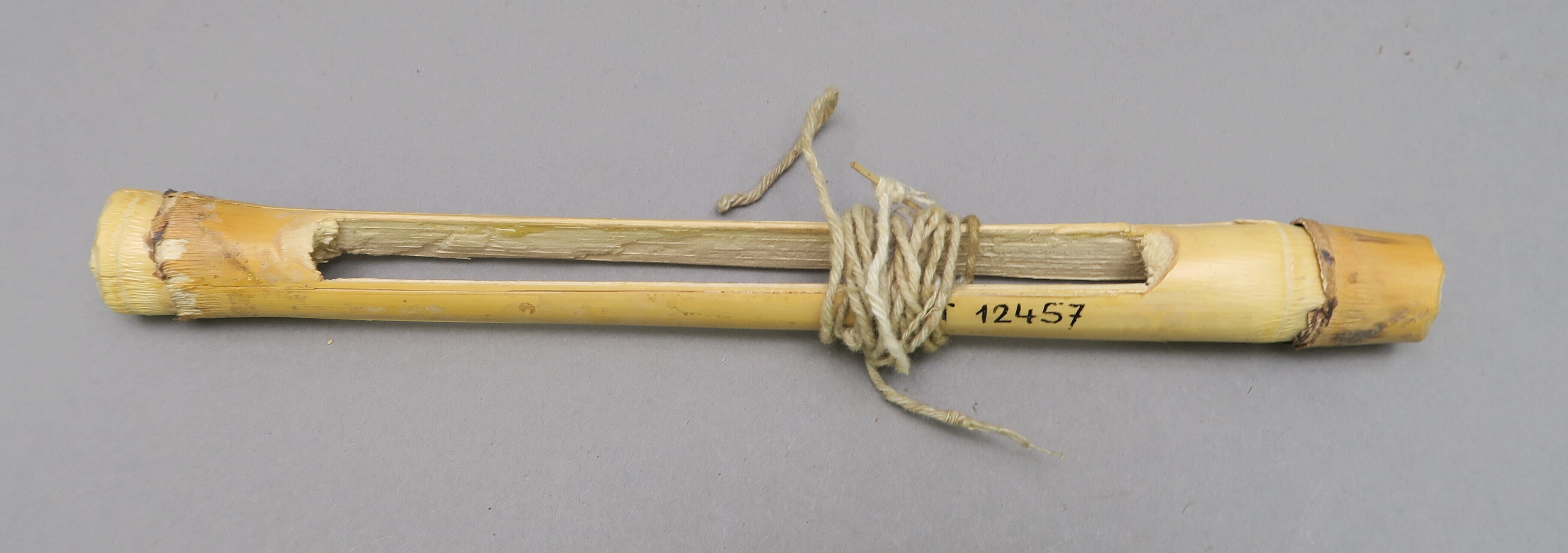
A Mafa maker turned a length of millet stalk into a double-voiced roarer: the hollow section split into two parallel sounding tongues, then pierced for a cotton cord more than a metre long — farm waste transformed into an airborne instrument. The Mafa are mountain farmers of the Mandara range in northern Cameroon, their terraced sorghum and millet fields climbing to the summits, their hereditary smiths famous for smelting iron. The Basel ethnographer Paul Hinderling carried this little instrument home from the village of Soulédé in 1953.
Ein Hirsehalmstück zwischen zwei Knoten ist so ausgeschnitten, dass die stehengebliebenen Teile zwei paralelle Lamellen ergeben. In das durchbohrte eine Ende ist an einem Querstäbchen eine 130cm lange Baumwollschnur eingezogen.
A piece of millet stalk between two nodes is cut so that the remaining parts make two parallel lamellae. A 130 cm cotton cord is threaded through one perforated end on a cross-stick.
Museum der Kulturen Basel, III 12457.
Particulars
- Object
- 24 cm split millet-stalk section with two parallel sound lamellae and a 130 cm cotton cord threaded through one perforated end.
- Function
- Not recorded.
Source
Museum der Kulturen Basel III 12457, catalogue term Schwirrholz; Mafa, Sulede, Cameroon; collected by Paul Hinderling and received in 1953. German description: a millet-stalk section cut into two parallel lamellae with a 130 cm cotton cord through one perforated end