JAK1937-001 - ethnographic attestation
The voice of the Lengola biaba
Democratic Republic of the Congo - Stanleyville-Ponthierville (Kisangani-Ubundu) district, Lualaba, Province Orientale - Central Africa
Restricted
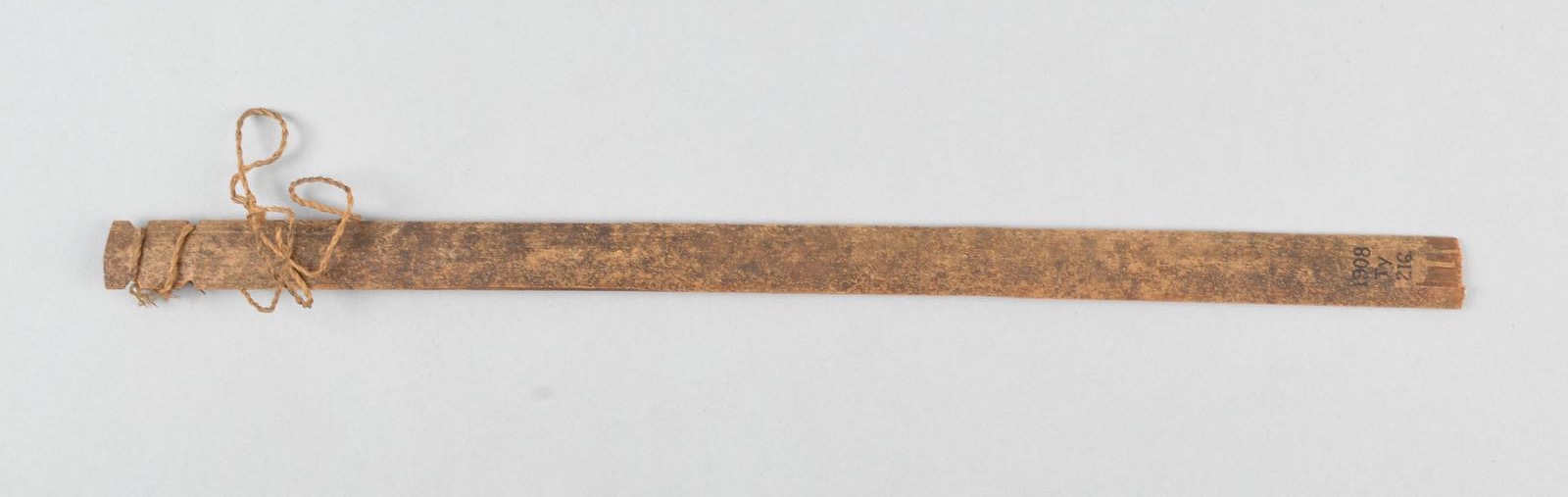
Source term: bromhout
bromhout: Dutch for bullroarer. biaba: the healing society, its dance and its effigy; the roarer is its voice. No Lengola word for the instrument is recorded.
The biaba society cured rheumatism and the other ills whose cause no one could name, and its cure could run for months. The patient lay in a hut with the biaba itself while drummers beat for it. Women and children were kept well away: the Lengola whirled a little plank full of holes on a strong cord, and its hum was the voice of the biaba. What it guarded was not to be seen. At Babatonde a missionary who shoved open one such door sent the old men scattering and found, in the dark at the back of the hut, a plank laid on two stones, dressed with leaves and tufts of red and white parrot feathers. Any woman or child who saw it would die.
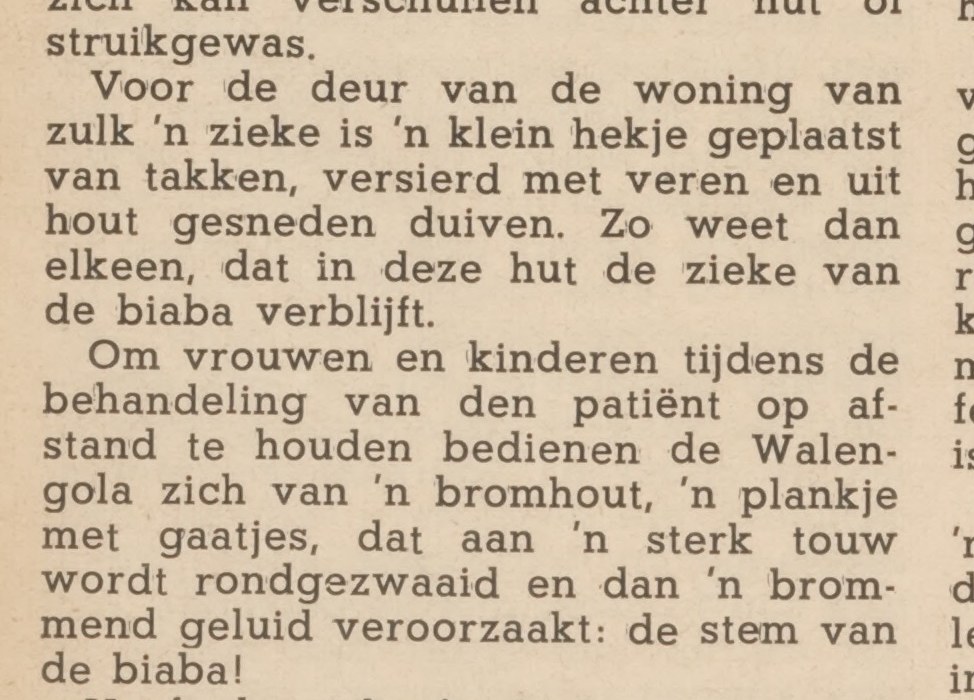
Om vrouwen en kinderen tijdens de behandeling van den patiënt op afstand te houden bedienen de Walengola zich van 'n bromhout, 'n plankje met gaatjes, dat aan 'n sterk touw wordt rondgezwaaid en dan 'n brommend geluid veroorzaakt: de stem van de biaba!
To keep women and children at a distance while the patient is being treated, the Walengola use a bullroarer, a little plank with holes, which is swung round on a strong cord and then makes a humming sound: the voice of the biaba!
Jak, 'Het geheimzinnig genootschap der Biaba' (1937), p. 283
- Object
- A small plank pierced with holes, whirled on a strong cord to give a humming sound.
- Function
- Whirled during the biaba society's months-long healing treatment to keep women and children away from the patient; its hum was announced as the voice of the biaba, the society's power housed in a feathered plank at the back of the patient's hut.
- Source
- J. Jak, S.C.J., 'Onder de Evenaar; Het geheimzinnig genootschap der Biaba', Het Rijk van het Heilig Hart van Jesus 36 (1937), part I (with Father Rommes's account of the Walengola biaba at Babatonde) and part II, pp. 283-284 (Delpher, MMKDC07:006421001). Context: A. Moeller, Les grandes lignes des migrations des Bantous de la Province Orientale du Congo…
- Source location
Page references
Jak 1937:283 (part II); part I scans 263-265
- Source confidence
- medium
- Location note
- Lengola country on the right bank of the Lualaba between Kisangani and Ubundu (Ponthierville, the mission base); the village Babatonde is not located.
Regions: Africa · Central Africa
- Spirit voice
- Forbidden to women