No. EXH2026-017
Bangelima (Ngelima)
Democratic Republic of the Congo · NE Congo (Babali initiation belt) · Central Africa
Restricted
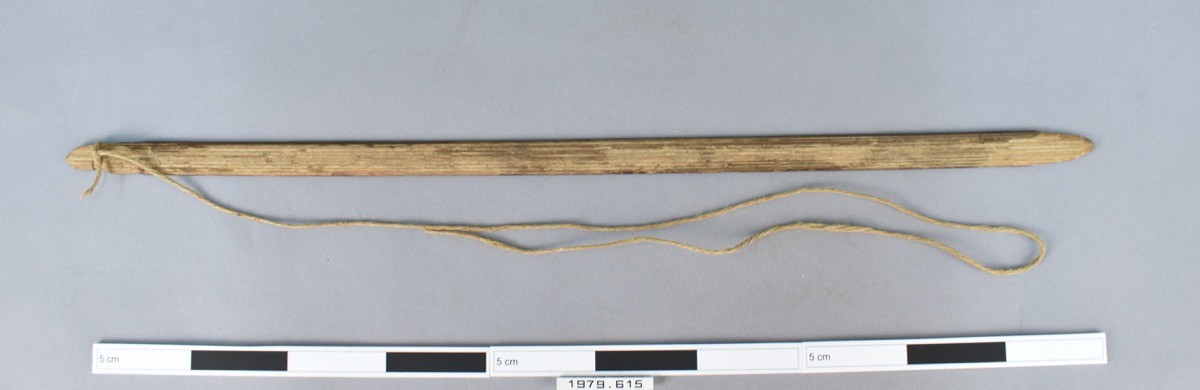
Source term: rhombe
The Bangelima (Ngelima), a Bantu-speaking people of the northeastern Congo forest, reach us not through any rite documented among them directly, but as one name in a list. Writing on the secret societies of the Belgian Congo, Édouard de Jonghe traced a tribal-initiation complex carrying the rhombe — the spinning blade whose droning, in his words, "frightens the uninitiated" — across the belt of peoples neighbouring the Babali, the same forest world that produced the Mambela initiation society and the leopard-men. De Jonghe set the Bangelima among the Bakumu, Babira, Wanyanza, Barundi, Bapopoi, Wagenia, and Lokele as groups where, with local variants, the complex recurred. By the time Bertil Söderberg compiled his survey of Lower Congo instruments in 1956 the bullroarer there had largely sunk to a child's plaything, its terrifying character explained, he noted, by the simple danger of the blade flying off its cord into a bystander's face. What the rhombe meant inside Bangelima initiation is not recorded.
de Jonghe a souligné que le rhombe est lié au complexe d'initiation tribale qui «se rencontre avec quelques variantes chez les voisins des Babali: Bakumu, Babira, Wanyanza, Bangelima, Barundi, Bapopoi, Wagenia et Lokele».
de Jonghe stressed that the bullroarer is bound up with the tribal-initiation complex which "is found, with a few variants, among the neighbours of the Babali: Bakumu, Babira, Wanyanza, Bangelima, Barundi, Bapopoi, Wagenia and Lokele."
Söderberg 1956:184-185, quoting de Jonghe 1936:62-63
Particulars
- Object
- Rhombe, the spinning blade of the northeastern Congo tribal-initiation complex.
- Function
- Rhombe tied to the tribal initiation complex of the Babali and their neighbours (de Jonghe).
Source
E. de Jonghe, 'Formations récentes de sociétés secrètes au Congo belge,' Africa 9(1) (1936), pp. 62-63, quoted in Bertil Söderberg, Les instruments de musique au Bas-Congo et dans les régions avoisinantes (1956), pp. 184-185