ZERRIES1942-004 - ethnographic attestation
Bamum mfu, named for lightning
Bamum kingdom, Noun Division, West Region (Cameroon Grassfields) - Central Africa
Restricted
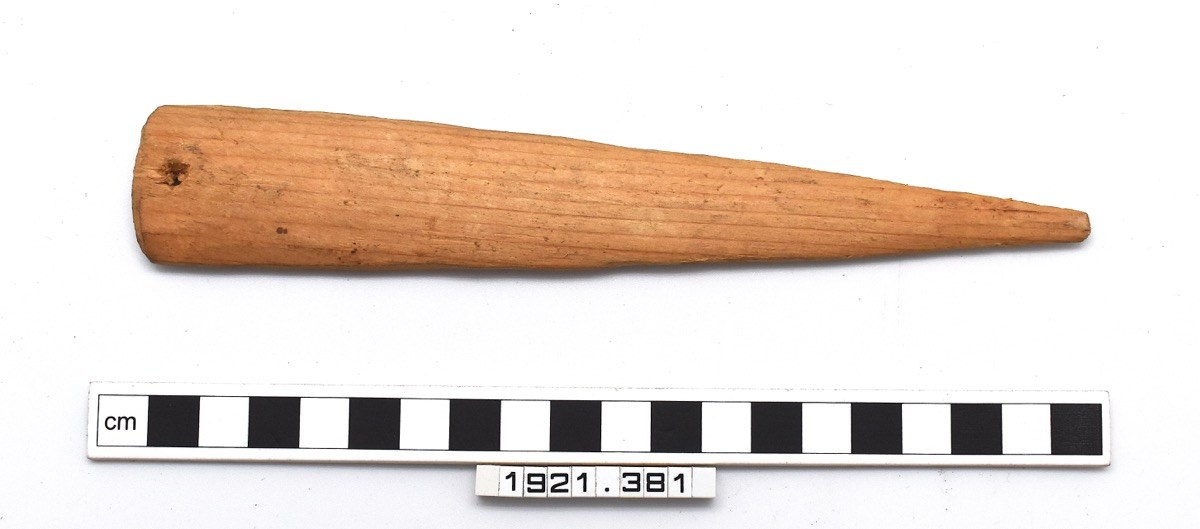
mwu / mfu
Source term: Schwirren aus Holz (Mwu oder Mfu); aus Bambus (Usischa)
mwu / mfu: the wooden roarer; to the peoples north of Bamum the word means "lightning", and the Bamum country people use it for the noise of thunder. usischa: the bamboo roarer. Fomwu (Foawu): the head of the roarer institution.
When old people of Bamum were buried, the mfu roared, and no woman or child might look at it. The wooden roarer carries the sky's name: among the peoples north of Bamum mwu means "lightning", and among the Bamum country people the same word names the noise of thunder. Roarers of bamboo, usischa, were swung too, and the whole institution answered to a titled head, the Fomwu.
Noch heute schwingen sie die Schwirre, deren Anblick Frauen und Kindern verboten ist, wenn alte Leute begraben werden.
They still swing the roarers, which women and children are forbidden to see, when old people are buried.
Otto Zerries, Das Schwirrholz (1942), p. 20, after Frobenius
- Object
- Bullroarers of two kinds: wooden ones, mwu or mfu, and bamboo ones, usischa.
- Function
- Swung at the burials of old people; women and children may not see them. The institution is headed by an officer called the Foawu or Fomwu.
- Source
- Otto Zerries, Das Schwirrholz; Untersuchung über die Verbreitung und Bedeutung der Schwirren im Kult (Stuttgart: Strecker & Schröder, 1942), p. 20, citing Leo Frobenius, unpublished D.I.A.F.E. expedition manuscript 11, pp. 8–9, 15ff
- Source location
Page references
p. 20 (Frobenius Ms. 11, pp. 8–9, 15ff.)
- Source confidence
- medium
- Location note
- Foumban, the Bamum royal capital (OSM); the source names the kingdom, not a village.
Regions: Africa · Central Africa
- Death and rebirth
- Forbidden to women