No. EXH2026-012
Teke (Bateke)
Republic of the Congo · Batéké Plateau · Central Africa
Restricted
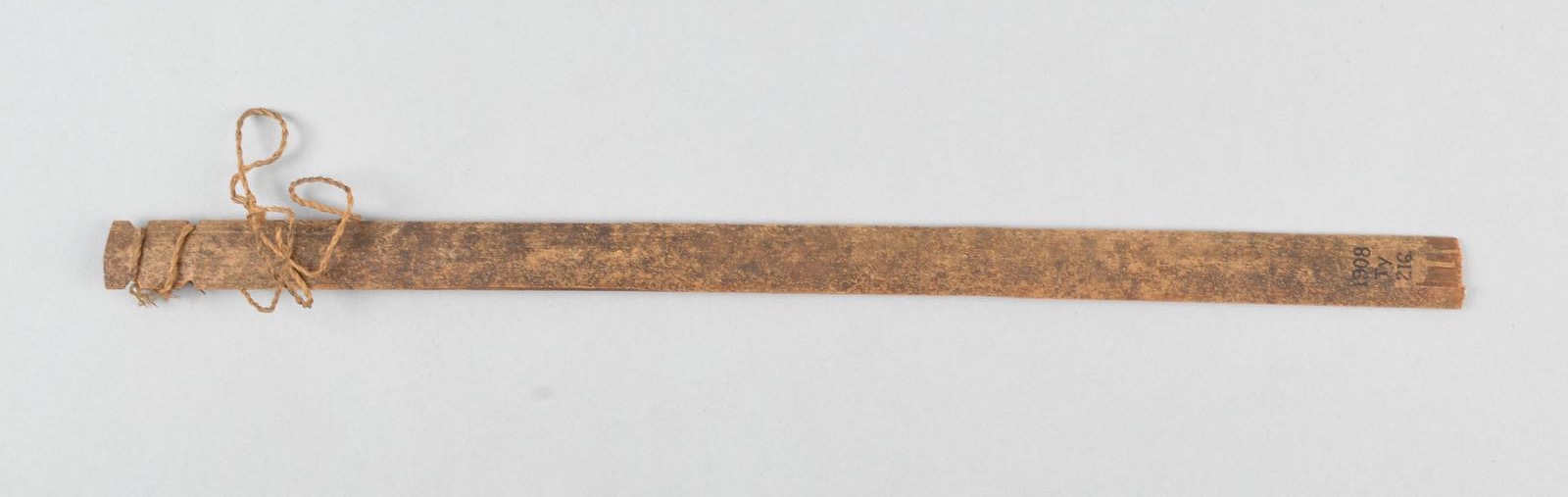
Source term: rhombe
At circumcision rites the Teke once swung the rhombe, a thin board of wood, bamboo, or iron whirled on a cord — the use Otto Zerries recorded for them. Bertil Söderberg, recording the instrument across the Lower Congo in the 1950s, set this in a wider pattern: among neighboring peoples the bullroarer belonged to the tribal-initiation complex, among the Kissi to the west it likewise accompanied initiation, and at Abeokuta the god Oro made his voice heard through it. Across Africa, on Walter Hirschberg's evidence, the instrument's sound carried a terrifying character, taken for the voice of an animal bush-spirit or of an ancestor. By the time Söderberg wrote, the Teke connection to circumcision was already a thing of the past, and in the Lower Congo generally the rhombe had become a child's plaything — a board that, badly swung, would fly off its string into the face of anyone standing near.
Zerries a déclaré que les Teke employaient auparavant le rhombe à l'occasion de la circoncision, et de Jonghe a souligné que le rhombe est lié au complexe d'initiation tribale.
Zerries stated that the Teke formerly used the bullroarer on the occasion of circumcision, and de Jonghe emphasized that the bullroarer is bound up with the tribal-initiation complex.
Söderberg 1956:184 (citing Zerries 1942:32), Les Instruments de Musique au Bas-Congo et dans les Régions avoisinantes
Particulars
- Object
- Rhombe (thin board on cord).
- Function
- Formerly used at circumcision (Zerries, cited by Söderberg).
Source
Bertil Söderberg, Les Instruments de Musique au Bas-Congo et dans les Régions Avoisinantes (1956), p. 184 (citing Zerries 1942, p. 32)