No. EXH2026-058
Northern Banyari (Nyali) of Kilo — oŭpa
Democratic Republic of the Congo · Kilo, Kilo-Moto goldfields district, Ituri · Belgian Congo · Central Africa
Sacred / spirit
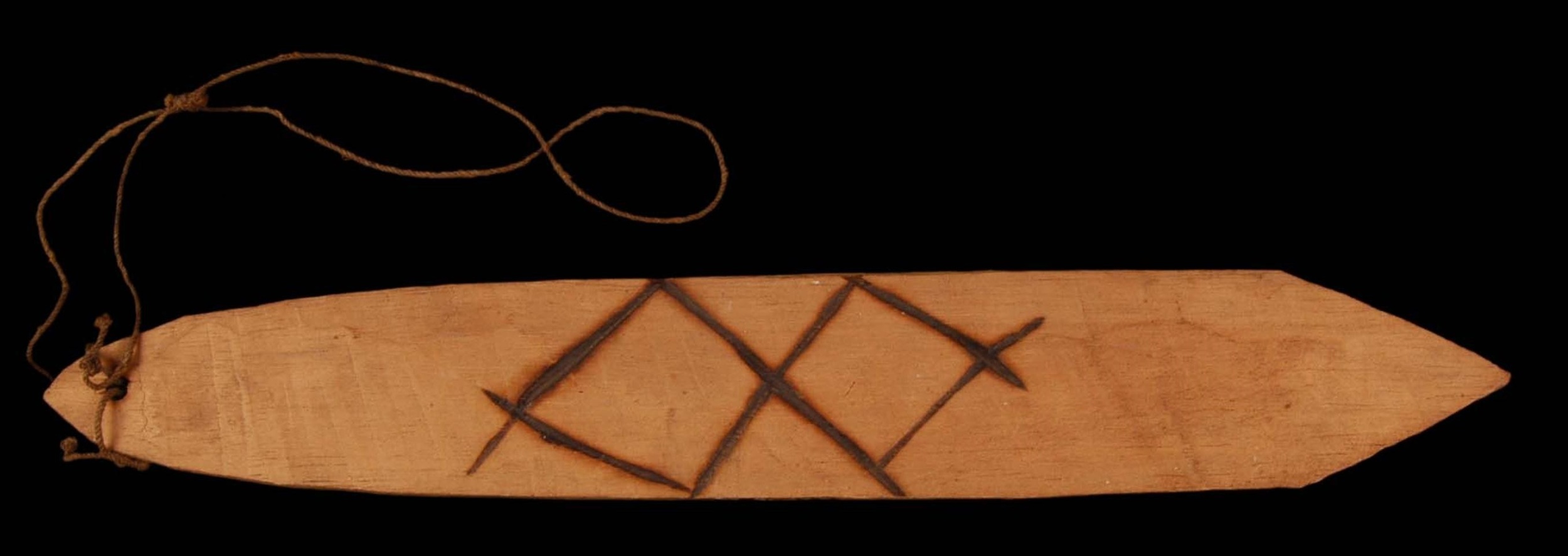
oŭpa
Source term: Schwirrholz
oŭpa: the northern Banyari (Nyali) name for the bullroarer at Kilo, given beside mungbalo, the wooden trumpet; Schebesta links the word to ogbä, "thunder" among the western Bambuti.
The northern Banyari, those of Kilo, call the wooden trumpet mungbalo and the bullroarer oŭpa. Paul Schebesta took both words down around 1929–30, in a list of initiation terminology gathered from the peoples living around the Efe, and then added an etymology of his own: many of the western Bambuti call thunder ogbä, and the connection with oŭpa, he wrote, is obvious. So this may be a bullroarer named for a storm. The Banyari are nowhere described sounding it at the weather, and Schebesta says flatly that he never saw a bullroarer among the Banyari at all, here or at the southern village he had visited earlier, though several people assured him one was used. Their kin at Geti call the thing something else entirely, nékundurúku, with a different god behind it. What the oŭpa was made of, how big it was, how it was strung — the record does not say. The word, and the initiation vocabulary it sits inside, are what came back from the goldfields.
Die nördlichen Banyari, jene von Kilo, nennen die Holztrompete mungbalo und das Schwirrholz oŭpa. Ich hatte bereits darauf verwiesen, daß viele westlichen Pygmäen den Donner ogbä nennen; der Zusammenhang mit oŭpa ist auf der Hand liegend.
The northern Banyari, those of Kilo, call the wooden trumpet mungbalo and the bullroarer oŭpa. I have already pointed out that many of the western Pygmies call thunder ogbä; the connection with oŭpa is obvious.
Schebesta 1933:135
Particulars
- Object
- The object is not described. Schebesta records the name only — no dimensions, material, cord or perforation — and states at p. 133 that he saw no bullroarer among the Banyari, though he knew from several statements that one was used.
- Function
- Entered in Schebesta's list of initiation terminology from the peoples around the Efe: the northern Banyari, those of Kilo, call the wooden trumpet mungbalo and the bullroarer oŭpa. Schebesta adds an etymology of his own, linking oŭpa to ogbä, the word many western Bambuti use for thunder. No account of use, and no weather practice, is recorded.
Source
Paul Schebesta, 'Religiöse Ideen und Kulte der Ituri-Pygmäen,' Archiv für Religionswissenschaft 30 (1933), pp. 133-135