KOLOSS1996-001 - ethnographic attestation
Oku Njamse, the war society's animals
Cameroon - Kingdom of Oku, Bui Division, North-West Region (Bamenda Grassfields) - Central Africa
Restricted
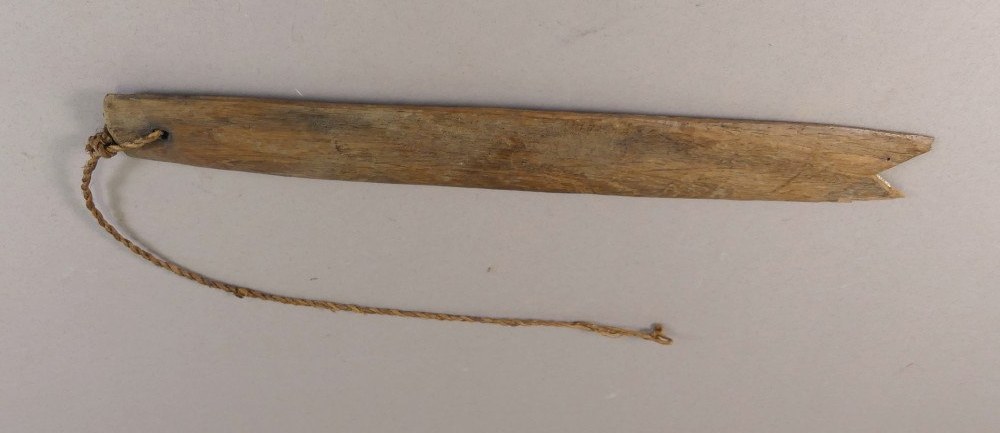
Njamse
Source term: Schwirrhölzer; Njamse (Tiere)
Njamse: "animals", Samba's name for its set of three bullroarers; its seven membrane pipes are Woni Njamse, "little animals".
Every military society in the kingdom of Oku keeps three bullroarers in the medicine corner of its house, and Samba calls its three Njamse, "animals"; its seven bat-wing membrane pipes are the "little animals". In the old wars the Samba mask ran ahead of the fighters with a roarer in each hand. Its wearer had taken drugs that made the world look small, so that he felt no fear, and enemies who saw the roarers were said to lose their wits. Samba itself, Oku says, was founded by a woman of Bangolan, and a woman still cuts the first plant for its medicine. The wars are long over. Now the roarers sound only when a society's highest members die: in December 1977 Manjong danced on an elder's grave at Ngashie, then played its secret roarers over him.
In jeder Hand trug sie eines der heiligen und gefährlichen Schwirrhölzer, bei deren Anblick die Gegner angeblich verwirrt wurden, ja sogar den Verstand verloren.
In each hand it carried one of the sacred and dangerous bullroarers, at the sight of which the enemy was said to become confused, and even to lose their minds.
Hans-Joachim Koloss, Publikationen zu Wissenschaftlichen Filmen, Ethnologie 19 (1996), p. 394
- Object
- Bullroarers held three to a set by each Oku military society, kept in the medicine corner of the society house and anointed with its dangerous medicine.
- Function
- The secret voice of the military societies: once carried into war by the Samba mask, one roarer in each hand, to unhinge the enemy; now sounded only on the grave when a society's highest members die.
- Source
- Hans-Joachim Koloss, 'Tikar (Äquatorialafrika, Kameruner Grasland) — Totengedenkfest für die Königsmütter in Oku. Filme E 3092–E 3100', Publikationen zu Wissenschaftlichen Filmen, Ethnologie 19 (1996): 329–402, at pp. 384, 392, 394; Koloss, 'Tikar (Äquatorialafrika, Kameruner Grasland) — Begräbnis; Filme E 2647 und E 3138', Publikationen zu…
- Source location
Page references
1996 pp. 384, 392, 394; 1993 pp. 14, 18, 22; 1985 pp. 3, 12
- Source confidence
- high
- Location note
- Elak (Oku), the palace town of the kingdom (OSM populated place); the 1977 burial was at Ngashie, another Oku village, not separately geocoded.
Regions: Africa · Central Africa
- Death and rebirth
- Forbidden to women
- Women-linked