No. MBENDJE2016-002
Mahongwé roarer at Mékambo
Ogooué-Ivindo, northeastern Gabon (Mékambo) · Central Africa
Restricted
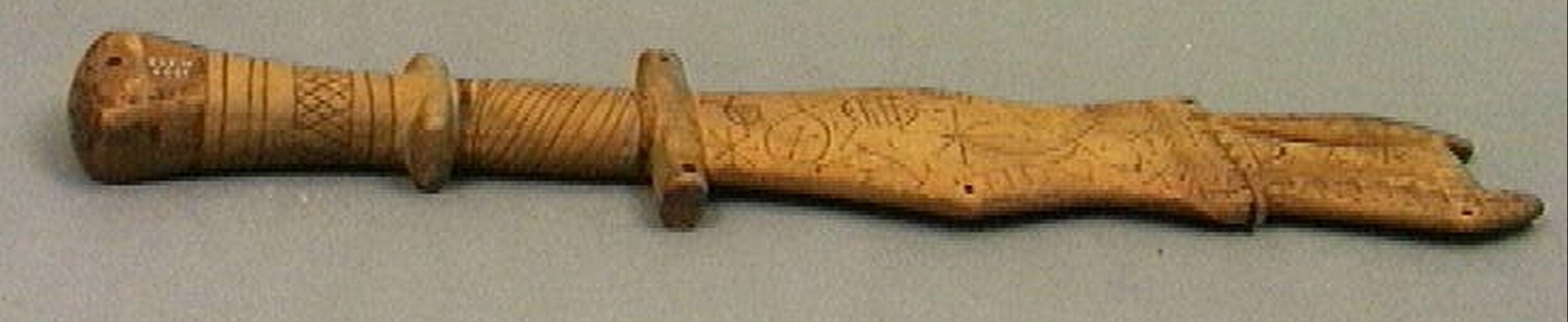
Source term: rhombe; joamiala
joamiala: the inventory's heading name for the Gabonese rhombe; the Mahongwé word is not recorded. bongoja: the secret truth-finding dance at which the instrument sounds. bwete: Kota-Mahongwé reliquary figure.
In the forests around Mékambo, in Gabon’s far northeast, the Mahongwé whirled a small wooden blade on a cord until it droned. The sound was there to frighten. It went with bongoja, a secret dance staged to bring out the truth, and anyone the matter did not concern kept to the house until it was over. The Mahongwé, a Kota people, are better known for their bwete, the ancestor guardians whose flat, leaf-shaped faces are sheathed in fine strips of brass and once stood over baskets holding the relics of the dead.
Particulars
- Object
- A wooden blade about 15 cm long on a cord, whirled to give a drone.
- Function
- Shared with the Banzèbi, Bekwil and Pové: frightens by its noise and is sounded at the secret bongoja dance, held to get at the truth, while anyone not concerned stays at home.