No. EXH2026-018
Bapopoi (Popoi)
Democratic Republic of the Congo · NE Congo (Babali initiation belt) · Central Africa
Restricted
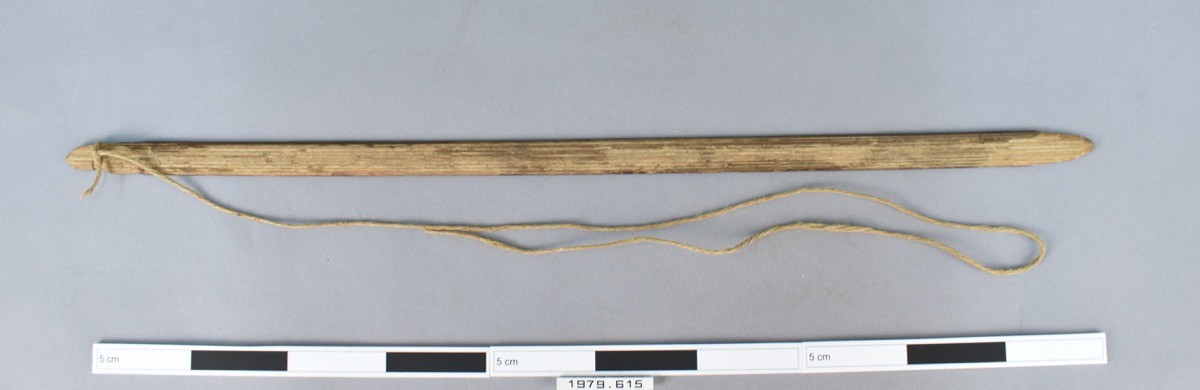
Source term: rhombe
The Bapopoi appear here not in a description of their own rite but in a list. In the journal Africa in 1936, Édouard de Jonghe placed the rhombe within the tribal-initiation complex of the Babali of northeastern Congo, and noted that the same complex recurred, with some variations, among the Babali's neighbours: the Bakumu, Babira, Wanyanza, Bangelima, Barundi, Bapopoi, Wagenia, and Lokele. The Swedish ethnographer Bertil Söderberg quoted that line in his 1956 survey of Lower Congo instruments, where the rhombe is described as a thin blade of wood, bamboo, or iron whirled on a cord to produce a whirring "qui effraie les profanes" — that frightens the uninitiated. Söderberg thought that across this region the instrument, once a secret object bound to initiation, was by his day no more than a child's plaything. What the Bapopoi themselves did with it, beyond their inclusion in de Jonghe's enumeration, is not recorded.
de Jonghe a souligné que le rhombe est lié au complexe d'initiation tribale qui «se rencontre avec quelques variantes chez les voisins des Babali: Bakumu, Babira, Wanyanza, Bangelima, Barundi, Bapopoi, Wagenia et Lokele».
de Jonghe stressed that the bullroarer is bound to the tribal-initiation complex which "is found, with some variations, among the neighbours of the Babali: the Bakumu, Babira, Wanyanza, Bangelima, Barundi, Bapopoi, Wagenia and Lokele."
Söderberg 1956:184–185, quoting de Jonghe 1936:62
Particulars
- Object
- Rhombe of the NE-Congo tribal-initiation complex.
Source
E. de Jonghe, 'Formations récentes de sociétés secrètes au Congo belge,' Africa 9(1) (1936), pp. 62-63, quoted in Bertil Söderberg, Les instruments de musique au Bas-Congo et dans les régions avoisinantes (1956), pp. 184-185