No. MUS2026-182
Bulu Zauberholz bullroarer, Sangmelima
Cameroon · Lobo River · Sangmelima · South Region, former German Kamerun · Africa
Play / practical
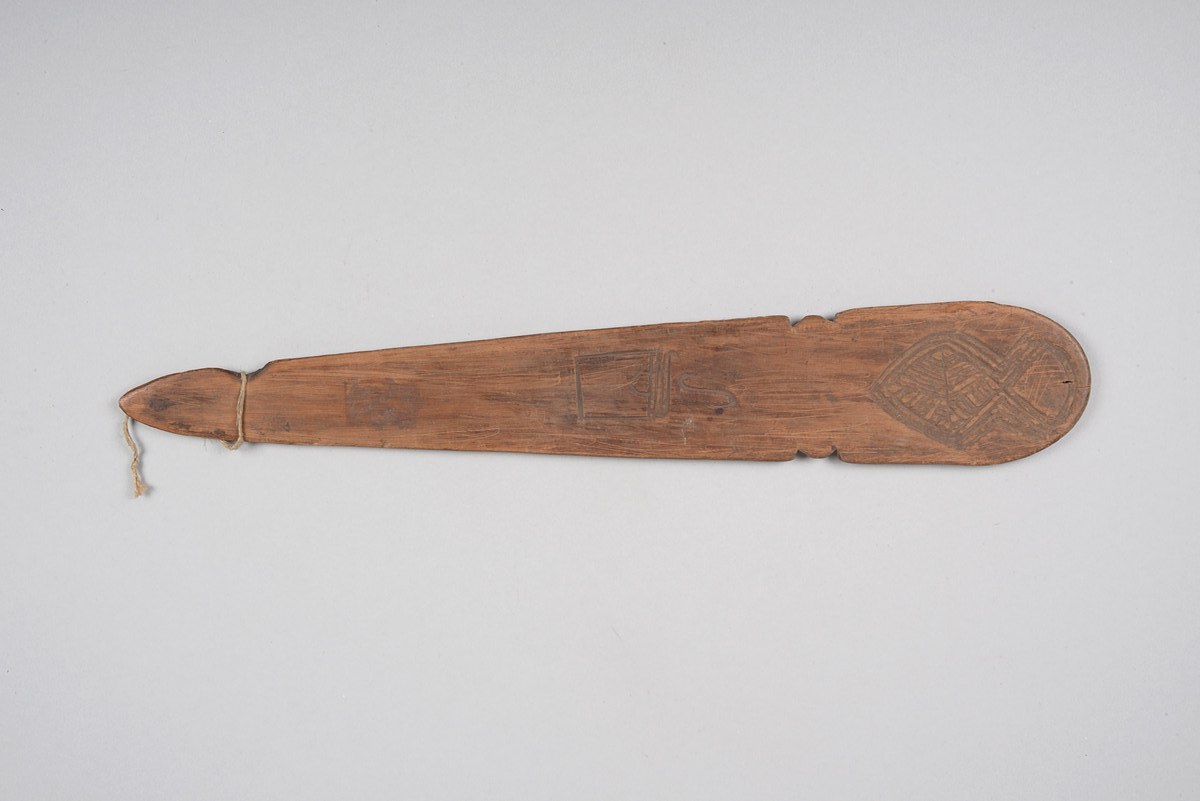
Source term: Schwirrholz
Zauberholz: German, 'magic wood' — the designation the blade carried when collected; Schwirrholz is the German museum term for a bullroarer.
A Bulu carver at Sangmelima, on the Lobo River, shaped a blade nearly half a metre long yet not even a centimetre thick. Incised figures crown its rounded head, a dovetail notch bites into each edge, one flank of the narrow end was shaped by burning, and the fibre cord still loops its little tail. The one word that travelled with it to Vienna in 1915 was German: Zauberholz, 'magic wood.' Among the Pangwe peoples, the Bulu included, Tessmann knew the instrument by a homelier office — the edjibongo, the 'child-eater,' its eerie voice raised by men and older boys to frighten the young.
Or.Vz.: "Zauberholz".
Original designation: 'magic wood.'
Weltmuseum Wien accession card, Post I/1915, inv. 91302
Particulars
- Object
- Incised wooden blade, 44.5 x 7.5 x 0.9 cm: long egg-shaped outline, one face flat and one moderately convex, incised figures at the broad end and mid-blade, a dovetail double notch cut into each edge toward the broad end, one side of the narrow end shaped out by burning, and a fibre cord still looped at the narrow tail.
- Function
- A bogey for small children, one of the Pangwe 'things to frighten children.'
Source
Weltmuseum Wien inv. 91302, Schwirrholz; culture Bulu; geography Kamerun / Lobo Fluß / Sangmelima; collector Cl. Schreiner, acquired through Hermann Rolle, museum entry 1915 (accession card Post I/1915, Or.Bez. 421)